Kıvanç Harputlu begins one account of building Onlayer with a Porsche. He describes buying it as a final gift to himself before the work of starting a company. It is an appealingly awkward opening for a story about financial restraint. The car belongs to the celebration; the business that follows belongs to the discipline. His recollection quickly leaves the showroom and turns to small amounts of capital, calculated decisions and the difficulty of building with his partners.
In that account, Harputlu says the team began with $145,000 in funding and deliberately kept investment limited. He wanted the business to demonstrate that a Turkish startup could create value without spending lavishly. He also admits that the choice was risky and took longer than they had hoped. The admission gives the story some texture. A founder can admire his own decisions and still remember how uncomfortable they were.
By late 2025, Onlayer had raised an $8.2 million Series A. Harputlu, its co-founder and CEO, was heading into another stage of the company’s life. Between the small beginning and the larger cheque sits a career that moved through microphones, music rights, technology sales and the unshowy business of helping financial institutions decide whom to trust.
The microphone came before the merchant
Harputlu studied geological engineering at Middle East Technical University. His account of that period takes an early turn: he realised soon after entering the department that he would not become a geological engineer, and approached Radyo ODTÜ. The career he describes then travels through media, copyright management and voice-recognition technologies before reaching businesses built around data. There was considerable travel between Istanbul and Ankara along the way.
His professional history includes a broadcast manager and radio host role beginning in 2010, a move into business development at Nokta in 2013, and sales management at VeriTeknik in 2016. An older career profile also places him in music-category management at Nokta. Its interview topics are a miniature portrait of that earlier life: content management, working with music, and what university radio had taught him.
It would be too tidy to claim that every hour on air was secretly preparation for fintech. The chronology is more interesting without that embellishment. He had experience with audiences and content before he had a company selling payment-risk software. He had worked on commercial relationships before enterprise banks became his customers. His route to the CEO’s desk passed through several kinds of work that required another person to say yes.
A checklist with room to grow
PCI Checklist, which his career history dates to 2018, started with a specific problem. Businesses handling payment-card data needed to manage PCI-DSS compliance. The platform offered real-time process management, security analysis and alerts. It was a narrow doorway into a large industry: a task that could sound administrative until a security weakness made it urgent.
In June 2019, Harputlu was explaining the venture at the fourth cohort’s Workup Demo Day, part of the entrepreneurship programme supported by Türkiye İş Bankası. The name PCI Checklist was still on the business. His presence there puts a useful marker on the story: before international expansion and large investment rounds, there was a founder explaining a particular tool to an audience of people who might help it find customers.
By November 2020, he was discussing digital payments and cybersecurity on Bloomberg HT’s Financial Technology programme with Sefer Yüksel. His argument connected growing payment activity with the exposure of e-commerce businesses. Banks, payment providers and merchants needed to work together on security. The concern already reached beyond the boundaries of a single company’s systems.
A February 2023 television conversation offers another dated snapshot. Harputlu said the business worked with nine banks and had analysed the cybersecurity risks of more than 20,000 e-commerce companies during 2022. He described work in the Middle East, India and Britain, and set a target of analysing 80,000 companies by the end of 2023. The target was an ambition at that moment; the earlier analysis count described work already done.
reported at the time
analysed in 2022
Five months, then the next question
Looking back on the early business, Harputlu recalls securing a deal with QNB Finansbank within five months. In his telling, identifying a sharply defined customer problem helped the company enter the usually slow world of enterprise sales. PCI Checklist subsequently developed into Onlayer, with a broader remit covering merchant monitoring, fraud prevention and performance analysis.
His advice to founders keeps returning to the conversation before the product. He recommends asking the same question repeatedly until the customer’s problem becomes clear. Forty is a wonderfully inconvenient number. It makes curiosity sound less like a personality accessory and more like a job that requires patience.
He also describes choosing independence when a global acquisition offer appeared. The team believed there was more to build. His account of investors is similarly practical: an angel might eventually contribute at executive level. Money could bring a person into the working life of the company. In these recollections, the business grows through customers, colleagues and decisions about whom to keep close.
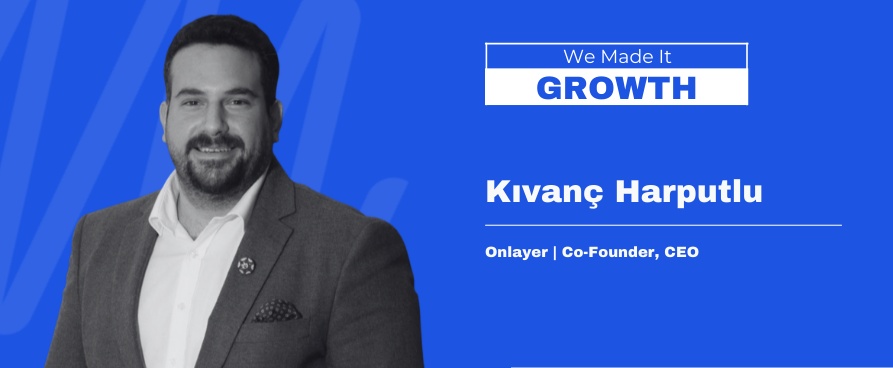
“Don’t be afraid to ask the same question 40 times until you truly understand the customer’s pain.”
Kıvanç Harputlu / We Made It Growth
The year the cheques grew
In February 2025, Onlayer announced a $1 million investment before its Series A. Gelecek Etki Fund led the round, with existing backers and new investors participating. Harputlu connected the financing to market access and sales development. His regional priorities were the Middle East, Africa and Asia Pacific, with plans extending to the United Arab Emirates, Saudi Arabia, Singapore and Hong Kong.
That same month, the company announced a collaboration with Mastercard Gateway. Banks and payment service providers using Gateway could engage directly with Onlayer for its Merchant Screening Solution. The arrangement mattered to Harputlu’s expansion plans because it created a way to put the product in front of financial institutions beyond the company’s existing markets. A distribution relationship can give a specialised business a much larger conversation.
The $8.2 million Series A followed later in 2025, led by Oleka Capital. Participants included Deniz Ventures, Revo Capital, Türkiye Development Fund’s INVEST101, Sandeep Gomes and Gelecek Etki Fund. At the announcement, Onlayer reported operations in 12 countries. The funding was intended to develop products, strengthen its regional presence and support growth across the Middle East, Africa and Asia Pacific.
Harputlu credited the team, customers and investors, as well as experience gained from Türkiye’s banking ecosystem, for the company’s progress over six years. That is a more populated picture than the solitary-founder legend. Onlayer’s current executive team includes fellow co-founders Emre Aydın, its CTO, and Tunç Yıldırım, its chief AI officer. The company is carried by several kinds of expertise, even when one person speaks for it.
A bigger map, with dates attached
In June 2026, Onlayer’s inclusion in the 2025 Deloitte Technology EMEA Fast 500 list was announced with reported revenue growth of 378.83%. Harputlu said the company then operated in 16 countries and aimed to reach 25 by year-end. The distinction between the two numbers matters. Sixteen was the footprint he described; twenty-five was the work still ahead.
The same care is useful when reading the company’s international story. A customer footprint, a partner’s distribution network and the countries covered by a data product measure different things. Harputlu’s Global Merchant Intelligence project, for example, analyses merchant data across more than 100 countries. That coverage describes the information the infrastructure can examine, rather than a list of places where Onlayer has opened an office.
For a founder, each kind of reach presents a different challenge. Selling in another market requires relationships. Analysing another market requires useful information. Supporting a bank requires dependable service after the contract is signed. Harputlu’s public priorities tie those activities together: build the product, deepen the relationships and turn compliance information into something customers can use to understand commercial opportunities.
The reading list gives something away
Asked what he recommends reading, watching or listening to, Harputlu chooses Tony Fadell’s Build. He likes its treatment of intuition and systems in product development. His podcast recommendation is Business Wars, particularly its Facebook versus Snapchat story, for the relationship between innovation, competition and moving quickly.
Those choices sit comfortably beside the business he describes. Build is concerned with making things work; a rivalry story asks what happens when someone else moves first. Harputlu identifies adaptation speed as a key quality for leaders facing changing technology, regulation and customer expectations. He wants an organisation that can change direction while still knowing why it is moving.
His enthusiasm for Global Merchant Intelligence follows that thinking. Data gathered for compliance can also help customers identify opportunities. A bank has to understand a merchant to assess risk; better understanding can inform the relationship that follows. Harputlu’s interest reaches into that second use of the information. A completed check can become the beginning of a more informed commercial decision.
Build by Tony Fadell
Business Wars: Facebook vs. Snapchat
A fast decision still needs an explanation
By August 2026, Harputlu’s discussion of banking had moved deep into its underlying architecture. He described cloud infrastructure, integration, shared data and a decision engine as connected parts of a system. Onlayer sits in the decision and risk layer. His emphasis is on how quickly and accurately an institution can decide, with the evidence available to explain the result.
He argues that regulated AI needs explainability, complete audit records and traceable data. Models need oversight as they change, and people need a route back into the decision process. His stated sequence is to establish governance before scaling. Speed carries responsibilities: someone may later need to reconstruct why a merchant was accepted, rejected or flagged.
The August partnership with Bulutistan brought that concern into supplier and business-partner risk. Harputlu said periodic checks were becoming insufficient, advocating continuous monitoring on one platform. The circle had widened again, from card-data compliance to the organisations surrounding an institution. The former radio host’s advice remains useful here. Before trusting a quick answer, spend enough time on the question.
Keep the conversation going
Meet the business, revisit the early career, or hear Harputlu explain the choices himself.