Josh Reeves’s first startup had an awkward defect: it worked. There were users, advertising dollars, and eventually a buyer. In 2010, the company was acquired. For an entrepreneur, this is usually where the story allows a small bow. Reeves found himself wondering why the achievement did not feel quite as satisfying as it looked.
He had built Unwrap, a platform for publishing applications. It gave him experience and a sale. What it failed to supply was an answer to a stubborn question: why keep doing this? “I wasn’t excited to talk about it,” he later recalled. Staying quiet about the business had become rather convenient.
His next company would require considerably more conversation. It would also concern a subject with limited cocktail-party appeal: payroll. Reeves, Edward Kim and Tomer London founded ZenPayroll in 2011. The company became Gusto in 2015. By April 2026, it was serving more than half a million small businesses.
The distance between those two businesses is the interesting part of Reeves’s career. An acquired startup had taught him how much a working business could leave unresolved. Payroll gave him a problem he could imagine caring about for decades, even after the explanation had lost its novelty.
The sale that left a question
Reeves was born in San Francisco and grew up north of the city. His father came from Pittsburgh; his mother arrived from Bolivia at eighteen. They met at the University of San Francisco and became teachers. He would come to see their moves as acts of entrepreneurship: choosing an unfamiliar place, then constructing a life in it.
At Stanford, he studied electrical engineering, earning bachelor’s and master’s degrees. He was a Mayfield Fellow and received the Terman Engineering award. His early career included Zazzle, where he was an early employee. The background is technical, but it also places him among people trying to turn ideas into things other people could use.
Unwrap supplied a less tidy education. A business can generate activity and money while remaining difficult to explain to yourself. After its acquisition, Reeves wanted his next venture to begin with a problem he felt compelled to solve. The question was becoming personal: what work deserved another substantial piece of his life?
“I wasn’t excited to talk about it.”
Josh Reeves, remembering his earlier startup
There is an appealing absence of drama in the answer he eventually chose. Payroll already existed. People already needed it. The opportunity lay in making a familiar obligation easier for employers who had plenty of other work waiting. A founder did not have to invent the importance of payday.
Three engineers, one very practical promise
Reeves, Kim and London had each run companies. Their families had experience with small businesses, too. They understood the administrative frustrations from nearby. All three had studied electrical engineering. Now they were volunteering to learn a field in which an unnoticed error could become somebody else’s very noticeable problem.
They joined Y Combinator’s winter 2012 batch. The initial product was deliberately restricted: new employers in California, with full-time employees. A small team spent its early effort on the machinery behind payroll. Expansion would come after proof that the essential work could be done properly. The modest scope concealed a fairly serious obligation.
The founders gave that obligation a personal deadline. They decided to wait to pay themselves until their own product could process the payments. Few product demonstrations benefit from having the presenters’ salaries hanging on the result. Here, the experiment and the business were conveniently inseparable.
Public launch came in December 2012. The founders’ narrow starting point mattered because payroll involves real local rules and real money. Adding another jurisdiction meant doing the work behind it. By September 2015, the company served businesses in all fifty states. That month, ZenPayroll became Gusto, a name intended to reflect the enthusiasm its customers brought to their own work.
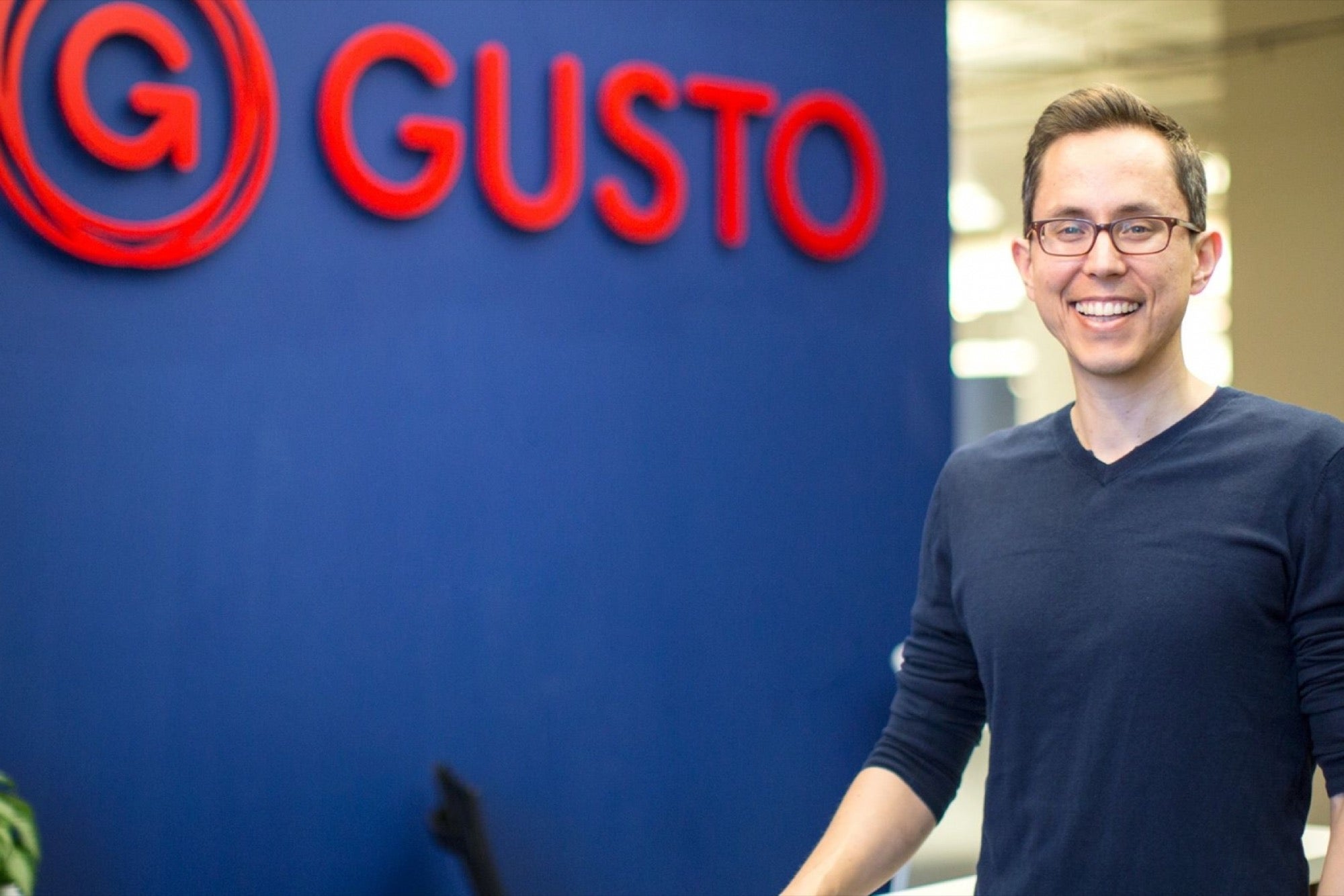
The partnership itself lasted. In January 2025, all three founders appeared together on a podcast, still involved in the company more than twelve years after its launch. An origin story involving friends is common enough. Continuing to run the business together gives that friendship a rather longer examination.
- 2010Unwrap is acquired
- 2011ZenPayroll is founded
- 2012Public launch in December
- 2015A new name: Gusto
- 2026500,000+ customers announced
The office came with slippers
Gusto began in a Palo Alto home. Reeves had grown up taking his shoes off indoors, so the house operated that way. When the company moved to an office, the custom followed. Visitors could find socks, slippers and sandals. Office culture had acquired a surprisingly literal point of entry.
The explanation was domestic rather than theatrical. Reeves wanted people to feel comfortable. It is easy to make too much of a shoe rack, but it is an unusually visible expression of a founder’s preferences. Everyone arriving has to encounter it. Some company values require a workshop; this one required a place to sit down.
Other preferences took more organization. During 2015, Gusto grew from sixty to three hundred people. Reeves had interviewed and made offers to the first sixty employees. As that became impractical, hiring reviews and onboarding workshops gave the expanding business ways to repeat decisions that had once depended on his direct involvement.
He described hiring through three considerations: values, motivation and skills. The point was to understand the reasons behind someone’s choices alongside the accomplishments. Repeatedly asking why could make an interview more revealing than a recital of credentials. A résumé records where someone has been; a conversation can begin to explain what they want from the next place.
By his account, the company added its first people team member, Jessica Yuen, in 2013, when it had about ten people. She did not come with a formal HR background. He valued her interest in people. His impatience with language that reduces colleagues to an input is plain enough: “People are not capital”.
“People are not capital”
Josh Reeves on the language of managing people
A bakery has better things to do
A small-business owner rarely starts with an ambition to become excellent at administration. A bakery has baking to do. In an early conversation with Gusto, a founder of Three Babes Bakeshop described her many responsibilities without listing payroll. Asked about it, she explained that Gusto had taken care of it. The task had slipped off the list.
Reeves’s idea of customer success is recognizable in that little omission. Software has done something useful when a customer can direct attention elsewhere. A business can measure activity inside an application; the person paying for it may prefer fewer reasons to open it. The pie remains a compelling alternative to the paperwork.
He also went looking beyond the screen. In 2017, Reeves and colleagues took a two-week RV trip to meet customers outside the Bay Area. Stops included businesses selling flowers, pool supplies and corsets. The variety matters: employers share recurring administrative obligations while living in very different commercial worlds. A single customer category can conceal a remarkable assortment of working days.

The same attention to ordinary work gives the product its stakes. Payroll returns on a schedule whether an owner feels ready or not. It sits beside hiring, tax filings and the other obligations that arrive with employing people. Helping with those tasks means entering a continuing relationship. Every pay period offers another chance to earn the customer’s confidence.
The clock gets longer
Reeves has described habits designed to keep a busy calendar from making every decision for him. One is to write down how he wants to spend his time, then compare that intention with the calendar. It is a small audit with potentially uncomfortable findings. Meetings have a way of voting on our priorities without asking permission.
His reading offers another clue. He has recommended Randy Komisar’s The Monk and the Riddle, especially its challenge to postponing the life one wants until some later success. He has also recommended The Lord of the Rings for the pleasure of entering another world and considering other perspectives. Middle-earth is an unlikely addition to a payroll executive’s reading list, which improves it considerably.
In early Gusto days, a more immediate change of scenery was South Park in San Francisco. The nearby loft lacked conference rooms, so Reeves met people outdoors. Years later, he recalled those conversations as a favorite early memory. The ambition was large; the meeting arrangements were pleasantly improvised.
In 2026, the scale gave him larger numbers to discuss. Gusto announced more than 500,000 small-business customers in April. In May, it reported that revenue over the preceding twelve months had exceeded $1 billion. Those are dated company milestones, measuring different things: the businesses using Gusto and the revenue the company had earned.
Reeves’s next ambition concerns how much work the software can take on. He has described AI helping Gusto anticipate an owner’s needs and act on them, including noticing missing hours before payroll. That remains an ambition to judge by what customers experience. The useful test is still close to the bakery: which task can disappear from the list?
The first startup left him asking what he wanted to keep explaining. Gusto supplied an answer rooted in other people’s working lives. Years later, the subject remains stubbornly ordinary. Someone has done the work. Payday is coming. Reeves has chosen to spend a substantial part of his own life making that next part easier.