Most companies would prefer you not linger on the moment they stopped doing the thing in their name. Reliance Foundry deserves the opposite treatment. The Surrey, British Columbia company has not poured metal on its own floor since 2003. It designs products, manages outside production, checks quality, holds inventory, publishes technical drawings, and sells into projects across North America. The furnace disappeared. The foundry knowledge stayed.
That distinction explains what Reliance does now. Its best-known products are bollards - those short posts that guide traffic, protect storefronts, separate bikes from cars, light paths, and occasionally make a plaza look as if somebody planned it. The catalog also covers bike racks and lockers, benches, waste bins, tree and trench grates, detectable warning plates, industrial wheels, traffic-calming gear, and custom castings. Customers include architects, landscape designers, municipalities, contractors, property managers, retailers, institutions, and industrial buyers.
Beautiful castings, ugly economics
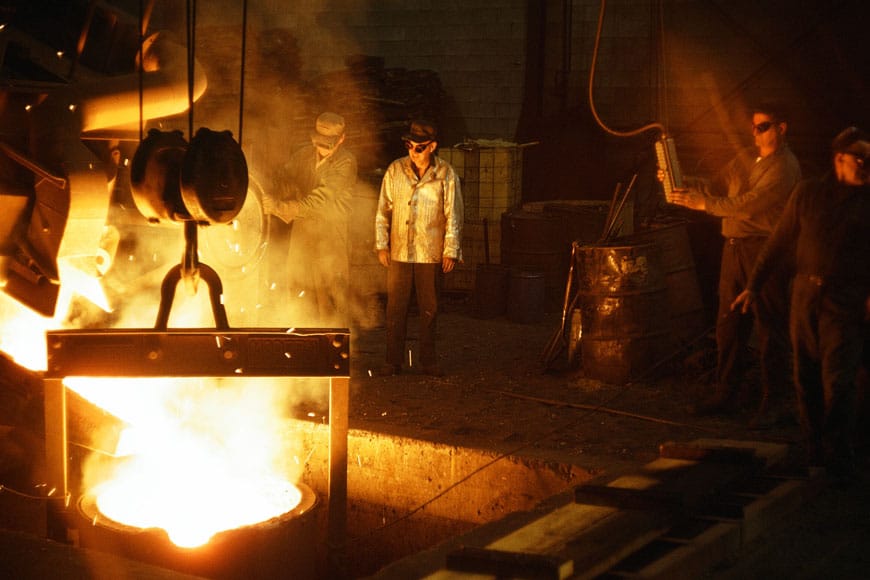
Reliance began in Vancouver in 1925, incorporated by four foundry workers: Mike and Gerry Engelbeen, H. G. Ireland, and Ray McDougall. An early municipal contract called for 225 cast-iron streetlamp standards. During the Second World War, the company says its workers ran 48-hour weeks and cast about 10 tons a day for the Allied effort. It grew into Vancouver's largest working foundry, serving municipalities and the mining and forestry industries.
The first dramatic failure was physical. A three-alarm fire in 1966 destroyed the original operation and forced a move to Surrey. The slower failure arrived in the 1980s and 1990s. Scrap, power, and labor were expensive. Overseas foundries improved. Brokers could offer cheaper castings. Orders were lumpy because a well-made wheel or lamp standard might last for decades. A busy quarter did not promise a busy year.
The operating system also creaked. Important approvals waited for an owner-manager's signature. Accounting happened on paper. The company could win work without knowing quickly enough whether the work was worth winning. When Brent Done computerized job costs, the data supplied an unpleasant punch line. One repeat order lost so much money that the brothers joked it would be cheaper to attach a $2,000 cheque and send the purchase order back.
A foundry chooses not to buy a foundry
By the turn of the century, the business was near bankruptcy and its owners were sometimes leaning on personal debt. The machinery installed after the 1966 fire was aging. In 2003, replacing it was estimated to require $5-6 million. Brent's accounting said the investment did not make long-term sense. Brad and Brent Done closed local casting and moved fully to contract manufacturing.
It was not a frictionless strategy slide. Employees lost jobs; management tried to relocate people. One departing worker told Brent that his grandfather would be rolling in his grave. Brian Done, who had spent his career in the business, answered more practically.
We’ve had to adapt any number of times through the history of Reliance. You’re just adapting.Brian Done
What changed their minds was not a single epiphany. It was a stack of evidence: precise job-cost data, a plant that required millions in capital, a shrinking local industry, and proof that the web could deliver distant demand. The company had launched a site in 1996. An inquiry from Little Rock, Arkansas, made the old assumption - foundries are local businesses - look suddenly negotiable.
Reliance started sourcing abroad in 1997. Brad traveled to partner foundries, assessed processes, and negotiated production. Castings returned to Canada for machining, heat treatment, and quality checks. After 2003, the remaining team numbered five. They filled orders, sourced suppliers, hired, kept accounts, and built a unified system connecting sales, purchasing, and inventory to the website. That web presence evolved from brochure to storefront and technical library.
03 / The modern machineThe product is metal plus certainty
Reliance now sits between a conventional manufacturer, an industrial distributor, and a specialist ecommerce operator. Standard bollards, bike racks, hardscape items, steel wheels, and traffic-safety products are stocked for shipping. Larger, modified, and custom work is quoted. The company designs in Canada and uses partner foundries internationally; some hardscape products are made in the United States. Local contractors perform installation.
Its useful difference is the information wrapped around the object. A professional buyer can find CSI or CSC specifications, dimensioned product drawings, AutoCAD files, installation guides, mounting options, finish choices, maintenance instructions, and working-load information. That library lowers the cost of specifying a product into a project. It also makes an online purchase less reckless than ordering an anonymous hunk of metal from a marketplace.
Where Reliance fits
price firstReliance
stock + guidance + customDesign brand
bespoke first
The catalog stretches from a flexible bollard priced in the low hundreds of U.S. dollars to tree grates and high-impact barriers costing several thousand before installation. Custom castings are priced case by case because alloy, pattern complexity, run size, process, machining, coating, and testing all move the bill. A standard in-stock order can be processed and shipped to North American destinations within a published window of up to 21 business days; high-volume or custom work takes longer.
Not every post stops a car. Decorative and flexible bollards can organize space while providing little meaningful impact protection. Reliance's Halvard and Vector lines occupy the tested end of the range. Halvard launched in 2024 with ASTM-certified options for storefronts and higher-security sites. Vector addresses lower-speed vehicle impacts under ASTM F3016. Correct product selection, foundations, spacing, and installation are part of the safety system. A handsome post in shallow concrete is still mostly a handsome post.
Keep the scar tissue, lose the sunk cost
The tempting summary is “outsource manufacturing.” That is too blunt to be useful. Reliance's move worked because it retained people who understood metallurgy, failure modes, finishing, machining, and industrial buyers. It did not replace know-how with a purchasing inbox. It replaced ownership of production assets with control of specifications, vendor relationships, quality, inventory, and customer information.
Cost every job
Revenue can hide work that destroys cash. Build the accounting that makes refusal possible.
Follow weak signals
A distant web inquiry revealed a market larger than the local sales territory.
Name the real expertise
Reliance's value was not only pouring iron. It was specifying and supervising reliable metal products.
Productize the knowledge
Stock lines, drawings, guides, and comparison tools make specialist knowledge repeatable.
Own the handoffs
Vendor selection, testing, inventory, quoting, and delivery still need a clear accountable operator.
There is a second lesson for B2B ecommerce: answer the next professional question before it becomes an email. What alloy? What load? Which mounting? Is it crash-tested? Where is the drawing? How should it be maintained? Reliance's pages are sales tools because they are also work tools. A specifier can move from curiosity toward a construction document without leaving the site.
05 / The boundary conditionsWhen this playbook falls apart
More likely to work
- Products can be standardized and stocked
- Expertise transfers across factories
- Quality can be specified and inspected
- Buyers value documentation and guidance
Less likely to work
- Process secrets live only on one shop floor
- Lead times cannot tolerate global freight
- Orders demand constant local customization
- Supplier oversight costs erase labor savings
The model is also exposed to tariffs, exchange rates, freight disruption, vendor concentration, minimum order quantities, and the loss of tacit manufacturing skill. Reliance's own history is candid about that last cost. Former owner Brian Done worried that North America had lost general manufacturing knowledge. A supply-chain business must therefore keep enough technical depth to challenge a vendor, diagnose a defect, and redesign a part. Without that capability, “asset light” can become “quality blind.”
Nor is every site suited to every product. Retractable bollards need drainage and routine maintenance; standing water can freeze mechanisms, while salt and dirt accelerate trouble. Crash protection needs tested hardware, correct foundations, and engineering appropriate to the threat. Reliance supplies documentation, but it does not install. The approach works when customers or contractors can execute the last mile properly.
06 / The second centuryFrom iron legacy to storefront risk
Parmar Capital acquired Reliance from Neenah Enterprises in 2023, returning it to Canadian ownership. In 2024, the Halvard launch pushed deeper into crash-rated perimeter protection. For its 2025 centenary, the company refreshed its identity and started “Buy a Bollard, Plant a Tree” with Vancouver-based veritree, setting a first-year goal of 10,000 trees. Its current messaging leans hard into storefront crashes, safer school zones, and the difference between decorative and certified protection.
That positioning makes sense. Reliance competes with security-bollard specialists, street-furniture brands, local fabricators, industrial suppliers, and direct overseas sourcing. It cannot always be the cheapest. Its claim is narrower: combine safety engineering, architectural options, available stock, and project-ready information in one place. For a buyer who needs a tested barrier with a cover that will not make a plaza look like a loading dock, that combination matters.
The company reached its hundredth year by violating the most obvious definition of continuity. It stopped pouring its own iron. What continued was the ability to judge metal, translate a site problem into a product, and make the purchase easier for somebody with a project schedule. The name remained accurate in the way that matters: not as a description of the building, but as a record of what the people inside know.