The pharmacy’s problem begins before the patient reaches the counter. Someone has to buy the medicine. In Nigeria, that can mean leaving the shop, travelling to a wholesale market, checking prices and returning with stock. During the pandemic, restrictions on movement exposed how much depended on that journey. A prescription could exist. A customer could have money. The medicine could still be somewhere else.
- The customer: pharmacies, hospitals and medicine vendors buying stock for other people.
- The proposition: source medicines, arrange delivery, manage inventory and apply for credit in one system.
- The telling number: 14,000+ healthcare providers reported by the company in May 2025.
Remedial Health built a business around shortening the distance between a shopping list and a stocked shelf. The interesting part is that the shopping list changed the business. Its founders started with a narrower proposition; their customers kept asking for more. There is a useful lesson here for anyone selling to small businesses: the request outside your catalogue may reveal the job the customer actually wants done.
The shopping list escaped the catalogue
Samuel Okwuada brought an unusual combination to the problem: pharmacy training and software development, which he says he taught himself at 14. Victor Benjamin brought more than a decade of pharmaceutical field-sales experience. One understood how an ordering system might work. The other knew the conversations required to get medicines into shops.


In a 2023 interview, Okwuada traced the earlier import business to his return to Nigeria after university in 2014. Medicines were produced in India and brought into Nigeria for sale. That experience preceded Remedial Health’s own chronology, which begins in September 2020 and records a launch in March 2021.
The early private-label proposition met a practical objection. Pharmacies needed products beyond the range the founders sold. Pandemic disruption made that broader need more pressing. The catalogue was too small for the task customers were handing them. Broadening procurement meant following those requests into a different business: organising supply across brands, rather than simply finding buyers for their own.
Okwuada had seen routine replenishment work differently in Britain. In his 2022 Nairametrics interview, he described ordering stock through a pharmacy system and finding it waiting the next morning. The appealing feature was its ordinariness. A reliable delivery should eventually become too dull to discuss.
“So why not place your order and let the products come to you?”Samuel Okwuada · Nairametrics, April 2022
Trust is a procurement decision
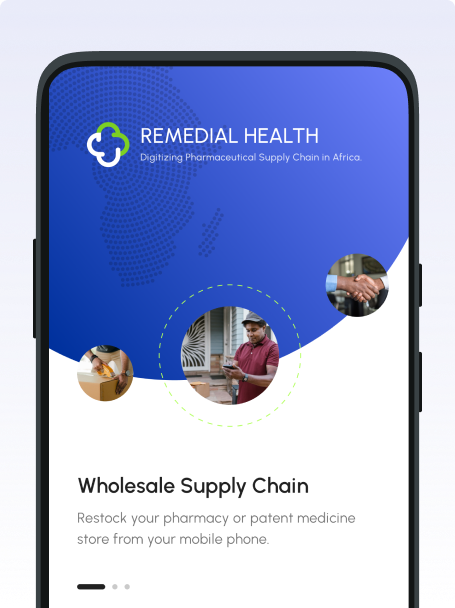
Remedial Shop, also called Remedial Store, brings medicines, consumables and small medical devices into one purchasing channel. Its published approach centres on sourcing from manufacturers and vetted distributors. The distinction matters because a convincing box tells a pharmacist less than a dependable chain of custody does.
The company also describes Mobile Authentication Service protection for its private-label medicines. That is a specific measure attached to a particular range. Its broader anti-counterfeit proposition rests on controlled sourcing. For a buyer, the useful question is therefore where a product came from and how it was handled, alongside what it costs.

Pooling demand gives the company a reason to negotiate bulk-buying discounts. Consolidating orders also saves the buyer from chasing several suppliers. These are ordinary wholesale advantages, made easier to access through a digital interface. The logistics still have to happen: a screen cannot store a carton, protect a temperature-sensitive product or steer a delivery vehicle.
- 01Vetted supplyManufacturers and distributors
- 02Order + creditFinancing after approval
- 03DeliveryStock reaches the provider
- 04Record + reorderInventory informs the next purchase
Simplified product workflow. Delivery timing and credit depend on service conditions.
The shelf is also a balance sheet
A pharmacy can know precisely what it needs and still lack the cash to buy it. Inventory is money waiting for a customer. Buy too little and the next prescription becomes a lost sale. Buy too much and cash sits in boxes while other bills arrive. Procurement and working capital are the same conversation viewed from opposite ends of the shelf.
Remedial’s Buy Now, Pay Later product lets businesses request inventory financing in the app, then use a Pay Later option after approval. The company advertises approval within 24 working hours and stock delivery within 24 hours. Those are service promises, subject to terms, rather than a stopwatch attached to every Nigerian address.
The distinction explains the shape of the 2023 funding. QED Investors and Ventures Platform co-led an $8 million Series A equity round. Another $4 million came as debt from local and international financial institutions. Calling the whole $12 million equity would miss something essential about the business.
Earlier announcements put the pre-seed round at $1 million in February 2022 and the September 2022 seed round at $4.4 million. These are financing milestones, not a receipt for building the company. They show capital raised; they do not tell us the total cost of vehicles, stock, staff and software.
The economics are recognisably B2B: sell pharmaceutical products to businesses, with financing and other services around that trade. Lending against inventory requires judgement about repayment and demand. Stock that moves slowly can become a problem for both sides. A bigger order is helpful only when the pharmacy can sell it responsibly and meet its obligations.
Software that remembers the last sale
Remedial Rx follows the stock inside the business. Its advertised functions include low-stock alerts, replenishment, reporting, accounting and patient medication records with role-based access. It also describes prescription checks and barcode validation. The attraction is continuity: the procurement system need not forget what happens after delivery.
The mundane details are revealing. Apple’s 2025 release notes describe returns management, offline inventory access and clearer order summaries. Returns, weak connectivity and disputed totals are the sort of problems that glamorous product presentations tend to omit. They are also the problems that determine whether a shopkeeper uses the system again tomorrow.
Other services address the people around the pharmacy. Benefits Manager offers insurers and HMOs medication procurement, distribution, formulary support and virtual doctor services. Remedial Intelligence offers market dashboards and demand insights. Market Access adds regulatory support, warehousing, distribution and marketing for manufacturers. A pharmacy order becomes useful information for the people deciding what to make and where to send it.
A crowded market, a specific customer
Remedial operates in a market with capable alternatives. DrugStoc also combines verified medicine procurement, inventory tools and credit. mPharma offers inventory and pharmacy partnership programmes. An app, financing or an anti-counterfeit promise alone cannot establish a lasting distinction.
Remedial’s particular proposition is the bundle around an existing healthcare business: buy stock, finance it, receive it and manage the operation. Customers include pharmacies and hospitals, but also proprietary patent medicine vendors, commonly abbreviated to PPMVs. Its manufacturer and insurer services widen the commercial reach beyond a straightforward wholesale sale.
The same announcement reported 300+ manufacturers and distributors, and over $40m in medicines financed. Network counts and cumulative financing measure different things.
The company’s May 2025 announcement put its network above 14,000 healthcare providers. That month it also celebrated third place overall, and first among healthtech businesses, in the FT/Statista Africa growth ranking. The ranking concerned revenue growth from 2020 to 2023. It is evidence of historic commercial expansion, rather than a clinical outcome measure.
A 2024 Salient Advisory report recorded procurement contracts with five Nigerian sub-national governments. The customer set was extending beyond individual shops. More recently, Google Play recorded a September 4, 2026 Android update. The release note was modest: bug resolution. Keeping the ordering tool working is part of the job.
What the shopping list teaches
The part another founder can copy is the sequence. Notice the request your product range cannot satisfy. Learn whether it recurs. Solve the purchasing difficulty, then examine the cash constraint that keeps the buyer from acting. Remedial’s story suggests that a repeated inconvenience can be a better guide than a grand declaration about changing an industry.
The conditions matter. The approach depends on trusted supply, disciplined inventory decisions, workable credit and dependable delivery. Software cannot cancel currency pressure or transport costs; financing cannot turn unwanted stock into demand. A pharmacy choosing the service should test the actual basket, delivery coverage and repayment terms against its own selling rhythm.
The cleverness lies in staying close to an unglamorous task. A pharmacist wants the right medicine ready when someone needs it. The software, the financing and the distribution network earn their place by helping that happen. The shopping list remains the best test of the business.