The exchange rate is agreed. The supplier is still waiting. For a business trying to turn Nigerian naira into an overseas invoice payment, those two facts can coexist with maddening ease. Verto was built around that gap: finding currency is one job; getting usable money to the other end is another.
The London-based company sells business accounts, foreign exchange and payment infrastructure, with a particular concentration on African markets. An importer can use its platform directly. A fintech can plug the same underlying services into its own product. The common customer is a business whose ambitions travel more easily than its cash.
Verto’s history is an exercise in following a problem beyond its first apparent solution. A currency marketplace became a broader payments platform. Along the way came venture funding, an engineering acquisition and a million-dollar prize. The interesting part is the work between those milestones: collections, payment tracking, local banking connections and the paperwork that determines who gets through.
The first dealing room was a group chat
In 2017, Ola Oyetayo and Anthony Oduu were discussing money over poker. Both had finance backgrounds and entrepreneurial plans. Oyetayo had been exploring remittances from the UK to Nigeria; Oduu was pursuing property technology. Their conversation turned toward the difficulty of paying suppliers abroad, particularly from emerging markets.
According to the founders’ account published by the Milken Institute, an informal WhatsApp group for currency exchange followed in 2018. That detail punctures the usual image of a payments startup arriving fully formed, all dashboards and compliance departments. First came people trying to find the other side of a currency trade. Verto joined Y Combinator’s Winter 2019 cohort.

The early marketplace addressed liquidity: businesses holding a difficult-to-exchange currency needed access to counterparties who could supply another. The company’s YC description still puts that network at the center, connecting businesses with liquidity providers, brokers, payment institutions and banks. The practical attraction was access to a trade, as well as a price.
Then the problem grew. In a 2021 PYMNTS interview, Oyetayo explained that customers needed to pay foreign suppliers after converting their money. An exchange alone left the job unfinished. Verto expanded into cross-border payments because the customer’s destination was an invoice settled in China, the United States or Europe. The marketplace remained useful; the product boundary moved.
Three jobs hiding inside one payment
The present-day offering splits that journey into three connected pieces. Business Accounts provides a place to receive and hold money. FX handles conversion. Atlas lets another company embed collections and payouts inside its own service. For buyers, the useful question is which piece removes the bottleneck they actually have.
Atlas puts these capabilities inside another company’s product. Illustrative workflow; availability varies by route.
Local accounts use domestic clearing systems; global accounts can receive international payments through SWIFT. Multi-currency wallets allow a business to retain funds until it needs to convert or spend them. Payment links add a way to request money, while multi-user access lets colleagues work within the account. These are finance-team chores collected into one interface.
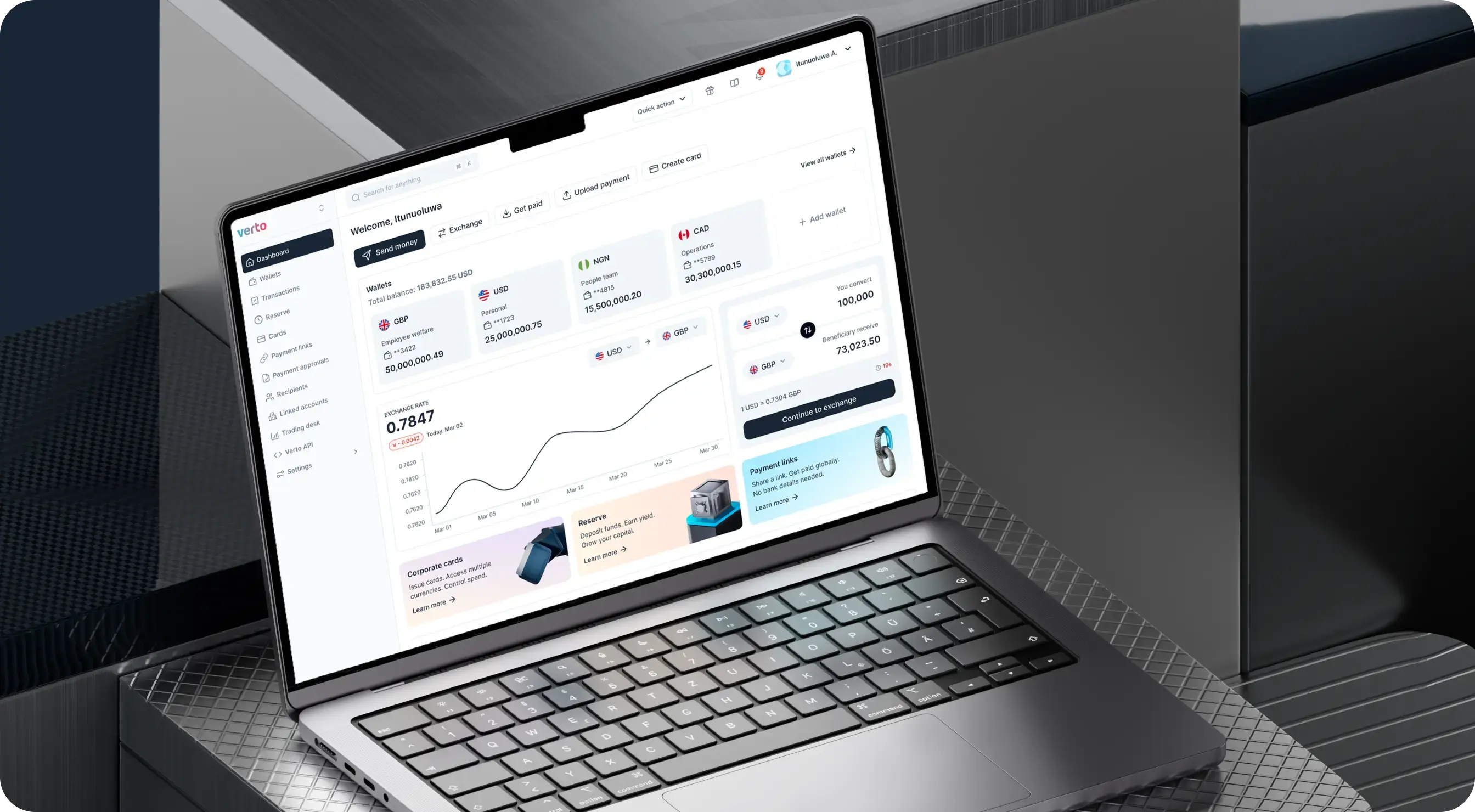
FX retains the company’s original specialty. Its offering includes immediate conversion, a marketplace where businesses seek counterparties at chosen rates, and a trading-desk service for large transactions. African currencies including naira, Kenyan shillings and South African rand sit alongside dollars, pounds and euros. The expertise being sold is partly software and partly knowing how to find and move money in those markets.
Atlas takes that expertise to a different buyer. A platform can create virtual sub-accounts, receive payment notifications, execute currency conversions and initiate payouts through an API. A remittance provider can use local bank or mobile-money payouts for the final delivery. Verto’s commercial pitch is that customers can add those capabilities without assembling every banking connection themselves.
Agriculture has no use for a mysterious transfer
Lima Technologies gives the proposition some dirt under its fingernails. The Kenyan agricultural business connects farmers with international markets. In Verto’s published case study, Lima describes delayed payments and bank operating hours that complicated collections. Its buyers include customers in the UAE and Europe.
The change Lima emphasizes is visibility. It can follow a transaction through initiation, progress and completion, rather than simply wait for an arrival notification. The case study also reports faster collections and describes a network of 15,000 farmers. Those are customer-story claims, but the operational point is clear: knowing whether money is moving helps a trading business plan what happens next.
Other named users illustrate the range. Solar company Sun King describes depending on Verto for international payments as it expands across African markets. Investment platform Cowrywise uses its API for foreign-currency transactions. AIfluence points to paying influencers across countries. Verto reports more than 5,000 clients on its About page; the examples are more informative than the count because they show different reasons to buy.
The free account still has a bill
Verto earns through subscriptions and usage charges. Its public dollar-denominated plans list Free at $0 a month, Lite at $50 and Emerging at $100, with custom Enterprise pricing. Developed-market FX fees fall from 0.6 percent to 0.5 percent to 0.4 percent across those first three tiers. A SWIFT payment is listed at $20. Exotic-market conversion can cost up to 2 percent.
Here is a deliberately narrow illustration. At $50,000 of monthly developed-market conversion, the published FX charge plus subscription totals $300 on each of those three plans. Below that volume, the subscription can outweigh the lower conversion rate. Above it, that arithmetic changes. This calculation excludes collections, payment charges and every other feature, so it is a comparison of one cost component, not a complete invoice.
Different plans. The same $300.
FX fee Subscription
Developed-market FX only. Other charges excluded. Published prices checked September 7, 2026.
Competition therefore has to be assessed route by route. Banks, brokers and payment providers such as Flutterwave or iBanFirst offer overlapping alternatives. Verto’s distinctive emphasis is the combination of emerging-market liquidity, account access and embedded infrastructure. A buyer needs a quote for the actual transaction, including the amount that reaches the beneficiary.
Buying the builders, then shortening the name
Building the operation required outside capital. Verto announced a $2.1 million seed round in July 2019, led by Accelerated Digital Ventures. A $10 million Series A followed in September 2021, led by Quona Capital with investors including The Treasury, MEVP and TMT Investments. BDO, which performed financial due diligence, described the funding as supporting platform development and geographic expansion.
In August 2022, Verto acquired Locusnine Innovations, the Indian engineering business that had helped develop its platform since 2019. It was a practical form of expansion: bring an established software relationship inside the company. Oyetayo’s year-end account explained that the developers had already worked through years of products, sprints and releases with his co-founder’s team.
Verto’s stated workplace values include taking ownership, focusing on customers and sharing failures openly. Those are employer promises. The acquisition is a more concrete clue to its working habits: build with people long enough to learn how the relationship functions, then formalize it. For other founders, that is a sequence worth examining.
By December 2025, Verto had moved from vertofx.com to verto.co. Oduu’s explanation made the positioning explicit: access and payment delivery mattered alongside the exchange rate. That year’s product additions included Bill Pay, bulk payments and the Atlas suite. The shorter address acknowledged a business that had accumulated more of the finance department’s work.
A million dollars meets the onboarding form
Verto won the $1 million grand prize in the Milken-Motsepe Prize in FinTech in May 2025. The award targeted access to financial services for small businesses in emerging and frontier markets. Unlike the earlier venture rounds, this was prize capital without an equity sale.
“the check actually cleared, I think, after three days.”
Ola Oyetayo · Milken Global Conference, May 2026
Returning to the conference in 2026, Oyetayo joked about the payment’s speed, then described its use. The money supported research into an AI onboarding assistant intended to help local African businesses sign up. He also reported adding about 70 people across Lagos, Cape Town and Nairobi, and connected the prize with expansion of the African team.
That choice of work is revealing. A payments product must get customers through verification before it can move their money. Verto’s licensing page describes a patchwork of permissions and partnerships: a UK electronic money institution, US arrangements including Global Innovations Bank, and Kenyan bank partners including UBA, Diamond Trust Bank and I&M Bank. The local arrangements are part of the product.
They also set its boundaries. A supported currency does not establish that every business can open every account, or send every payment in both directions. Eligibility checks, the particular payment route and the recipient’s arrangements still matter. A simple transfer between widely traded currencies may give a buyer little reason to pay for Verto’s specialist capabilities.
The lesson to copy begins with the WhatsApp group: find the transaction people are struggling to complete, test whether they will use help, then follow the remaining obstacles. Verto kept finding more work after the currency exchange. Its customers get to judge the result in the least theatrical way possible: the supplier confirms the money arrived.
Follow the money
Explore Verto, its pricing, Atlas platform and company blog. Read the Lima Technologies story or watch the 2025 Milken prize pitches and ceremony.