Money is a terrible traveller. It packs paperwork, picks up an exchange rate, stops at borders, submits to inspection and occasionally arrives looking less valuable than when it left. David Messenger has spent the latter half of his career trying to make that journey feel uneventful. The difficulty is that uneventful finance requires a great many events behind the curtain: licences, risk controls, bank relationships, local clearing connections and software that remembers what the customer was trying to accomplish in the first place.
Messenger is CEO of Global Businesses at PingPong Payments, a role created in 2023 to extend the company’s cross-border infrastructure to enterprises. His thesis is disarmingly plain. A company does not wake up wishing to execute a payment. It wants to settle a supplier invoice, complete a booking, pay a marketplace seller or close a month’s accounts. The movement of money is merely one difficult verb inside a longer sentence.
This is the latest version of an idea that has followed him through consulting, video games, mobile networks, card payments and two startups. The surfaces change. The nuisance underneath is usually fragmentation.
One phone, two lives
In 2013, Messenger co-founded Mast Mobile with a group that included fellow Virgin Mobile alumni. The irritation then was familiar to any employee issued a corporate handset: work and private life had become two phones, two bills and one trouser pocket too few. Mast put a business number and a personal number on the same device. Calls arrived natively, the correct identity could be selected for outbound conversations and the bill was divided automatically between employer and employee.
The proposition sounds obvious in retrospect, which is the fate of good simplification. Underneath sat carrier infrastructure, identity, billing and a link to Salesforce. Above it sat one phone. By the time Mast announced a $7 million funding round in 2015, twenty companies had signed up within the first month of commercial sales. Hearsay Systems acquired the company in 2017.
Messenger had already learned how much invisible machinery ordinary experiences require. At Virgin Mobile USA, where he joined in 2005, his responsibilities covered corporate development and strategy, information technology, customer care, human resources and facilities. He worked through the company’s public-market period and its sale to Sprint. At American Express from 2010, he built online and mobile growth initiatives, including work on new markets and partnerships. The résumé looks eclectic until one notices that each job sits where a complicated network meets a customer who would prefer not to study it.
The bridge to China
The most consequential partnership of Messenger’s American Express years began in 2010, when he helped lead the company’s entry into China through LianLian. Eight years later he founded Nuna Network, a New York venture partly owned by LianLian. Nuna set out to build payment, remittance and trade-finance software connecting China with the Americas and Europe. It was a practical bridge: Chinese merchants were selling through global marketplaces, yet receiving and managing their money still depended on a thicket of banks, currencies and national rules.
LianLian acquired Nuna, and Messenger became CEO and later executive chairman of LianLian Global. The work put him inside a fast-growing form of commerce and outside the comfortable assumption that a payment product built for one market would travel intact to another. He spoke of the information imbalance between China and the West with the humility of a visitor who had been coming to China for more than a decade and still felt he was scratching the surface.
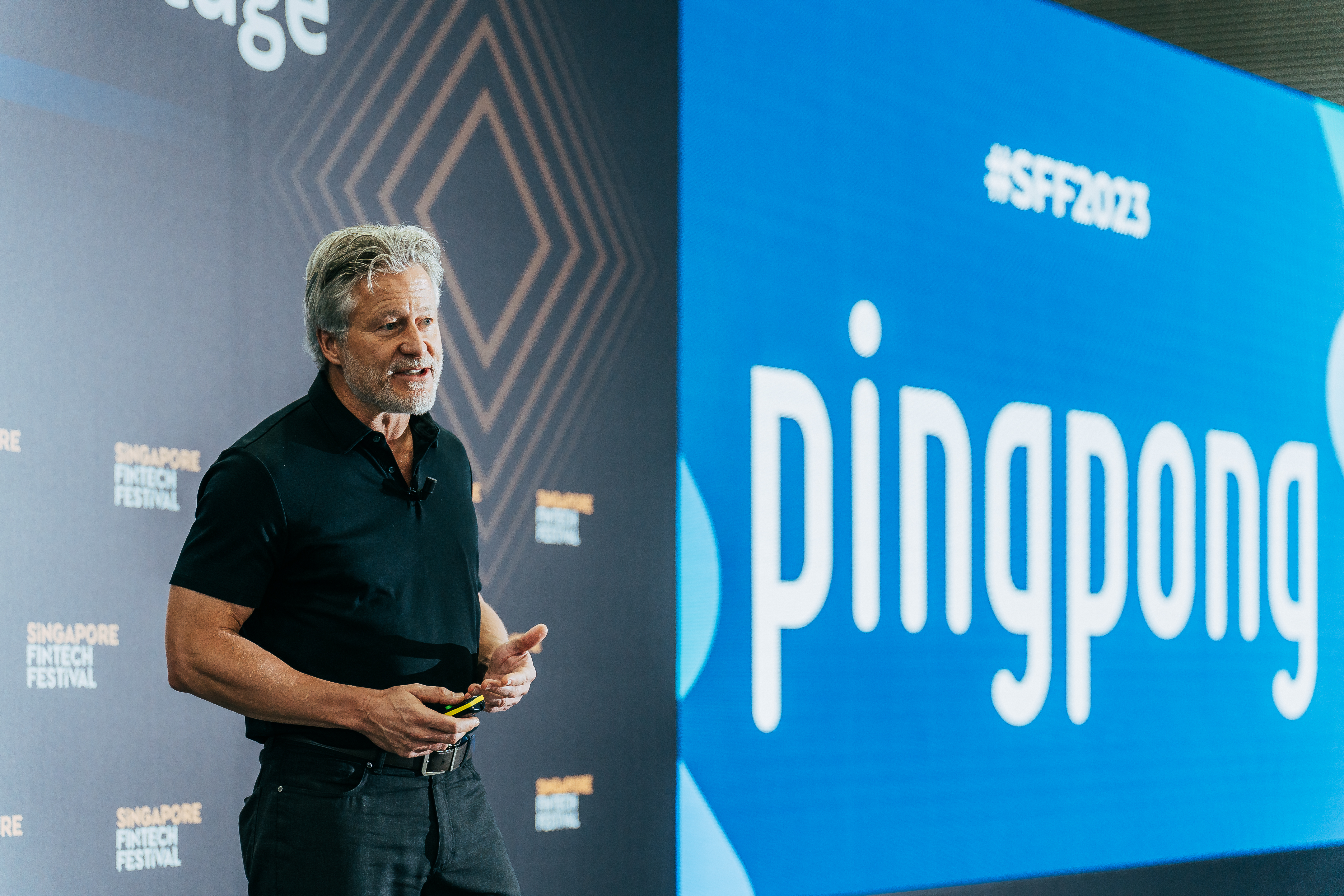
At Singapore FinTech Festival in 2023, now wearing PingPong black, he described the same lesson in operational terms. Technology mattered, but so did local teams and strong relationships capable of responding when regulation, supply chains or foreign-exchange conditions moved. Global finance, in other words, is not made global by deleting geography.
“It’s not the hand of cards you are dealt, it’s all about how you play it.”Advice Messenger remembers from his grandmother
Cards, footprints and a very long voyage
Messenger’s preferred operating manual arrived before business school age. When he was about eight, his grandmother told him that the cards matter less than how they are played. She also supplied a second maxim: footprints in the sands of time are not made by sitting down. He has repeated both as the best advice he received, describing a habit of choosing a constructive perspective and then looking for the next useful action.
His childhood hero offers a second clue. Messenger read the Iliad and the Odyssey repeatedly and admired Odysseus for persisting toward home while thinking his way through one obstruction after another. It would be too neat to treat a Greek epic as a career plan. Still, an executive who crossed from British university to American consulting, telecoms and cards, then into a China-based payment business, has not exactly chosen the short ferry.
There is a quieter detail, too. Surrounded by the usual armoury of screens and productivity apps, he became attached to a digital notebook that felt like paper. Its value was not another stream of information but the chance to write, concentrate and think. The preference fits an operator who speaks less about novelty than about what a tool removes.
Speed has a good press agent
Payments marketing adores a stopwatch. Messenger is suspicious of it, at least in business-to-business finance. A consumer may care whether a transfer takes five seconds or five minutes. A CFO loading a batch from an enterprise system is more likely to care whether it will arrive on the promised day, in the right account, at an understood cost and with records that reconcile. Speed is welcome. Predictability pays the rent.
That distinction explains PingPong’s less photogenic assets. The company says it has more than 60 financial licences, supports activity across more than 200 countries and regions, and has processed $350 billion in cumulative payment volume. Those figures describe the network, not Messenger alone. They are also a useful map of his argument: the interface is a small part of the product. Regulatory permission, local clearing, compliance controls and banking connections are what allow the interface to keep its promises.
He applies the same both-and logic to the supposed contest between banks and fintechs. Banks bring capital, institutional trust, durable systems and long relationships. Fintechs bring specialised software, local licences, agility and detailed knowledge of particular workflows. Treating them as substitutes can leave an enterprise with gaps. Combining them can produce a stack stronger than either sales pitch by itself.

The payment leaves the stage
The newest expression of Messenger’s argument is travel. Between a customer booking a trip and an agency settling with a supplier, exchange rates can move. Multiply a modest shift across thousands of bookings and foreign exchange becomes a margin problem. In 2026, PingPong and Sabre announced work to put FX optimisation inside the Sabre Mosaic Marketplace, closer to the moment the agency sets the customer’s price.
For Messenger, this is what embedded finance ought to mean. The user should not leave the booking workflow, assemble several vendors and become a minor scholar of currency timing. The financial capability belongs inside the task. He has described the best payment as the one a business stops thinking about, because attention can return to the commercial outcome.
Artificial intelligence enters his account in similarly practical clothes. He points to onboarding, transaction monitoring, fraud work, routing and product development rather than a synthetic oracle replacing the finance department. The aim is better judgement at scale and less manual friction. A technology earns its adjective only after it has improved the verb.
The next useful action
Messenger once said that, outside fintech, he would be interested in reinventing education. He had seen the reach of virtual tools and also their limits, and imagined a model that combined technology with the human advantages of learning together. The comment reveals an ambition broader than payments but recognisably his: preserve what works, hide needless complexity and redesign the seams.
For now, the seams are in global commerce. They run between a booking and its settlement, a marketplace and its sellers, a bank and a fintech, a local rule and an international ambition. Messenger’s career has placed him on both sides of enough of those joins to know that simplification is not the absence of complexity. It is complexity carefully carried by someone else.
There is little romance in a payment arriving exactly where and when it should. That is precisely the point. Odysseus needed an epic to get home. The modern enterprise, Messenger suggests, would much prefer a receipt.
Keep reading and watching