Consider the driveway. A shipping container is sitting on a trailer, and somebody has to decide whether that trailer can get through the gate. The purchase may have taken a few clicks. The last few yards require judgment. This is a useful place to begin with Boxhub, because the company’s product is easy to recognize and its actual work is easy to overlook.
- Buy new or used containers online, with sourcing and delivery arranged.
- The early technical breakthrough was accepting suppliers’ messy files.
- Price the whole project: transport, site preparation, and conversion count.
Boxhub sells the steel boxes that carry freight, then finds customers who need them for storage, workshops, offices, or a more ambitious second life. The attraction is convenience. A buyer should not need a shipping-industry apprenticeship to purchase something that has already spent years being moved around the world.
01 / The spreadsheet won
Co-founder Philip Skov brought shipping experience; Maximilian Birner brought a background in technology startups. Their opportunity lay between an industrial supply chain and people unfamiliar with its habits. Boxhub dates its founding to 2017. It later established operations in Toronto while maintaining a New York company address.
An early project began with a plan for two direct supplier APIs. After examining shipping companies’ processes, Boxhub decided that connecting straight to their equipment-management systems was not the best approach. It changed course, building a database that could ingest emails, Excel files, PDFs, websites, and accessible closed systems. The resulting system integrated 17 companies against a revised target of 10. Its project report says the work finished on schedule and slightly under budget.
There is a lesson here for anyone building software for an established trade: find out where the information actually lives. A PDF attachment may be inelegant, but it is still inventory. Making it usable can matter more than persuading everyone to adopt your preferred interface.

02 / An industrial purchase, domesticated
Today’s buying process starts with location, size, and condition. Boxhub sources from local depots and coordinates delivery through third-party carriers. Its expertise sits in matching available equipment to a customer’s use, then managing the handoffs needed to get it there. The website advertises standard delivery within five business days.
The catalog includes 20ft and 40ft units, selected high-cube versions, refrigerated containers, and boxes with different door arrangements. Accessories include shelving, ramps, vents, locks, and window and door kits. A container is a standardized object; what somebody wants to do with it is wonderfully less standardized.
The business model is a managed sales operation serving consumers and companies. Customers pay for equipment and delivery; specialty requirements go through quotes. For a contractor, the value may be fewer hours spent sourcing storage. For a first-time buyer, it may be having somebody explain the difference between a weatherproof box and one suitable for freight.
There are alternatives. Local dealers offer containers and local knowledge. Container xChange’s North American service targets container retailers, with inventory, pricing, and depot pickup coordination. Boxhub’s appeal is a purchase organized around the end user, including getting the box onto their property. That comparison is about the work each service handles, rather than a claim that one seller always costs less.
03 / The box has a price. The idea has a budget.
At the time of this profile, Boxhub’s website advertises used 20ft containers from $1,800 and new ones from $2,700. Used 40ft units start at $2,200; new 40ft units at $4,500. These are starting prices. Location, delivery, taxes, condition, and specifications belong in the actual quote.
The distinction matters particularly when a cheap box inspires an expensive dream. Boxhub’s modular-building page says it supplies containers and can refer buyers to builders; it does not provide homebuilding services itself. A container purchase leaves a separate construction project to organize. Its guidance also discourages heavily used, wind-and-watertight units for modular builds.
Some finished products take a different route. Boxhub lists climate-controlled container offices in 20ft and 40ft sizes, with an advertised three-to-four-week lead time. Published availability centers on locations within 300 miles of Oakland, Long Beach, and Atlanta; other destinations require confirmation. The standard-container delivery promise should not become a blanket assumption about every item in the shop.
04 / A marketplace needs people with trucks
Customers have included NASA, General Electric, Hobby Lobby, and the New York City Housing Authority. Alongside those organizations are people buying ordinary storage and entrepreneurs imagining something else. Boxhub’s funding announcements describe thousands of buyers, rather than a business dependent on one romantic use for containers.
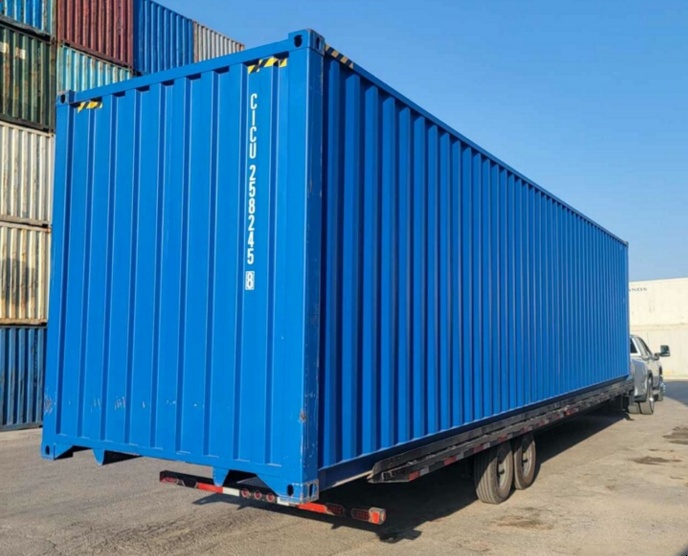
The delivery partners offer another view. In a March 2023 company case study, Houston operator I-Nava Hotshots described growing from one driver to seven after just over a year working with Boxhub. Co-owner Claudia Nava praised the company for asking partners how its technology could make their work easier.
“Boxhub is easy to work with.”Claudia Nava / I-Nava Hotshots
That is a modest compliment, and a useful one. More orders only become a better marketplace if suppliers and carriers can handle them. Boxhub’s careers page emphasizes ownership and transparent communication. Here, those values have a practical test: whether another business can reliably do its part.
05 / Measure before you dream
Boxhub’s delivery guide calls for 14ft of width, 16ft of travel clearance, 120ft of straight unloading space, and 20ft overhead while tilting. The surface must support a heavy truck. These requirements explain why the driveway deserves attention before the decorating scheme.
Returns have their own arithmetic. Published terms deduct outward and return transport costs, plus cancellation fees. The company’s example turns a $2,500 standard-container order into a $1,400 refund after two $500 transport charges and a $100 cancellation fee. A buyer should read those conditions before paying.
Boxhub raised a $12.4 million Series A in June 2023, led by AlleyCorp, to fund expansion and product development. The enduring business question is whether it can keep reducing the effort around a very physical purchase. Its early change of course suggests a practical answer: study the existing work, accept its awkwardness, and improve the handoffs. Then make sure the truck fits.