A distributor needs eight sizes of the same product. The website offers a handsome photograph, a large button and the opportunity to repeat the same task eight times. Somewhere, a designer is pleased. Somewhere else, a customer has picked up the telephone. Duran Inci has spent much of his working life in the space between those two reactions.
His subject is the small obstruction with a large commercial consequence. A buyer knows a part number, but search cannot recognize it. A customer has negotiated a price, but a new store forgets the agreement. A manufacturer offers a configurable product, while the website cheerfully permits a combination the factory cannot make. Advertising can send more people into these situations. It cannot order their parts for them.
Inci’s career makes more sense when followed through these problems than through his titles. He co-founded Optimum7 in 2007, building a business around ecommerce development and digital marketing. He became CEO of Zen Media after its acquisition of Optimum7 in September 2025. A year later, he was named CEO of Ecommerce.com while continuing to lead Optimum7. The titles moved; the preoccupation with the buyer’s next step stayed put.
Consider his September 2026 explanation of bulk ordering. Optimum7 lets business customers enter several product codes and quantities together, or upload an Excel order. It also builds technical search and calculators for goods sold by measurement. These are practical accommodations for people who arrive knowing what they need. A spreadsheet, in this setting, deserves rather more respect than it tends to receive at a branding meeting.
An education in the unfinished
Inci’s account of arriving in America begins with soccer. In a 2023 conversation with Ufuk Erdoğmuş, he said he came to Florida International University in 2000 on a soccer scholarship. His parents were primary-school teachers. He described the early years as difficult, with the restrictions and limited work options of an international student shaping the experience.
University took him eleven years to finish, he said. That detail complicates the tidy version of a founder’s biography: education, graduation, company. His story has overlapping tracks. Learning a market and making a living were already under way while the academic chapter remained open. There is something useful about a timeline that refuses to behave like a brochure.
He credits Arthur Cooper, his Optimum7 co-founder, with teaching him the fundamentals of American business. They met through the internet-marketing company Netspace, where Cooper was a franchise operator. Inci had previously worked on ecommerce at Makesgoodscents. The mentor mattered because technical ability alone did not explain how a different business culture worked.
That makes his later interest in teaching less surprising. He had needed someone to explain the machinery around the work. In the classroom, he would turn his attention to the gap between an academic course and an employer’s expectations. A lesson about online visibility could be a lesson about getting hired. The stakes were personal before they became commercial.
Back in the classroom, with the internet watching
Optimum7’s relationship with FIU’s Global Strategic Communication creative-track program dates to 2014. The collaboration brought workshops, seminars and practical digital-marketing work into students’ education. Inci and program director Grizelle De Los Reyes argued for students graduating with experience they could actually use. Writing, design, analytics and communication were parts of a working assignment rather than separate boxes on a syllabus.
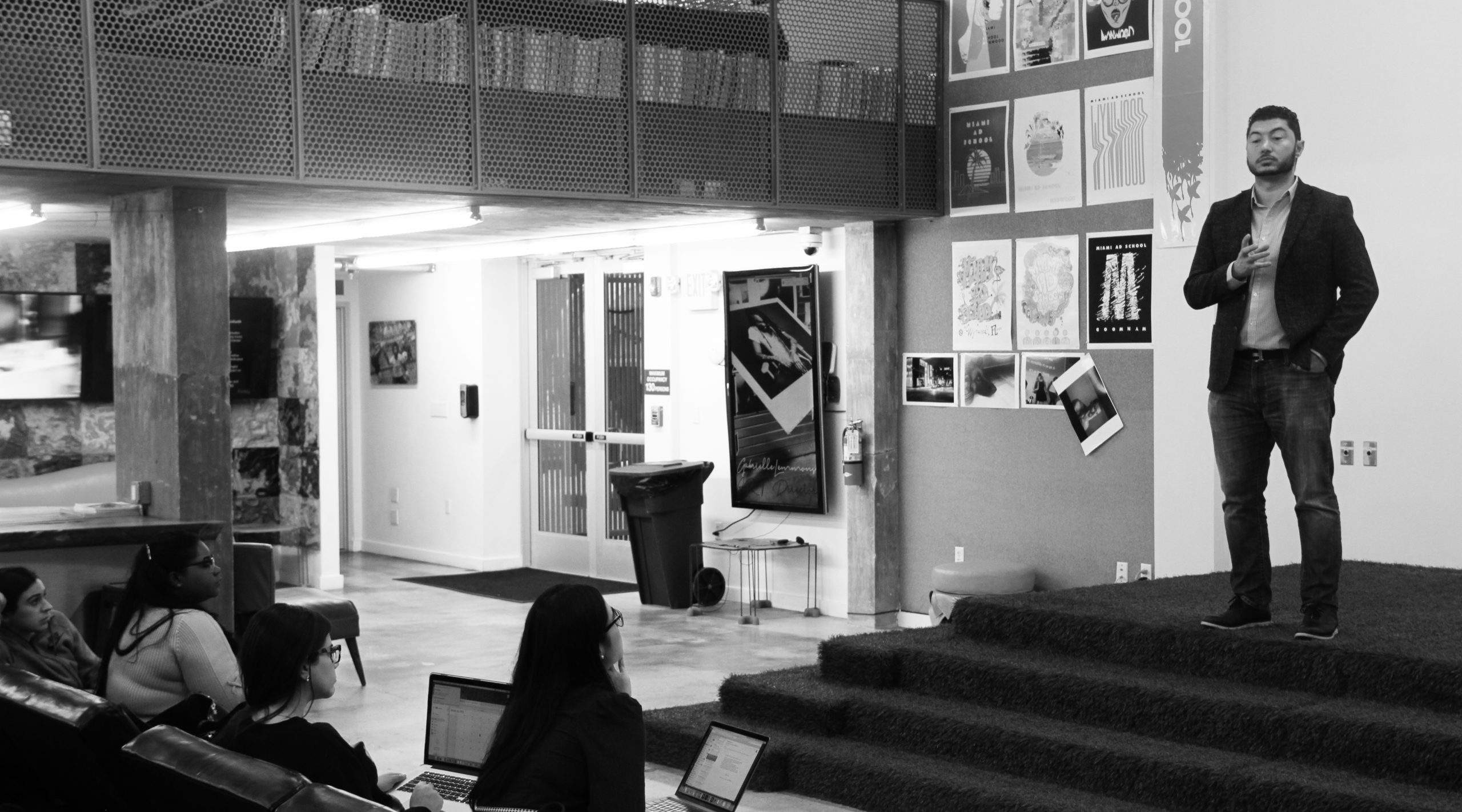
His public biography also records digital-marketing teaching at FIU and speaking at SMX and eMetrics. A photograph from his own archive catches the teaching side of this career: Inci standing before students with open laptops, surrounded by the visual bustle of an advertising school. There is no boardroom table in sight. The work still involves explaining how an audience gets from one place to another.
At a Biscayne Bay workshop with social-media strategist Lucia Sastre, the audience’s own names became part of the assignment. They discussed professional profiles, privacy settings, online searches and the connections students could build before looking for work. Inci’s concern was concrete: employers could look people up, so students needed to take responsibility for what appeared.
The advice belongs to an earlier internet in some particulars; Google+ figured in the discussion. That obsolete detail is also a useful reminder of the problem he was teaching. Platforms change faster than curricula. A student needs ways to inspect and improve a public presence, then keep doing it as the places where people look begin to move.
The catalogue can be complete and still be wrong
By September 2026, his public explanations were returning to industrial catalogs with almost forensic specificity. A migration might transfer every product record and still break the filters customers use. A technical attribute could land in description text rather than a structured field. The data had arrived, but the function that gave the data its value had disappeared.
For a distributor, that distinction is substantial. A buyer searching by thread size, compatibility or another specification needs the catalog to narrow correctly. A count of imported records cannot establish that. Inci’s team describes mapping important fields to named destinations before transfer and testing how the rebuilt catalog behaves for buyers and connected systems. The success screen is only the beginning of the examination.
Customer-specific pricing introduces another version of the same difficulty. A contract price belongs to an account, and an account may be linked to an enterprise resource planning system. Buying permissions and approval steps also have to survive the move. Inci’s September explanation treats validation as an ordering exercise: log in as a buyer, check the price and complete the purchase under the right rules.
A mattress configurator offers a further twist. Optimum7 described a build in which the valid combinations depended on rules previously held by the people taking orders. The engineering task was to make those rules explicit and apply them during selection. An attractive three-dimensional preview could help a buyer see the product. The underlying logic had to stop an impossible product reaching production.
Together, these examples give his business vocabulary a particular texture. Growth might mean saving a customer several repetitive clicks. It might mean preserving the meaning of a database field. It might mean asking an experienced employee which combinations are possible and writing down the answer. None of these makes a glamorous photograph. Each can decide whether the glamorous photograph sells anything.
A $10 million change of desks
The Zen Media deal brought this technical background into public relations. Announced on September 16, 2025, the acquisition was described by the companies as a $10 million transaction. Inci became Zen Media’s CEO; its founder, Shama Hyder, became chief visionary officer. Optimum7 retained its specialized ecommerce and technical-performance focus under the Zen umbrella.
The combination proposed connecting earned attention with paid media, search, conversion work and revenue operations. That is an understandable ambition for someone accustomed to inspecting the steps after a visit. A company can win coverage and still have a quoting process that discourages inquiries. It can attract the right buyer and present the wrong account price. The combined business was organized to work across those boundaries.
Hyder and Inci were already familiar with one another’s work. His personal site carries her testimonial about his ecommerce and digital-marketing experience. It also includes a recommendation from Specialist ID president Patrick Barnhill, who describes Inci’s contribution to his company’s growth and his role as a mentor and consultant. These relationships show a career conducted through other people’s operating problems.
A year after the acquisition, the leadership arrangement changed again. The September 10, 2026 Ecommerce.com announcement named Sarah Evans CEO of Zen Media and Inci CEO of Ecommerce.com, alongside his continuing Optimum7 role. For a reader following him through the Zen chapter, this is the next scene: the operator moves toward a commerce platform while the communications business has a new chief executive.
Zen Media’s acquisition of Optimum7 brought Inci into the CEO role.
An assistant joins the shopping trip
Ecommerce.com’s announced audit asks how well AI agents can find, read and recommend a brand. The platform emerged from private development in September 2026, with its broader tools scheduled for the first week of October. The announcement described two years of development supported by five years of proprietary engineering. Those are development periods, rather than evidence of what customers will achieve.
The question is a recognizable extension of Inci’s earlier work. A human buyer once needed a store to recognize a part number; an AI assistant needs information it can retrieve and interpret before it can recommend a seller. The route to the purchase has acquired another participant. The old discipline of making commercial information usable has another audience.
He had been developing that argument publicly before Ecommerce.com’s announcement. In a June 2025 interview with Sarah Evans, he described an AI Communications Spiral: examine customer information, look for recurring obstacles, test messages, coordinate assets and measure the response. His concise instruction to founders was, “Don’t sell AI - sell performance.” The emphasis falls on the result a customer can experience.
The useful part of this outlook is its insistence on a feedback loop. Messages are hypotheses about what a buyer needs to understand. They can be tested and revised. A tool’s ability to produce language does not settle whether that language helps someone order, compare or commit. Inci’s long experience of stores gives him a ready supply of questions with which to interrogate the new tools.
“Don’t sell AI - sell performance.”
Duran Inci, June 2025
A guitar, a tennis court, a next step
There are less commercial kinds of practice in his life. A 2016 Optimum7 media kit described flamenco guitar, a dog named Puffy and competitive sports including soccer, tennis and basketball. His Turkish-language company biography adds stand-up comedy to his interests. The person discussing conversion rates also has an audience for whom a well-timed joke might be sufficient.
In his later interview, he connected soccer and tennis with quick decisions, and flamenco with attention to patterns. Those are his own explanations for the hobbies. They also offer a pleasing change of scale: a chord, a return, a moment that has to be handled while it is happening. Neither a tennis ball nor a guitar is impressed by a slide deck.
His public teaching and consulting work similarly favors action. The personal website offers workshops, corporate training and individual coaching alongside conference appearances. The subject is often how to recognize an operational problem and put a process around it. Over time, the same habit has taken him between classrooms, clients, agency leadership and the emerging business of AI-assisted discovery.
The most revealing object in this story may still be that customer’s eight sizes. It is ordinary, exact and indifferent to marketing fashion. Inci’s latest work asks whether an assistant can recommend the business. His older work asks whether the business can fulfill the recommendation. Between those questions sits a person who would very much like to finish an order and get on with the day.
Follow the next chapter
Visit Duran Inci’s personal site, Optimum7, Zen Media and Ecommerce.com.
Find him on LinkedIn, X, Instagram, Facebook and YouTube.
Read the 2023 Oyuna Devam conversation, the 2025 AI interview and the September 2026 Ecommerce.com announcement.