Matthew Caiola wanted to be a news reporter. The anchors on television had his attention, and he imagined joining them. Then, at Iona College, two classes changed the direction of that ambition: news reporting and writing, and organizational communications. Public relations offered another way into the same world. He could help a story reach the public while working with the people whose businesses gave it something to say.
“Growing up I always wanted to be a news reporter,” he recalled. It is a useful starting point for understanding the chief executive of 5WPR. Caiola’s career has crossed corporate communications, technology and digital marketing, but the early fascination survives: how does a person, a company or an idea become something other people pay attention to?
There was an early lesson in the hazards of paying too little attention. In his first days at an agency, Caiola went to a client pitch without researching the people he would meet. He confidently introduced himself to someone he believed was the client. The supposed client was a colleague he had not yet met. An introduction is a small piece of theater; getting the cast wrong rather spoils the opening.
Another early experience had a happier ending. Working with a startup, he helped place a story that, in his account, led to a funding round and subsequent hiring. He watched a young business change shape. That experience sharpened his interest in startups and in the practical consequences of communications. A story could do more than occupy space. It could help a business take its next step.
“Growing up I always wanted to be a news reporter.”
Matthew Caiola
Thirteen years to the corner office
Caiola graduated in 2005. His degree was in mass communication, with a concentration in public relations and a minor in political science. His early jobs included an account executive role at Aerotek and work at Avalanche Strategic Communications, where his assignments covered clean technology, aviation and consumer businesses. Sales was part of his early professional education, too. He later described it as useful preparation for PR.
He joined 5WPR in 2009. The company had been founded by Ronn Torossian in 2003; Caiola’s route was through its ranks. He took on leadership of corporate and technology work, then digital. In February 2022, after thirteen years at the agency, he became co-CEO alongside Dara Busch. His current role is chief executive officer, with responsibility for the firm’s strategy, growth, culture and client work.
The work grew in scale before the title arrived. His emerging technology team recorded more than 50 percent growth annually for three years. The department expanded to more than 120 employees and over 100 clients. Those figures belong to that period of development, rather than a running count of the agency today. They explain something concrete about his rise: he had already been building a sizable operation inside the business.
Expansion brought specialization. Gaming, sports betting, blockchain and cybersecurity required different knowledge, different conversations and different audiences. Caiola’s client experience has included Amazon, VIZIO and Samsung SmartThings, as well as former Apple and Pepsi chief executive John Sculley. His client experience also includes Axiom Space. The range asks a communicator to change vocabulary without losing the ability to explain what matters.
- 2005Graduates from Iona
- 2009Joins 5WPR
- 2022Becomes co-CEO
- 2026Publishes AI discovery research as CEO
A good story needs somewhere to go
One revealing example came through travel technology. In 2022, Caiola discussed 5WPR’s work with Harvest Hosts, a membership business connecting RV travelers with places to stay, including farms and wineries. The communication opportunity was unusually tangible. A creator could travel, stay somewhere unexpected and show an audience what the membership made possible. The product supplied the plot.
He described an approach that followed a creator’s experience over a day or several days. It borrowed from the reporting that had interested him in college: give people something they can watch unfold. His discussion also included AirHelp, which assists passengers with compensation claims after disrupted flights. In both cases, the technology becomes intelligible through a traveler’s experience, rather than a recital of product features.
The same interest in connecting the pieces shaped his oversight of The HOW Agency, 5W’s digital media business. By December 2023, he was explaining how an internal digital team had expanded into a separately named agency. The purpose was to give the team more resources and room to develop its services. Earned coverage, digital content and paid distribution could be planned with one another in mind.
In his 2025 writing about B2B marketing, Caiola returned to the problem of disconnected efforts. He argued for joining PR and digital strategy, using audience information to make communications more relevant and keeping messages consistent across channels. The buyer may encounter a business in several places before doing anything. For Caiola, the campaign has to survive that journey. A fine opening line is wasted if the next conversation sounds like a different company.
The team behind the title
Caiola’s recognition includes a Silver Stevie in the 2023 American Business Awards category for Communications, Investor Relations, or PR Executive of the Year. He was also named an Agency Leader of the Year honoree in Ragan and PR Daily’s Communicators of the Year Awards. European CEO’s 2023 public relations industry award listed Caiola and Busch together. These are dated distinctions, milestones in a career rather than permanent rankings.
His public responses to recognition repeatedly return to colleagues. After the Ragan honor, he said, “I owe a massive thank you to my incredible team, without them I wouldn’t receive these recognitions.” The sentiment fits the way he describes management: trust the abilities of the people doing the work, and give leaders room to think about the wider business. Delegation depends on having people whose judgment you can use.
There were organizational changes beneath that language. Caiola helped develop recruiting relationships with historically Black colleges and universities. The agency formed a staff diversity and inclusion committee and broadened its approved vendors to include more businesses owned by women and minorities. It also added Juneteenth as a holiday. These are choices about who enters an organization, who supplies it and whose experience is acknowledged within it.
Training supplied another piece. Through 5W University, senior leaders taught sessions ranging from PR skills to leadership development. The agency’s expansion of research and analytics, described in 2023, added further attention to campaign measurement. Taken together, these efforts suggest an operational reading of storytelling: someone has to hire the writers, teach the craft, examine the results and keep the business able to do it again.
The audience now has a machine in the middle
By 2026, Caiola’s public work was concentrating on a new question: what happens to brand discovery when the first response a prospective customer reads is assembled by an AI system? In April, he and the 5W research team published The GEO Reckoning. GEO, or generative engine optimization, concerns whether a brand is cited or recommended within AI-generated answers. The distribution problem had acquired another intermediary.
The report organizes its argument around four areas: a recognizable brand identity, corroboration across independent publications, content that is easy to extract, and material that stays current. These are the report’s proposed priorities. They shift the discussion away from a single coveted placement toward the body of information an answer engine may encounter. Being understood repeatedly becomes part of the communications assignment.
In May, Caiola and Torossian published a banking AI visibility index, based on a stated dataset of 31,500 prompts. Caiola also wrote about the difficulties B2B technology companies face when AI answers omit them, describe them with outdated information or borrow a competitor’s language. His proposed exercise was direct: ask several systems about your category and inspect what comes back. The brand’s self-description and its public description may differ.
His June commentary pursued the distinction between ranking information and assembling an answer from multiple places. He argued that clarity, corroboration and distribution deserve attention alongside the reputation of an individual publication. This remains his strategic argument, rather than a settled verdict on the future of every newsroom. It does, however, follow the pattern of his career: watch the route between a business and its audience, then adjust the work when that route changes.
Identity
A consistent picture of the brand.
Corroboration
Independent references that agree.
Structure
Answers that are easy to extract.
Freshness
Information kept current over time.
Back where the questions began
On April 15, 2025, Caiola returned to Iona as the keynote speaker for Scholars Day. Twenty years after graduation, the former student was addressing a gathering devoted to student research and creative work. There is a pleasing continuity in the setting. The college classes that first moved him toward PR had become the place to discuss what that decision had made possible.
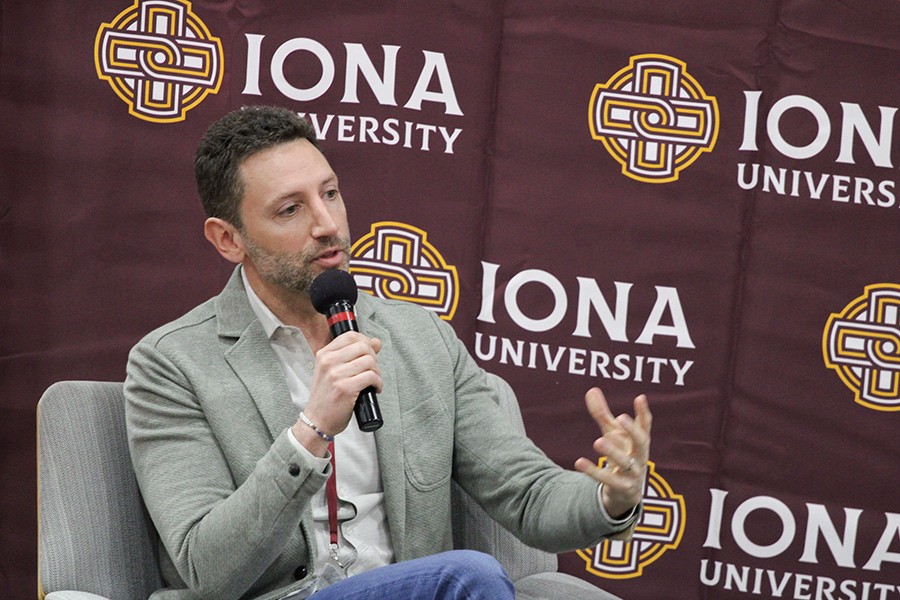
The alumni connection also had a practical result. Iona student Nate Wales secured a summer internship at 5WPR after connecting with Caiola. It is a small, specific example of an idea Caiola often advances: relationships have value beyond the immediate transaction. His advice to students and professionals emphasizes keeping good people close and remaining open to interests that do not fit neatly into one career diagram.
“I don’t see a linear path to success,” he said. Outside work, his disclosed interests include the Mets, Jets games and his rescued Cockapoo, Layne. In 2023 he was watching Succession, drawn in partly by its media setting and Manhattan surroundings. A communications executive watching a drama about a media dynasty seems almost excessively appropriate. At least the dog offers a different audience.
The recurring theme is attention, followed by action. A college class changes a career choice. A startup story helps open a business opportunity. An alumni conversation opens an internship. A changing search interface prompts a new research program. Caiola began by wanting to tell the public what was happening. His work now asks how a story reaches that public at all, and what a company must do to deserve a place in the answer.
Continue the conversation
Caiola’s work, interviews and campus appearance.