Sean Cassidy joined DKC in 1992 as an account executive. The firm was barely a year old. He later became president and then chief executive, while the work around him has acquired enough new disciplines to occupy a small college catalogue. Publicity, events, digital content, audience research, influencers, artificial intelligence. Staying at the same company has involved a considerable amount of moving.
The beginning was less orderly than the résumé. Cassidy graduated from Tufts University in 1990 after studying Cold War foreign policy, just before the subject underwent a rather consequential revision. He entered a slow economy without a job lined up. A small agency owner liked his writing, and public relations became the available door. He went through it without having spent his adolescence dreaming of press releases.
His earlier working life included waiting tables at Gallagher’s Steakhouse in New York. That detail belongs beside the degree, rather than beneath it. His eventual profession would involve different customers and different requests, but it was still a service business. The path from restaurant floor to agency leadership makes a better story than a supposedly inevitable calling. It allows room for accident, work and the decision to keep going.
The job that kept changing
Dan Klores founded the firm in 1991. Cassidy became a partner in 1996 and president in 2004. Those dates give his career a shape: a young employee arrives at a young business, gains responsibility, and eventually takes charge of an institution he has helped build. There is no need to manufacture a sudden revelation. Twelve years separate his arrival from the presidency.
His professional range grew across music, corporate communications, media and public affairs. The names associated with his work include Lady Gaga, Clive Davis, Delta Air Lines, Sony Music Entertainment, Citi and NBCUniversal. That is a varied cast. An artist has a voice and a following; an airline has passengers and a timetable; a financial company has customers and expectations of trust. Each brings its own vocabulary and consequences.
By 2025, DKC credited his leadership with 500 percent revenue growth over two decades, expansion into several American cities, and new businesses in creative services, experiences, content and analytics. It is a description of agency growth, rather than Cassidy’s personal earnings. Its significance is structural: he spent those years adding ways to serve clients while remaining inside the company where he had started.
The resulting career resists the usual equation between movement and ambition. Cassidy’s promotions happened in one organization, but the organization became a different proposition. For someone interested in how careers develop, that distinction matters. A long tenure can contain many jobs, even when the company name occupies only one line on the page.
- 1992Account executive
- 1996Partner
- 2004President
- 2024CEO
A publicist with an editor’s pencil
Cassidy’s account of the work has a useful compactness. “As a PR executive, you’re 50% marketer, and 50% editor.” The marketer wants the client’s story to travel. The editor has to decide whether anyone outside the client’s meeting room will care. Both live in the same job, with ample opportunities to disagree.
DKC’s phrase “maximizing return on news” puts that argument into its positioning. A story needs a reason to exist in public. An announcement may be important to the person making it and still require work before it means something to an audience. Cassidy has described remaining involved with media trends and sitting in team meetings to keep a feel for the agency’s daily work.
The editor’s pencil also appears in his choices of colleagues. In 2013, DKC brought Joe Quenqua from Walt Disney Studios to lead its entertainment division from Los Angeles. Quenqua’s background included publicity across film brands and Disney’s stage properties. Cassidy was adding someone who understood the machinery behind entertainment, including the relationships needed to bring it into public view.
Two years later, Kristin Boehm arrived to direct DKC Connect after serving as deputy editor of People.com. Her experience combined content, audience engagement and digital operations. A newsroom career had become useful to an agency building a larger digital practice. Cassidy’s editor-and-marketer formulation was acquiring colleagues who had actually worked on the editorial side of the desk.
When the event became the assignment
The expanding job had a physical dimension, too. In 2012, DKC launched DKC Incite, an event marketing and production division led by Kelly Butler. Its remit ran from creative concepts and production schedules to venues, permits, talent and the practical business of sound and lighting. Publicity could now include making the thing people were invited to attend.
This is where the phrase brand experience becomes pleasantly concrete. Someone needs to arrange a room. Someone needs to secure permission to use it. Someone needs to make sure that the clever idea survives contact with the electrical supply. DKC’s new division addressed concerts, pop-ups, sporting events, premieres and other occasions where the story had to work in three dimensions.
Dixie Roberts, a leader at DKC’s HangarFour creative agency, later described the change in client briefs. Requests once led with public relations and included some social work or an event. Then the event started leading the request, with publicity attached. In her telling, Cassidy recognized the shift and brought creative capabilities together in an agency with dedicated teams and its own culture.
That recollection offers a useful view of his management from another desk. The business was changing because clients were asking for a different mix of work. Cassidy responded by changing its organization. The story could begin in a venue, on a screen or through a creator, and the agency needed people who could follow it there.
The quiet rule inside a noisy trade
Cassidy’s stated rule for running DKC is disarmingly ordinary: he rejected a workplace conducted through shouting and swearing. “It’s hard enough as it is without doing that.” Public relations already supplies its own pressure. Adding a hostile boss would be a peculiar employee benefit.
His approach to hiring includes telling people what the work will demand. Staff must shape a client’s story and carry it across different channels, in a business where the days vary. He has also emphasized personal relationships with clients and members of the media. Those connections are part of the work, built by people who have to continue dealing with one another after the immediate deadline passes.
DKC’s public description of its culture includes mentorship, workshops, professional development and work across departments, alongside volunteering and trivia nights. These are the company’s stated practices. They fit the practical problem Cassidy describes: people need room to learn as their assignments change. A firm that adds disciplines also has to make those disciplines intelligible to its staff.
There is a civic version of the same impulse. For DKC’s twenty-fifth anniversary in 2016, the firm introduced DKC Impact, offering pro bono public relations and digital services to small nonprofit organizations. Cassidy appointed Bruce Bobbins and Dana Bakich to lead it. The project put experienced practitioners and digital skills behind organizations that could use help being heard.
A new owner, a longer horizon
September 2024 changed the ownership and the leadership titles. Acceleration Community of Companies bought a majority stake in DKC. Cassidy became chief executive; Matthew Traub, previously chief operating officer, became president. The transaction placed the firm in Michael Nyman’s network of marketing and communications businesses.
The stated purpose was broader access for clients. ACC’s businesses included experiences, influencer marketing, design and fabrication, and analytics. DKC brought strategic communications and a substantial sports practice. The new arrangement provided more places to take a client’s problem when it required several kinds of expertise at once.
Cassidy spoke about looking ahead to what clients would need over the following decade and beyond. Sports offered one example. DKC had worked with organizations including the Big East, Manchester City, Formula 1 and the NBA. He described the overlap among sports, entertainment and culture, and the value of combining DKC’s experience with ACC’s Los Angeles presence and relationships.
The decision gives his long tenure another turn. After years of building the firm’s capabilities, he chose a network that could extend them. His stated aspiration was to offer clients a broader range of communications and marketing services. The name on his business card changed, but the underlying question remained practical: what else will the assignment require?
The next reader might be a machine
The newer assignments include understanding how artificial intelligence presents a brand. In November 2025, ACC appointed Michael Moschella to lead ACC Intelligence while continuing to oversee DKC Analytics. The division combined research, data science and AI work, with two tools addressing different parts of the communications problem.
Definity was introduced to test creative work and messages against synthetic audiences. AIME was designed to monitor and influence how generative AI systems interpret and cite brands. Cassidy identified representation on AI search platforms as a central concern for clients. The old editorial question had acquired another audience: systems that assemble answers before a person chooses a link.
His enthusiasm has limits. Discussing marketing expectations for 2026, he cautioned against rushing into AI-generated creative. His concern was people’s ability to detect material that feels unconvincing. It is a useful caution from someone whose trade depends on getting a message received. Speed and volume do not settle the question of how an audience responds.
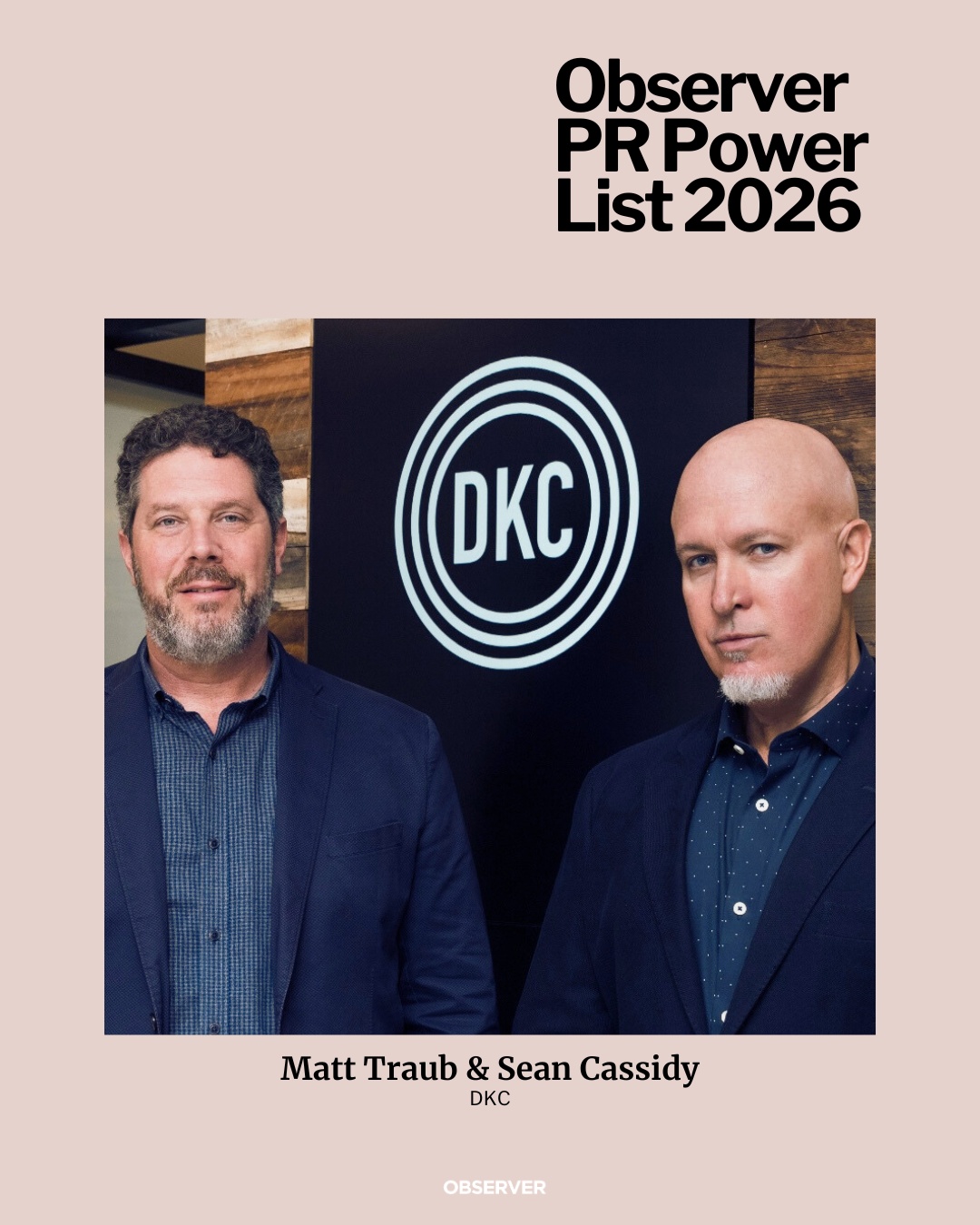
Meanwhile, the agency’s work still includes a much older form of storytelling. DKC’s 2025 campaign for Ken Burns’ The American Revolution followed more than twenty years of work on his films. Coverage ranged across newspapers, magazines, radio and podcasts. The 2026 Observer list placed DKC eighth and reported 10 percent organic revenue growth for 2025, its first full calendar year in ACC.
Those developments place two versions of the future beside one another: tools for understanding algorithmic answers, and years of preparation to bring a historical film to viewers. Cassidy’s career has accumulated both. He entered the business because he could write. He stayed while the audience, the channels and the company changed. The editorial question keeps earning its place: why should someone pay attention?
“One thing that humans seem to still possess...is a pretty good B.S. detector.”
Sean Cassidy, on AI creative and the audience
Keep the conversation going
Interviews, professional profiles and further reading. DKC’s social accounts are listed as company accounts.
- DKC website
- Sean Cassidy on LinkedIn
- DKC on Instagram
- DKC on X
- DKC on Facebook
- Listen: InPeRspective, June 2025
- Listen: Agency Leadership Conversations
- Watch: NYSE TV CEO conversation
- Read: Cassidy on leadership and hiring
- Read: the 2024 ACC announcement
- Read: Observer’s 2026 PR Power List
- Read: ACC Intelligence launches
- Read: marketing predictions for 2026