The sentence arrived in a conference room and landed like a jab. Reed Gusmus had prepared for his presentation to QASymphony chief executive David Keil the way diligent people often prepare when they are not yet sure what matters: he brought everything. Slides. Rows. Columns. Bullets. Background. Context upon context. Keil stopped him and asked, “Reed, what’s the point of this slide?”
It happened again. And again. Gusmus later wrote that he sometimes left those meetings feeling as if he had gone nine rounds in a boxing ring and lost. The sting was useful. What he considered helpful context was clutter; what looked complete to him was making the audience work too hard. The question became a running joke among the marketing team, then a farewell present: a Photoshopped image of Keil bearing the line that had interrupted so many decks.
Years later, as chief marketing officer at master data management company Profisee, Gusmus still carries the question. It has become a compact test for executive work: What matters? Why does it matter? What should happen next? His advice is blunt enough to fit on a slide: speak in headlines, begin with the answer, and remove anything that does not help the decision.
“Every slide should have a headline that makes a point. Not just a topic. A takeaway.”Reed Gusmus on executive communication
A career assembled channel by channel
Gusmus did not begin with a sweeping C-suite remit. His public work history starts with an account-management role at Bank of America and freelance assignments while he studied management at Kennesaw State University. The freelance list reads like an early digital marketer’s crowded workbench: search optimization, paid search, web design, marketing videos, photography and strategy. He learned the channels before he led the system.
Roles at Best Pick Reports, ClickMedia and PGi followed. Search became pay-per-click, pay-per-click widened into digital marketing, and digital marketing opened into demand generation. At QASymphony, an Atlanta software-testing company, the constraints sharpened the job. There was little brand awareness, a limited budget and an expectation to produce leads and revenue anyway.
Gusmus described the response as comprehensive and scrappy. The team used multiple channels, tracked what worked and chased quick wins without confusing a tactic for a strategy. His former colleague Jeff Perkins later wrote that roughly 70% to 80% of QASymphony’s new-business revenue was marketing sourced, crediting Gusmus with running the lead-generation program. A colleague’s recommendation on Gusmus’s profile is more specific still: the business grew from $1 million to $10 million in annual recurring revenue within two years, with Gusmus’s digital marketing and lead generation helping drive the climb.
The work earned tangible recognition. QASymphony’s “Ditch and Switch” campaign received a Gold Stevie in 2017 for a software and apps marketing campaign. The team had also received an ON24 award for on-demand webinar performance. Awards are tidy artifacts; the operating principle underneath them is messier and more transferable. Gusmus kept returning to a balance between creative invention and analytical discipline. An idea earns attention. Measurement decides whether it earns another dollar.
He brought editors a first draft
At Profisee, where Gusmus moved through demand-generation and vice-president roles before becoming CMO in 2022, another stalled room produced another lesson. Strategy sessions with his marketing leaders kept circling. The people were capable and opinionated, but motion was scarce. A work-style exercise supplied an explanation: every leader on the team showed a strength in discernment, the habit of evaluating, refining and finding holes.
Gusmus, by his account, is energized by invention and galvanizing. He generates ideas and rallies action. Discernment frustrates him. He had, in his memorable phrase, assembled a formidable group of “editors” and asked them to write the first draft.
So he changed the material rather than blaming the meeting. He began arriving with a strawman, a draft plan or a deliberately unfinished idea. The discerners now had something to test. His invention did not need to masquerade as a finished answer, and their skepticism no longer felt like a brake. It was the mechanism that sharpened the work. The room began to build instead of stare.
The meeting fix: Map what energizes the team. Bring an artifact suited to those strengths. Let inventors originate, discerners refine, galvanizers move and finishers close.
There is a pleasing modesty to the solution. Collaboration is often discussed as if putting smart people together completes the job. Gusmus’s experience suggests that the shape of the unfinished work matters just as much. A blank page flatters nobody. A rough proposal gives disagreement a surface.
The business of making records agree
Profisee gives Gusmus a product whose premise rhymes with his communication lesson. Large organizations collect versions of customers, products and suppliers across many systems. Names differ. Records duplicate. One department’s trusted answer conflicts with another’s. Master data management reconciles those fragments into governed records that analytics, operations and software can use.
In a Microsoft customer account, Gusmus described the aim as building a trusted foundation of an organization’s important data. The corporate language is technical, but the problem is familiar: too much information can obscure the answer. A presentation needs a point; an enterprise needs to know which record is real.
That work has moved closer to artificial intelligence. Profisee has expanded its Microsoft Fabric integration and introduced AI-assisted data-management features. In fiscal 2026, the company reported a 37% annual recurring revenue compound growth rate and a workforce 20% larger year over year. In August 2026, it reported first-half new sales up 45% from the prior year. The figures belong to the company, not one executive, and Gusmus treated another recent marker in the same collective spirit. When Profisee was placed in the Leaders quadrant of the 2026 Gartner Magic Quadrant for master data management solutions, he wrote that the recognition belonged to everyone there.
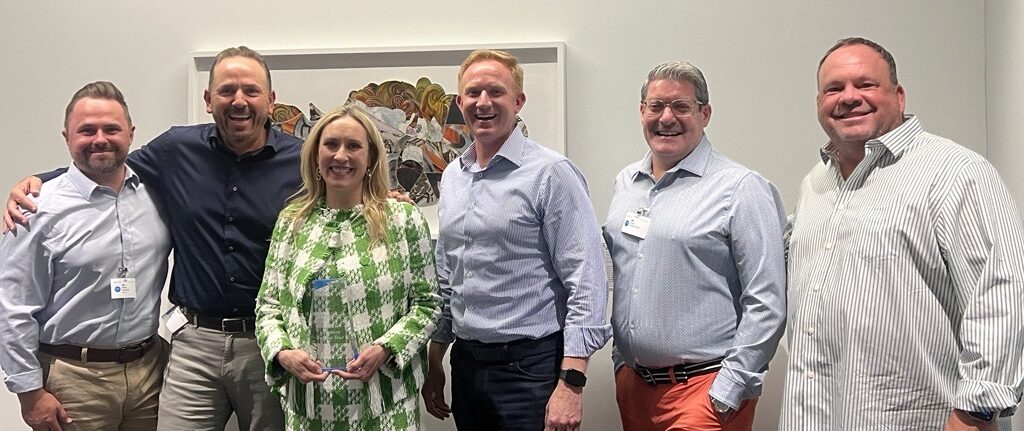
The partnership work has put him in rooms far removed from the freelance projects of 2006. In July 2024, he joined Profisee chief executive Len Finkle and other colleagues at Microsoft’s Redmond campus to present Jessica Hawk with Profisee’s global partner award. Yet the growth from channel operator to company officer is easier to understand as accumulation than reinvention. He learned how search captures intent, how campaigns create demand, how a team turns activity into pipeline, and how a message survives a skeptical room.
The leadership growth curve
Progress keeps its awkward middle
Gusmus’s recent essays are unusually willing to preserve the awkward parts. He has written that he hired too quickly, chose people who looked right on paper but did not suit the team, ignored his instincts and failed to give the process enough care. He has described a period when fixing problems himself felt like good management, until he saw that it created dependency instead of developing problem-solvers.
His alternative is situational. A slipping launch may need direction: reset the scope, name owners, establish the date. A capable employee who has lost confidence may need coaching: questions, patience and the dignity of owning the next move. Gusmus uses a football image, with a nod to Alabama coach Nick Saban. A coach watches from the sideline; taking the ball and running the play for someone else defeats the purpose.
When an overcommitted high performer hit a wall, Gusmus first wanted to reshuffle the workload. He did clarify priorities, including his own responsibility for the confusion. Then he asked harder questions: What are you holding that you do not need? What is driving the overload? What are you afraid to decline? The employee did not need a rescue so much as room to recalibrate. Gusmus reduced the lesson to another clean line: “Management solves the now. Coaching builds for the next.”
“You start. You struggle. You figure it out. You get better.”The cycle Gusmus says returns with every larger challenge
This is his leadership growth curve: begin before feeling ready, wobble, learn, improve and meet the next curve. Experience does not cancel the pattern. A senior executive moving into a smaller company can lose the layers of support that once made competence look effortless. A new manager can discover that being the answer person is a poor way to build an answering team.
Gusmus’s influences make an unlikely shelf. He encountered Ogilvy on Advertising in college and later said he had reread it several times. John Wooden’s Practical Modern Basketball, followed by the coach’s writing on leadership, shaped how he thought about teams. He has also named Paul Allen’s philosophies as a guide. Advertising craft, college basketball and a technology founder meet in the same place: build a system, study what happens, and improve without sanding away imagination.
The point, finally
The simplest version of Gusmus’s story would be a ladder: freelancer, specialist, manager, director, vice president, CMO. The more useful version is a sequence of corrections. Measure the creative idea. Give discerning colleagues a draft they can attack. Stop burying the decision under the work it took to reach it. Know when a team needs an answer and when it needs space.
He closes several essays with “Enjoy the journey,” a genial sign-off after pages spent admitting how uncomfortable the journey can be. The phrase works because the polish does not erase the bruises. The crowded slide remains in the story. So do the hiring mistakes, the stalled meeting and the urge to take the ball.
A career in demand generation teaches a person to notice friction. Where did attention disappear? Why did interest fail to become action? Gusmus has gradually applied those questions beyond the funnel. To presentations. To team composition. To coaching. To the fragmented data beneath a modern enterprise. Clarity, in each case, is less a flash of eloquence than the result of useful subtraction.