Raymond Yip’s first answer to an everyday Hong Kong problem was a marketplace. After years in New York, he had become accustomed to selling unwanted possessions online. Back in Hong Kong, the same errand seemed unnecessarily difficult. He began working with Tony Wong; Fiona Lau joined them. Then feedback exposed the obstacle: they would need buyers and sellers to arrive together. The team changed direction and built tools that let merchants open their own stores. SHOPLINE began with a useful act of surrender.
There is something pleasingly unceremonious about that beginning. The inconvenience survived scrutiny. The proposed solution did not. A merchant could use a storefront without waiting for a new marketplace to become busy. For Yip, the detour put a more immediate customer problem within reach.
He and Wong had each won a month’s membership at CoCoon after taking part in Startup Weekend Hong Kong in April 2013. Yip’s team won for user experience. A free desk is a modest founding monument, but it does have the advantage of being somewhere to put a laptop.

Before the storefront, sneakers
Yip already had a life in technology. His corporate career included Citi and Lehman Brothers, with work spanning New York and Hong Kong. His personal chronology lists a Citi vice presidency in architecture and technology engineering from 2008 to 2014. Large organizations supplied one kind of product experience. His own consumer experiments supplied another.
Among them was Sneakers, a Facebook application built around virtual gifts for sneaker fans. His General Assembly biography describes it as reaching 500,000 hits a day. That is a measure of activity, with all the limitations of a hit counter, rather than a count of people. In 2011 he also founded a mobile social network for sneaker enthusiasts. Another project placed advertising around the words people typed into blog comments.
These are wonderfully specific internet businesses. Shoes that exist as gifts on a screen. A community gathered around the shoes people actually wear. Advertising finding its way into a conversation. Before the merchant software, Yip was already working where an audience, an interface and a business model meet.
His Hong Kong banking schedule still followed New York hours, leaving mornings for experiments. It is an appealingly practical detail. A career change can begin with a period of overlap, with one calendar quietly making room for another.
A pitch is also a product
By 2014, SHOPLINE had a product to explain and investors to persuade. Fiona Lau arranged a meeting with Rui Ma of 500 Startups. Yip took out his iPad and pitched in a café. In his later account, he remembered how unprepared he had been for fundraising: little strategy, few connections, and plenty of questions he could not answer.
The application for the accelerator’s tenth batch included a video. The team devoted a day to it and kept the outtakes. Acceptance brought a flight to San Francisco and another kind of education: learning to explain the business under pressure. Yip recalled practising his Demo Day pitch about 300 times before presenting at Microsoft’s Sunnyvale offices.
For a designer, there is a familiar process here. Put something in front of people. Find where understanding breaks down. Try again. A pitch has users too, although these particular users can decline your business before their coffee cools.
There was a financial lesson as well. The three founders initially contributed HK$30,000 apiece. Yip later described having approached fundraising too much like asking for a favour. He learned to present the product, the team and their ability to execute with more confidence.
Confidence, in this telling, could coexist with rejection. He spoke about repeatedly hearing no and carrying on to the next conversation. That is a less glamorous image than the triumphant funding announcement, and a more useful one: the founder as a person learning how to make his work legible to someone who has no obligation to care.
The checkout has a postcode
The early SHOPLINE proposition depended on understanding the place where a sale happened. By 2015, Yip was describing Taiwan integrations that let shoppers collect packages and pay at 7-Eleven. AllPay was another part of the local payment picture. These details belonged inside the product, where a merchant could use them without assembling the whole arrangement alone.
A convenience store is a good corrective to abstract talk about digital commerce. The order may begin on a screen. The customer still has to receive something, trust the process and pay in a familiar way. A tidy checkout that ignores those steps can be exquisitely designed and thoroughly inconvenient.
“Technology is easy to introduce, but tradition is very difficult to break.”
Raymond Yip, 2015
Yip’s observation makes room for customers to have reasons. In a compact city, buying something downstairs may be perfectly sensible. Online sellers have to work with that reality. The interesting design question becomes how much adjustment a product asks of someone before it delivers any benefit.
This is also what gives the SHOPLINE origin its staying power. A website builder can sound like a collection of features. Seen from a small seller’s side, it can mean getting a business into a form customers can understand and use. The distance between those two descriptions is where much of the work sits.
The classroom after the launch
Yip later co-founded Clickful, an advertising business aimed at companies in Asia. The customer problem had moved further along the same commercial journey: once a business could present itself online, it still had to find people likely to buy.
In December 2017, Clickful held a Facebook advertising workshop at Uptown coworking space. Its follow-up answered questions about managing accounts, making banners and finding audiences. The dashboard was designed around small-business owners with limited time, bringing together creative tools, campaign information and automated optimization.
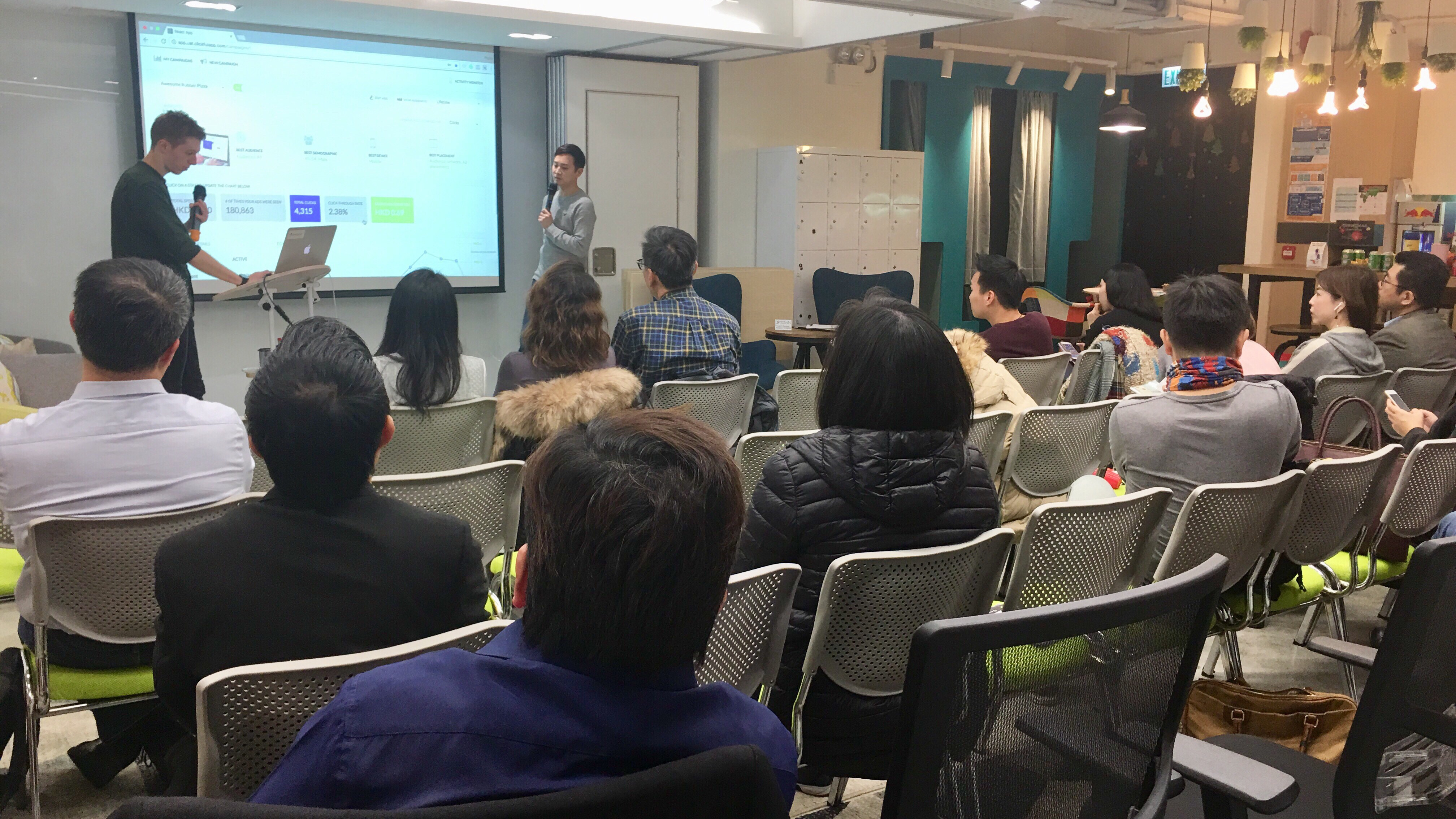
The workshop is a useful glimpse of the work around the software. Someone has to explain what to try, what a result means and when to change course. A dashboard can display an answer while leaving its owner unsure what question to ask next.
There is a consistent small-business sensibility here. Time spent mastering the tool competes with time spent running the business. Teaching, simplifying and choosing what to leave out can all be part of making a product usable. The launch only gets the conversation started.
An investor with a builder’s memory
In October 2018, Yip announced he was joining Zeroth.AI as a full-time partner, investing in and leading accelerator cohorts in Hong Kong. He had experienced accelerators from the founder’s side. Now he would help shape the experience for other companies.
His account of the move contains a small inventory of startup initiation: the first event, first co-founder, first hot desk and first Mac. He joked about covering the laptop with startup stickers. Even professional reinvention, apparently, can have a stationery phase.
He described helping founders through funding and expertise as a continuing motivation. His preferred accelerator analogy was a buffet, with participants choosing the help relevant to their businesses. The image suits someone whose experience crosses design, engineering, fundraising and team building. Different founders arrive hungry for different things.
Mount Parker Ventures subsequently listed him as a venture partner and a mentor to teams at Entrepreneur First and Founder Institute. His ADPList profile also offers design mentorship. These roles put him in conversations where a founder’s immediate problem may be a product decision, a hiring gap or an explanation that fails to land.
That range gives his career an interesting shape. He has occupied several positions around the same table, building products, explaining them and helping other people decide what to build. Each role offers a different view of how an idea becomes a working company.
Still at the drawing board
Today, Yip’s personal biography lists him as lead product designer at Animoca Brands / Open Campus and co-founder and managing partner at Playmaker Ventures. His Hong Kong-based practice also offers freelance design and startup advice to clients internationally.
The public portfolio makes the design work tangible. For Open Campus, he describes work across the main website, EDU Chain, Open Campus ID and an incubator platform. Layouts, illustrations and interfaces sit together, with blue and green isometric artwork giving the different surfaces a shared visual language.

His current process begins with understanding user needs, business goals and constraints, then moves through flows, prototypes, interface design and work with engineering. It is a grounded description of a job that can acquire a great deal of decorative vocabulary.
Read beside the early merchant tools, that process offers a useful way to understand his choices. A shop owner needs to arrange a sale. A founder needs to explain a business. A learner needs to navigate an unfamiliar system. Each brings a task to the interface, and each has a reason to leave if the next step becomes too much work. Across these settings, the designer has to decide what deserves attention, what needs explaining and what can disappear. The finished screen contains only part of that judgment. Much of its value lies in the confusion someone else no longer has to work through.
The founding CEO title remains part of his story. So do the virtual sneakers, the café pitch, the advertising classroom and the design files. Taken together, they suggest a career best understood through the work itself: making an idea clear enough for another person to do something with it.
The marketplace plan changed. The practical question endured. What would make this easier for the person trying to get on with their day?
Follow the work
Explore Yip’s projects, public profiles and conversations.
- Raymond Yip’s design portfolio ↗
- LinkedIn ↗ · Instagram ↗ · Facebook ↗
- His account of the 500 Startups experience ↗
- Watch: SHOPLINE’s accelerator application, with outtakes ↗
- Watch: SHOPLINE at Silicon Dragon, 2015 ↗
- The 2015 conversation with Alexander Leung ↗
- Yip on joining Zeroth.AI ↗
- Playmaker Ventures ↗ · Design mentorship ↗ · SHOPLINE ↗