The expensive part of an online shop can be the smallest change. A sentence needs editing. A promotion needs launching. Someone opens a development ticket, and the retailer waits. In SHOPLINE’s account of its work with Crazy Price Beds, even minor text changes had become entangled in weeks of technical work. A bed seller had acquired a second occupation: supervising software.
That is a useful place to start with SHOPLINE, a company selling the machinery behind the buy button. The storefront is visible. The inventory records, recurring payments and customer conversations are where a business can lose an afternoon. SHOPLINE’s commercial proposition is to bring more of those jobs together, making a growing retailer less dependent on a collection of separately maintained tools.
The marketplace they walked away from
The company began with a different idea. After moving from New York to Hong Kong, co-founder Raymond Yip found selling personal belongings online surprisingly awkward. He and Tony Wong started working on a mobile marketplace; Fiona Lau joined on the business side. Feedback exposed the familiar difficulty of recruiting buyers and sellers simultaneously. They redirected the project toward tools that helped merchants establish their own shops.
In a 2014 interview, Yip emphasized mobile use and local selling habits. The useful lesson is the change in unit of value: a merchant could benefit from store-building software without waiting for a new marketplace to attract a crowd. SHOPLINE could sell a capability that worked for one customer at a time.

The subsequent expansion gave that local starting point an international reach. Founded in 2013, SHOPLINE is now headquartered in Singapore. Its corporate history records entry into Australia, Britain, the United States and Japan in 2023. The company says more than 600,000 merchants have used its services. That describes a footprint; it should not be read as a disclosure of current paying subscribers.
Outside capital helped finance the journey. SHOPLINE joined the 500 Startups accelerator in 2014, received Alibaba Entrepreneurs Fund backing in 2016 and announced a $20 million strategic investment from JOYY and Engage Capital in January 2020. Its investor announcement then described a team of 300. Today’s company profile puts staffing at approximately 2,000.
A customer does not shop in departments
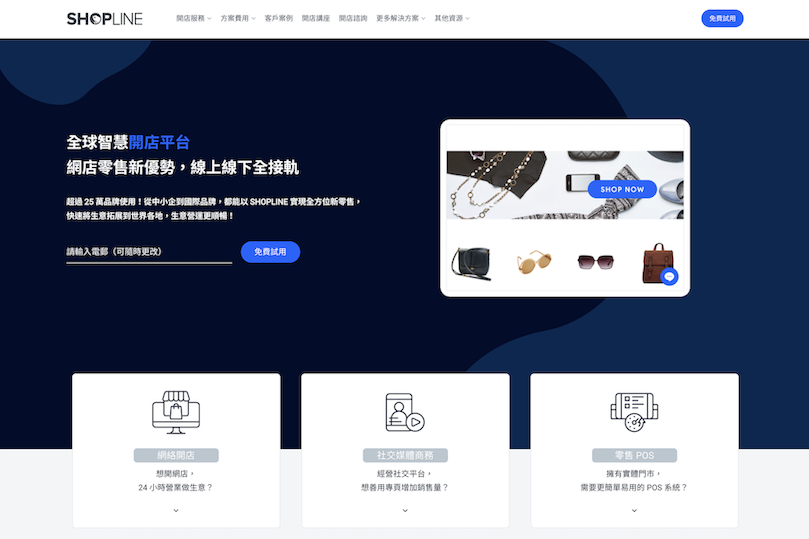
SHOPLINE combines a hosted online store with point-of-sale, customer management, marketing and other retail tools. A brand can build a site, organize products, accept orders and connect physical retail. Its marketplace connector covers channels including Amazon, Shopee and Lazada. The underlying ambition is straightforward: wherever the sale begins, the people fulfilling it should be working from coordinated information.
Website02
Store03
Social
Social commerce gives this proposition a particular accent. SHOPLINE supports livestream ordering through keyword comments, along with centralized conversations across supported messaging channels. Its WhatsApp integration allows teams to work on the same customer conversation without duplicating it. A viewer’s interest becomes something a merchant can process, rather than another message to remember after the broadcast ends.
For wholesale sellers, a dedicated application adds quantity-based price tiers and ordering controls. For repeat purchases, SHOPLINE Subscription offers adjustable delivery schedules and customer self-management. Those are different commercial jobs: a bulk buyer negotiating quantities does not behave like a household replenishing a cupboard. A useful platform must accommodate both without turning every variation into a development project.
The bed retailer’s escape hatch
Crazy Price Beds supplies a concrete example of the tradeoff. SHOPLINE’s published case describes an unwieldy BigCommerce-and-custom setup. Agency proposals for a migration mostly exceeded $1 million and ran to eight to 16 months. The retailer chose an in-house migration using native features, existing apps and APIs, and reportedly went live in one month.
The same account reports a 25 percent conversion increase during Easter 2024, 25 percent lower software costs and 30 percent savings on internal technology expenses. Those are customer-specific, vendor-published results. The agency estimates were proposals, not the amount the retailer ultimately spent. What readers can copy is the scope decision: identify which requirements deserve custom work before paying to reproduce the entire old system.
Crazy Price Beds’ reported results in SHOPLINE’s case study. Different cost categories; these percentages should not be added together.
Chili oil makes a better software demo
Hot Boi Chili Oil puts a smaller business in the frame. The Vietnamese-inspired chili-crunch brand moved from Shopify looking for easier merchandising, subscriptions and marketing connections. Its SHOPLINE case describes bundles, customer-managed delivery schedules and SmartPush communications. The attraction was practical for a lean team: keep selling jars without making the integration list somebody’s full-time responsibility.
Seattle Gummy Company approached from another direction. Its WooCommerce setup had accumulated plugin and subscription-management complexity. After migrating, the company described easier subscriber self-service and less technical effort to make changes. SHOPLINE’s account reports a 58 percent decrease in subscription churn within five months. That result is specific to the merchant and period, rather than a forecast for the next brand through the door.
“Shopline has given us a much more reliable foundation to grow on.”
Brad Fitch · Seattle Gummy Company
In SHOPLINE’s customer case study
The common thread is operational. These businesses already had products and customers. Software was becoming harder to manage as the commercial model grew more complicated. The cases suggest that SHOPLINE’s strongest competitive argument is often about reducing coordination work. Whether it beats Shopify, BigCommerce or WooCommerce depends on which integrations and workflows a particular merchant actually needs.
The price tag has several layers
The global pricing page lists monthly subscriptions of $29 for Starter, $79 for Essential and $269 for Premium, with enterprise quotes available. Listed third-party transaction fees are 2 percent, 0.8 percent and 0.5 percent respectively. Local plans and payment arrangements matter, so these figures are a starting point for a comparison.
Consider an illustrative merchant processing $10,000 a month entirely through transactions subject to those fees. Starter’s subscription plus the listed platform fee would be $229; Essential’s would be $159. This calculation excludes payment processing, tax and apps. The lesson is arithmetic: a cheaper subscription can produce a higher combined bill.
Paid extensions add another layer. SHOPLINE’s Web Push documentation sets a $99 monthly or $990 annual price from March 31, 2026. A buyer comparing platforms should therefore count the tools a real operating day requires. Email volume, specialist functions, implementation work and staff time deserve space beside the headline subscription price. Replacing software has a cost even when the replacement simplifies life later.
First, make the pictures load
SHOPLINE’s own infrastructure history offers a less glamorous explanation of its expertise. Image-rendering latency was a problem as the business expanded. It added Google Cloud to its multicloud architecture in 2017, using its network and infrastructure for image services and BigQuery for analytics. The published Google Cloud case reports a 50 percent reduction in image-display latency on Taiwanese ecommerce sites.
Engineering director Ronald Li described the cloud approach as central to expansion. The more useful detail is the sequence: find the slow, visible part of the shopping experience, change the infrastructure supporting it, then measure the difference. A product photograph that arrives late is a retail problem as well as an engineering metric.
The human organization had its own scaling questions. In a 2017 interview, Lau emphasized proactive communication and trust as the team grew. She described joining team discussions rather than waiting for reports. That historical account connects the management philosophy to the product challenge: when many people must coordinate a merchant’s operations, delayed information becomes expensive.
AI gets a job description
SHOPLINE’s newer announcements apply AI to familiar retail tasks. In May 2026, its Taiwan operation presented an AI retail report and official Model Context Protocol connectivity, alongside plans for tools addressing customer retention, marketing performance and operational insights. The regional announcement describes a product direction; it is not proof that every capability is available in every SHOPLINE market.

By early September, its global blog was highlighting ChekOut.ai for conversational commerce and Papermap for AI-assisted data analysis. These partner stories show where the company is directing attention. The sensible test remains a merchant’s task: answering a product question, understanding an order pattern or deciding which customers need attention.
For a buyer, a demonstration should include the awkward cases. Sell the last unit through one channel, then check the others. Change a subscription. Process a return. Ask who maintains a specialist integration. SHOPLINE’s YouTube Shopping documentation, for example, specifies channel eligibility and module prerequisites; adding a connection is not the same as qualifying to use it.
An integrated platform is less persuasive when a merchant depends on unsupported local services, deeply bespoke workflows or features whose migration costs exceed the expected savings. The decision belongs at that level of detail. SHOPLINE’s most credible promise is a working day with fewer handoffs and fewer repairs. A merchant should be able to see exactly which ones disappear.
Open the shop, inspect the machinery
SHOPLINE website ↗Plans & pricing ↗Company blog ↗News ↗Developer center ↗GitHub ↗LinkedIn ↗Twitter / X ↗Facebook ↗Instagram · Taiwan ↗
▶ Watch: SHOPLINE Live / Facebook ordering demoPublished January 2021 · historical product demonstration