Barry Shaked once said that running another startup would disappoint him. After leaving Retalix, the retail software company he had spent most of his working life building, he thought he might prefer philosophy. This was a respectable plan. Philosophy has many unresolved questions, but comparatively few customers waiting for a software update.
By 2014, he was co-founding Tabit with Nadav Solomon. The new company would make software for restaurants. Shaked had returned to the food business, although the food itself was still somebody else’s department. His concern was the machinery around the meal: taking an order, getting it to the kitchen, keeping the operation connected and settling the bill.
There is a familiar temptation to explain a career like his through the eventual transaction. Retalix became a public company, then an acquisition. Tabit attracted investors and expanded abroad. Yet the smaller details are more revealing: a scooter carrying cash registers, a retirement gift made from employees’ photographs, a golf game that became part of a negotiation. Shaked’s working life is full of people trying to get something done together.
A basement, a scooter, a checkout
His first business had an unusually literal delivery problem. In 1982, while attending Bar-Ilan University’s Computer Science School, Shaked began programming cash registers. He worked from a basement on Shadal Street in Tel Aviv and returned the programmed machines to customers on the back of a scooter. The software travelled with hardware and a rider.
The company was called Point of Sale. Its early work involved Datachecker programmable registers. Brian Cooper, a friend and golfing partner who also came from South Africa, joined as a full partner in 1984, taking responsibility for finance and administration. By the following year, the business had seven people. It was a small group working on an ordinary commercial necessity.
Ordinary necessities can travel. Relationships with international equipment companies helped bring the software into stores beyond Israel. The company listed in Tel Aviv in 1994 and later on Nasdaq. What began around the checkout widened into a retail software business serving grocery, convenience and fuel operations. Point of Sale eventually became Retalix.
Customers included Tesco, Publix, BP and Carrefour. These are businesses where the transaction is repeated throughout the day, and where a small obstruction has plenty of opportunities to become irritating. Retail software lives close to that repetition. The checkout has to keep moving whether anyone finds the technology interesting or not.
The retirement with a familiar desk
Shaked left Retalix at the end of 2009. In retirement, his home office reproduced his old workplace, down to the desk, chairs, pens and papers. The setting had changed; the stationery had apparently declined to participate. Employees gave him a portrait assembled from photographs of hundreds of colleagues, a picture of the founder that contained the people who had worked with him.
He spoke about wanting time away from business and about the possibility of studying philosophy. Golf took up some of the newly available space. The prospect of another startup sounded, to him then, rather too much like continuing what he had already done. A different subject might offer a different kind of achievement.
That interval matters. NCR completed its acquisition of Retalix on February 6, 2013, several years after Shaked’s departure. Its completion announcement put the transaction value at approximately $650 million. The company he founded had acquired a life beyond his tenure. The next venture would require a fresh decision to begin.
“I was hungry to get back into the food business.”
Barry Shaked, on returning after Retalix
His explanation for returning was pleasantly straightforward: he missed the food business. There was no need to manufacture an entirely unfamiliar identity. He could bring what he knew about commercial software into a setting with its own rhythms, frustrations and people. This time, a customer might be waiting for the main course rather than standing beside a shopping trolley.
The other founder knew the dining room
Solomon supplied an important part of that change of setting. He had run a restaurant before serving in the Israeli Navy, later studied food engineering at the Technion and worked as a consultant. Shaked brought experience building retail systems. Solomon understood the restaurant from inside its working day. The combination gave Tabit two different views of the same operation.
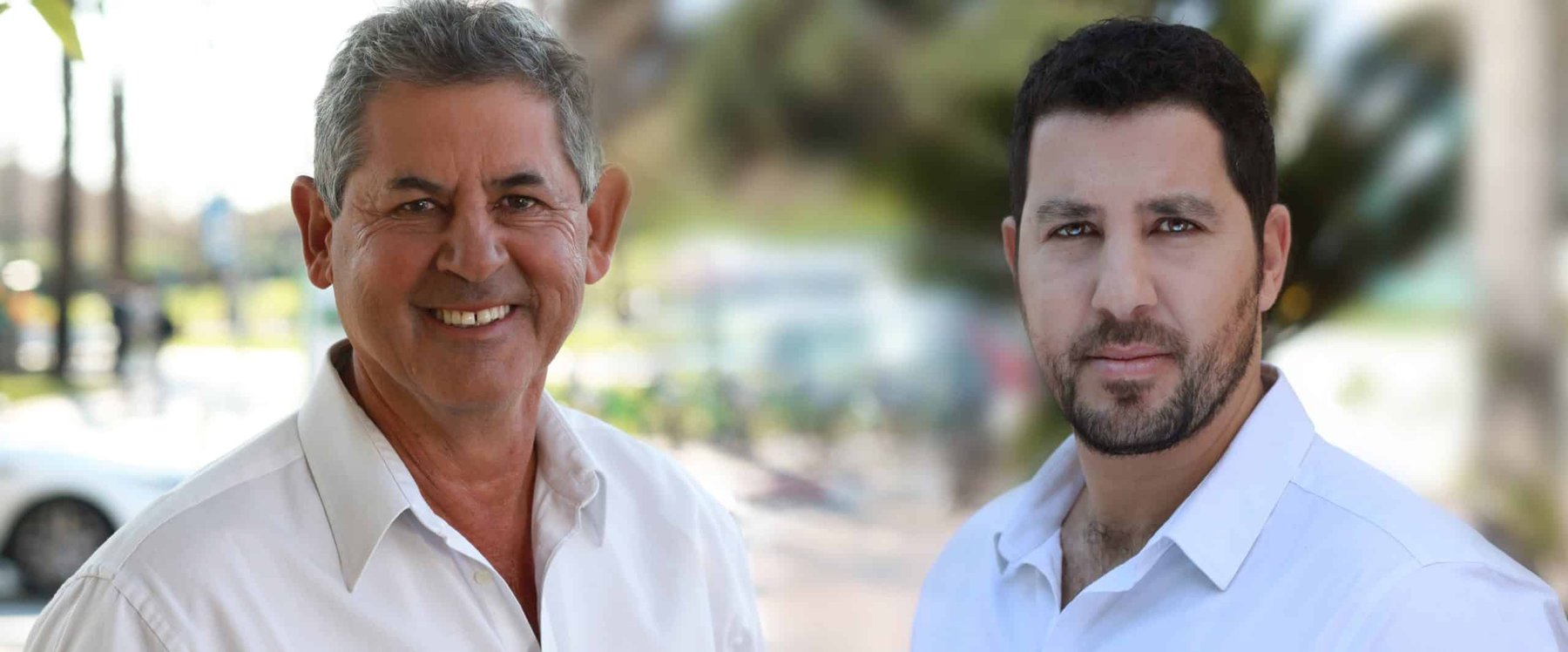
They founded Tabit in 2014. The practical question was easy to picture. A server writes down an order, walks to a register, enters it again, checks something with the kitchen and eventually makes another journey to arrange payment. A restaurant can contain a remarkable amount of travel without anybody leaving the premises.
Tabit was built around mobile devices and a shared platform. Servers, kitchen staff, managers, hosts and customers could interact with connected parts of the operation. Tablets and smartphones became working tools rather than additional screens attached to a desktop routine. The premise asked the software to follow the work through the restaurant.
Order→Kitchen
Prepare→Payment
Settle
Connected operations, with management visibility across the venue.
The distinction matters for a founder with Shaked’s background. Knowing supermarket software gave him experience of transactions and demanding customers. A restaurant still required attention to different behaviour. A table is occupied over time. Orders arrive in stages. People change their minds. The computer has to accommodate dinner.
Investment followed the operating proposition. In April 2020, Tabit announced a $35 million Series B round led by Vertex Ventures Israel, Pitango Growth Fund and Harel, taking its disclosed funding at that point to $65 million. The stated use included expansion in the United States. These were company resources for the next stage, rather than a personal scorecard for its founder.
For Shaked, the partnership also supplied an answer to the problem of starting again. Experience can make a new company seem familiar before its customers have had their say. Working with someone whose background included running a restaurant placed a different kind of knowledge beside his own. A checkout and a dining room both collect payments, but nobody expects a supermarket queue to linger over dessert.
A classroom with a putting green
Golf is the other recurring setting in Shaked’s story. It connected him with Cooper long before Tabit, and it became something he taught as well as played. At the Interdisciplinary Centre Herzliya, his Business and Golf course paired classroom discussions with actual lessons on the course. Prospective business partners could be considered alongside the practical difficulty of hitting a small ball.
Shaked described the game as a way to observe character: how people treat rules, approach risk and conduct themselves when somebody else is watching. It is an appealing educational arrangement. A presentation allows considerable rehearsal. A missed shot is more likely to produce an unscheduled response.
He also recalled a 1994 negotiation with a UK supermarket in which a pricing gap of more than $100,000 was taken onto the golf course. Winning presented a delicate possibility: could beating the prospective customer cost him the business? He said his side won and still got the deal. The lesson, at least on that occasion, permitted a satisfactory scorecard.
“Bring your golf clubs, not your CV.”
Barry Shaked, discussing Business and Golf
His interest extended to tourism. In 2018, he described wanting more golf courses in Israel, with an eventual ambition of 15. That was a separate aspiration from restaurant software, but it adds a useful dimension to his public life. The game occupied his leisure, his teaching and his ideas about attracting visitors.
Back at the table
By April 2026, Shaked was offering Australian hospitality operators a set of practical questions for choosing mobile systems. Could the technology ease staffing pressure? Help staff make relevant suggestions? Show where errors occur? Support relationships with guests? Connect the venue? The questions placed the working restaurant ahead of the product demonstration.
There is a demanding standard hidden in that approach. A system can contain a feature without making anybody’s evening easier. Staff have to know how to use it. Information has to arrive where it is needed. Managers need to understand what the numbers mean for the next service. Buying the equipment is only one part of changing the routine.
In May 2026, Fiserv announced an exclusive Clover partnership with Tabit to launch Clover Reserve powered by Tabit. The offering addresses full-service and fine-dining operations, including course pacing, floor management and tableside checks. Opening, changing, splitting and closing a bill are all part of the service process it is intended to support.
Fine dining makes the timing question particularly visible. A payment tool sits inside an evening with its own pace. The course sequence, the table and the kitchen have to remain in agreement. These are the kinds of operational details the new offering explicitly addresses. They also explain why the word hospitality belongs beside the word software in the company Shaked returned to build.
The partnership gives the restaurant chapter of Shaked’s career another distribution route. It also brings the story back to a familiar place: the point where a business serves a customer and records what happened. Decades separate the programmed register on the scooter from a handheld device in a dining room. Both have to earn their place during a working day.
Perhaps the philosophy plan was never as far from the eventual job as it sounded. Restaurants present questions about time, attention, cooperation and the difficulty of satisfying other people. Shaked chose to work on them with software. Somewhere between the table and the kitchen, there is usually another journey worth examining.