Noah Glass wanted a cup of coffee. The coffee was downstairs. This should have been a brief story. Unfortunately, everyone else wanted coffee before work, too, and the queue had its own ideas about how Glass should spend his morning. He began imagining a different arrangement: tell the shop what you wanted, pay before arriving, and collect the drink when it was ready. A phone ought to be useful for something beyond explaining why you were late.
In October 2026, more than two decades after that thought began taking shape, his company launched an app that lets people order from hundreds of restaurant brands in one place. Between the coffee line and that launch came South Africa, a surrendered business-school place, a change in who paid the bills, a stock-market debut and a return to private ownership. Saving other people time turned out to be a lengthy occupation.
Coffee, with a side of waiting
Glass founded the business that became Olo in 2005. The iPhone arrived in 2007. Early mobile ordering required customers to accommodate the technology rather more than customers generally enjoy. Go online. Create an account. Connect a phone and a credit card. Configure the things you might order. Then use text messages to call up those choices. Convenience came with homework.
One early experiment near Yale supplied a useful surprise. Panini, included alongside coffee, attracted customers who wanted to collect food without waiting for it to cook. Even an empty counter could conceal a delay. The sandwich made the value of ordering ahead particularly plain: the kitchen could get started while the customer was somewhere else.
That distinction mattered. A coffee queue was the irritation Glass understood personally. Food preparation suggested a wider problem. The useful unit of measurement was becoming the time between deciding to eat and actually getting the food. There was room to improve that interval even when a restaurant was doing everything properly.
Before the software, a pizza route
Glass had already worked on the other side of that interval. At seventeen, in the summer of 1998, he delivered for Pizza Man in Newton, Massachusetts. His first job had been as a convenience-store gas-station cashier. Restaurant work would also include serving and bartending. The founder discussing digital orders had handled the less digital business of getting food to people.
Food was familiar at home in a different way. His mother, Peggy K. Glass, wrote cookbooks and tested recipes on the family. Chocolate-cake weeks were a benefit. Eating at restaurants was comparatively unusual, which helped make restaurants interesting to him. There is a pleasing domestic logic here: a household well supplied with home cooking helped produce a career spent thinking about takeout.
At Yale, he studied political science, played lacrosse and sang with the Baker’s Dozen. He graduated in 2003. An earlier summer at Shutterfly had pulled his attention toward technology products. Watching digital photographs become something customers could order and receive made building things feel like a plausible career. Software could reach into an ordinary activity and change how it worked.
His next education came through Endeavor, the organization supporting entrepreneurs. Helping establish its South African presence brought him to Johannesburg. That put him close to people building companies, and to developers who could turn his ordering idea into a working prototype. A change of geography supplied collaborators that a morning coffee line could not.
The expensive art of being early
Developers Craig Stockden and Nick Dempster helped build the prototype. Investor David Frankel became an early backer. Glass had a place at Harvard Business School waiting for him; pursuing the company required giving up that path. The decision made an excellent origin story. It did rather less to solve the daily problem of persuading people to use the product.
Glass later described early sales conversations in which restaurant brands questioned the premise itself: would people really order food on their phones? Selling required an argument about changing habits before it could become an argument about software. A founder could demonstrate a working system and still encounter a customer who saw no reason for the system to exist.
Meanwhile, the company’s own behavior needed changing. Spending money to attract consumers to a new ordering service was expensive. Supplying technology to restaurant brands offered another route: the restaurant already had customers and a reason to tell them about ordering ahead. The same basic capability could have a different buyer, a different distribution channel and different economics.
“This is probably a better model.”
Noah Glass, on the shift toward restaurant-paid software
Frankel recalled Glass arriving at a board meeting with a comparison between the old money-consuming approach and the new revenue-producing one, followed by that modest verdict. The understatement is part of the charm. When the arithmetic improves, a founder does not always need a trumpet.
Glass places the company’s move into profitability at the end of 2012. The early team was small, and the work had gone on for years. By 2013, he describes a different problem: demand had begun exceeding the company’s ability to supply it. Persistence had included changes to the business, rather than simply repeating the original pitch with greater conviction.
- 2005Text an order
- 2012Reach profitability
- 2021Ring the NYSE bell
- 2025Return to private ownership
- 2026Launch the Olo App
A bell, then another beginning
On March 17, 2021, Olo began trading on the New York Stock Exchange. It raised $450 million, selling eighteen million shares at $25 each. Glass stood at the bell with the company’s name behind him. Sixteen years separated that photograph from the founding. A ceremony can compress a great deal of unphotogenic work.
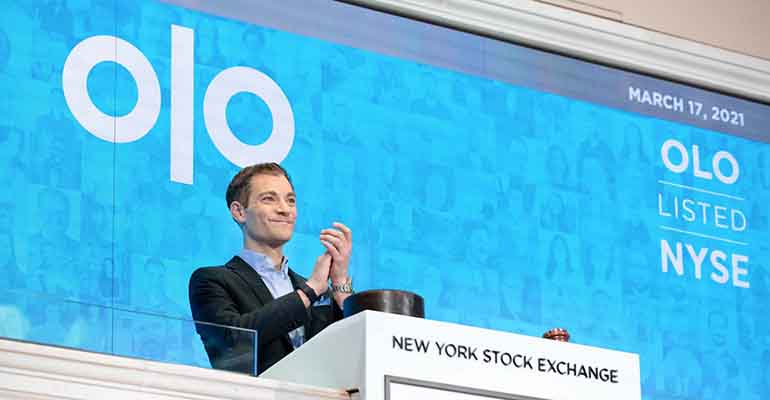
For Glass, being public also had a practical meaning. Restaurants were building operations around Olo, and he wanted them to see a durable partner. Reliability has a different weight when software sits between a hungry customer and a working kitchen. A restaurant cannot ask the lunch rush to return after an investor presentation.
Public ownership lasted until 2025. On September 12, Thoma Bravo completed an all-cash acquisition valuing Olo’s equity at approximately $2 billion. The shares stopped trading. Glass continued as founder and CEO. The change brought a new owner to an existing company with existing restaurant relationships, rather than an ending to his work there.
The investor relationship also has a longer history in Glass’s career. In 2019, he became a Founder Partner at Founder Collective, joining a program intended to help experienced founders support newer ones. Someone who has spent years explaining an idea before its market arrives has useful company to offer a person doing the same.
The guest behind the transaction
As Olo expanded, Glass’s attention moved beyond whether an order could travel digitally. He became interested in what the restaurant learned when it did. A transaction can carry useful knowledge: what someone ordered before, whether they return, how they prefer to interact. Collected across disconnected systems, those details are difficult to use well.
His argument about direct digital sales follows from that concern. Restaurants can offer ordering through their own websites and apps while also participating in outside channels. The question is what happens to the relationship afterward. Does the restaurant understand the person it just served well enough to improve the next visit?
Glass’s language for the ambition is hospitality. The aim is to help more people receive the recognition a regular gets. At scale, memory needs assistance. His company now supplies ordering, payments, marketing and guest-data tools, among other products. The technical breadth circles back to an experience anyone who has a favorite lunch spot can understand.
There is a human boundary to that ambition. Glass has described wanting technology to support staff in the moments that involve welcoming and serving people. An employee handing over an order still has something to contribute. Removing repetitive work can create room for attention. Whether that attention actually reaches the guest is the test that matters at the counter.
His wider commitments stay close to the restaurant world: Portillo’s board, the Culinary Institute of America’s trustees and Share Our Strength. The last connects his professional community with No Kid Hungry. Ordering food and supporting access to food sit alongside one another in that part of his work.
Back to the first idea
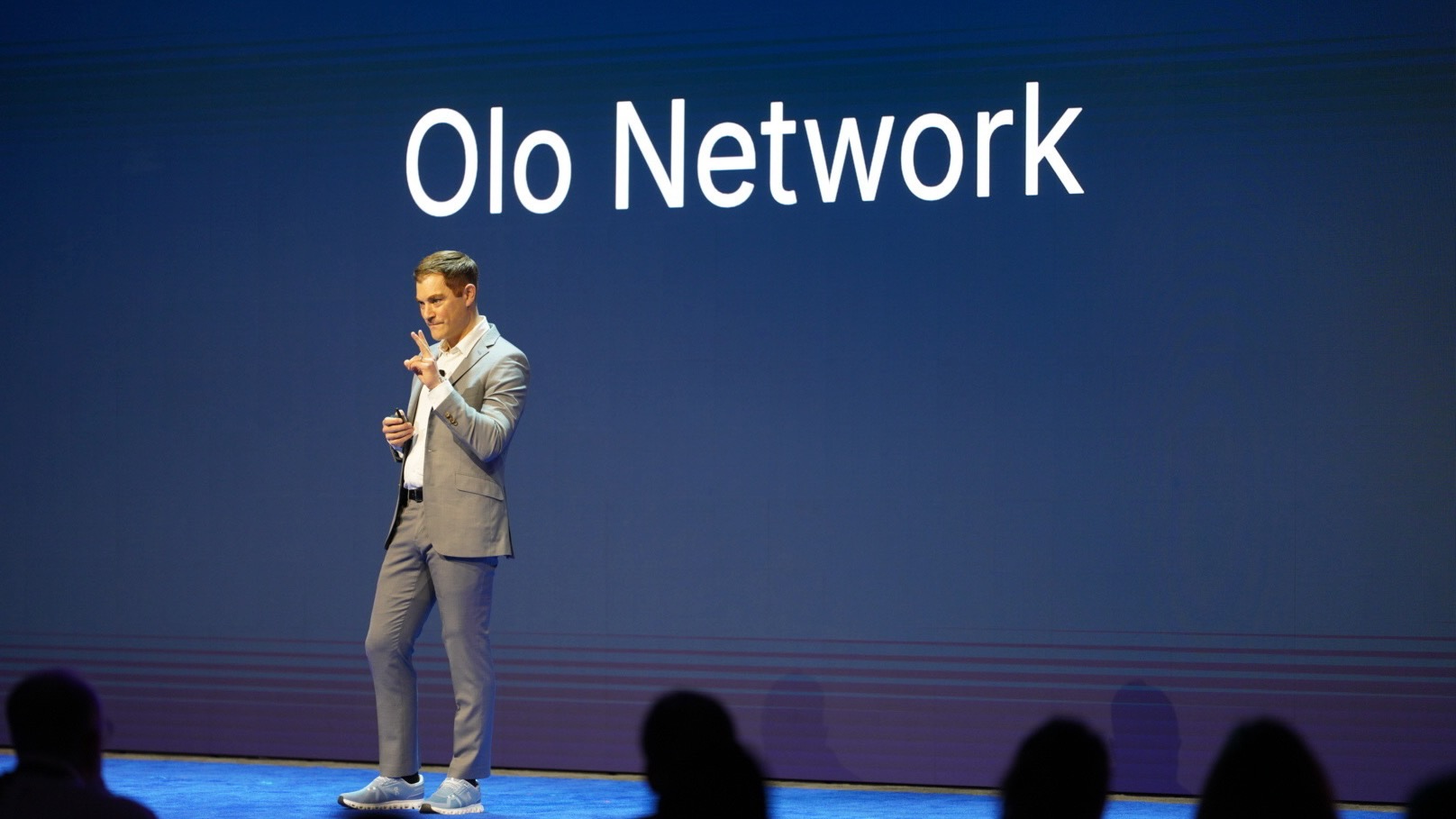
Olo introduced its Network plans in March 2026. On October 20, the consumer app arrived with more than 250 national and regional restaurant brands. Customers could follow restaurants, browse and order through a shared experience. Olo says the app avoids menu-item markups; restaurants retain their guest relationships rather than handing them over to a commission-based marketplace.
The company reported a broader platform serving more than 800 brands across 90,000 locations at launch. Those figures describe Olo’s overall business, rather than the smaller set initially available in the app. The distinction explains something about the long route: years of restaurant infrastructure now sit underneath a product presented directly to diners.
Glass also sees that network as preparation for ordering through AI assistants. A request for lunch may eventually begin somewhere other than a restaurant website or a delivery app. His concern is that restaurants should remain connected to their guests when the starting point changes again. It is a new interface for an old preoccupation.
He has kept a Day 1 mentality and a less polished team motto: “Embrace the Suck.” Both fit a career in which the obvious modern convenience arrived through awkward earlier versions. The coffee line supplied the question. Panini, restaurant customers, developers, investors and years of revision helped supply an answer. Now Glass is asking diners to try another version of the shortcut. Lunch, at least, should arrive sooner.
Keep the conversation going
Profiles, conversations & further reading