Raymond Wu remembers a winter arrival in Beijing in 2003. He had finished his first semester of college and was visiting relatives. Outside the aircraft was a grayness dense enough to obscure the neighboring planes. At first it looked like fog. The smell, carrying exhaust and something like scorched metal, suggested otherwise. Dust covered the vehicles parked at the airport. This was a homecoming with an unwelcome change of scenery.
Born in China in the 1980s, Wu had moved to the United States in the following decade. His childhood memories included bicycles, low buildings and blue skies. Returning to China let him see its transformation at intervals. That airport visit became a reference point he would return to when explaining why he started WYND. “I’m trained as an engineer,” he wrote. He began thinking about making the contents of the air measurable.
The company came years later. First came the business of studying other businesses. Wu worked at McKinsey, then became a principal at technology investment firm Silver Lake. In 2014, he left investing and co-founded WYND. The professional direction changed: he would now have a product of his own to explain, finance and get out into the world.
Before the product, a room full of people
An engineering degree can explain an interest in sensors. It explains rather less about persuading people to gather around an unfinished idea. Wu had practiced that part, too. At MIT, where he studied electrical engineering and computer science, he co-founded the MIT Tech Fair, later known as TechX. The event brought companies and their technology to campus. It was an early exercise in making technical work visible to an audience.
He also co-founded Emporium Technologies, a marketplace connecting students. WYND therefore followed an earlier attempt at building a business, rather than appearing as his first encounter with entrepreneurship. His background included engineering work at Bose and Broadcom. Across those roles, there were circuits, customers and organizations to understand. The range matters more than a tidy description of him as either a finance person or a hardware person.
Wu’s speaking biography adds a less predictable detail: he fenced saber at MIT. Away from work, he has listed soccer, camping and karaoke among his interests; a podcast biography also mentions basketball. There is a welcome amount of movement in that list. His public introduction even makes room for a goldfish. An executive biography need not resemble the inventory of a filing cabinet.
- MITEngineering + student ventures
- McKinseyConsulting
- Silver LakeTechnology investing
- 2014 / WYNDBuilding the business
A small machine with a second job
WYND’s early proposition was deliberately portable. Its June 2016 launch introduced a purifier small enough to accompany its owner, with a detachable tracker that could measure particulate levels independently. A clip let the tracker travel separately. Bluetooth connected the system to an app, and an automatic mode adjusted the purifier using the sensor’s readings. There were two jobs inside the proposition: change the immediate environment and show what was happening in it.
That combination had practical consequences. A person could see readings rather than rely entirely on a reassuring whirr. The purifier and tracker could work together, while the tracker retained a use away from the main device. Portability shaped both pieces. A large monitor tethered to a small purifier would have made an awkward traveling companion, rather like packing a grandfather clock to check the time on holiday.
The development process was more crowded than a lone-inventor story suggests. Wu has described making more than 50 prototypes for beta users and using their feedback to improve the design. His team initially sought an existing sensor, then decided to make its own when the available choices did not fit its requirements for size, cost and accuracy. That decision added engineering work. It also made measurement part of the company’s own technical foundation.
“we invented our own”
Raymond Wu, on developing WYND’s sensor
The rocket connection has names
Two of Wu’s colleagues help explain how that foundation took shape. Co-founder Jason You had worked on sensors used around the launch pad at Kennedy Space Center. Hardware engineer Eric Munoz brought experience in fluid mechanics from work on rocket engines. At WYND, those backgrounds met a considerably smaller object. The engineering questions concerned moving air efficiently and measuring it reliably in a portable package.
You’s familiarity with calibration included an appreciation of temperature, humidity and other conditions that could affect a sensor. Munoz’s experience concerned the way air moves through a system. Neither contribution fits neatly into the decorative phrase “space technology.” The connection was the people’s prior work and what they knew how to do. Wu’s part was helping turn the team’s prototype into something that could be sold.
It is an instructive detail in his career. The investor-turned-founder did not arrive with every specialty in his own hands. A product brought together different kinds of experience, with specific people responsible for specific problems. In a compact object, the collaborations were largely hidden. The customer saw a bottle-sized machine. Behind it were decisions about airflow, sensing, manufacturing and how much complexity a person should have to deal with.
The orders arrive. Then the work arrives.
By 2018, Wu could describe what had happened after the crowdfunding launch: more than 3,500 orders from over 80 regions in 30 days. He said the team spent roughly two years developing the portable product, introduced its prototype through Kickstarter in mid-2016, and began shipping in mid-2017. The distance between a campaign and a delivered object occupies a modest amount of calendar space. For a hardware company, it contains a great deal of work.
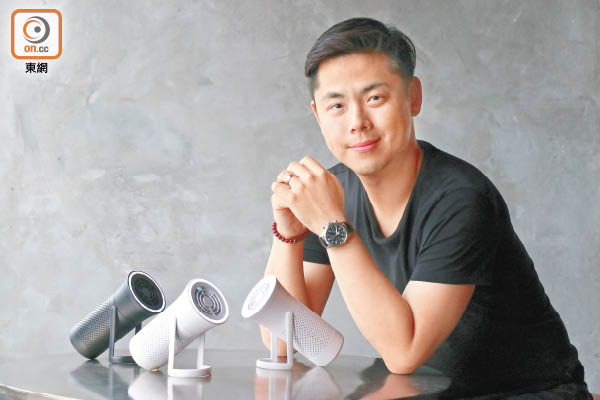
Hong Kong became part of the story through a 2018 partnership with Modus HK. In a press photograph from that period, Wu sits beside a small collection of the devices. The products are tilted on stands, ready to direct their output. There is something pleasingly literal about the scene: the founder has an idea to discuss and several examples sitting on the table. No diagram of an imagined future is required.
Later that year, WYND introduced Halo and a home purifier, extending its attention to larger spaces. Wu described that expansion as a response to the community and to newly developed technology. The company’s footprint in the room was changing. The original device traveled with an individual; the newer pairing addressed the room itself. That progression set up a further question: what would a building operator want the measurements to do?
A property manager wants a timestamp
Sentry, launched in July 2022, gave that question a commercial setting. It was aimed at short-term rental owners who wanted alerts about smoking and excessive noise. WYND had tested it with participating Airbnb hosts and Vacasa rental owners during 2021 and 2022. Wu discussed the costs of lingering smells, extra cleaning and complaints from the next guest. These were the details of running a property, where an incident can interfere with the next booking.
An early prompt came from a host who noticed an unusual amount of smoke at a rental. Wu’s account connected that observation to the development of Sentry. The customer had helped identify another job for the technology. By the launch, Wu was already discussing larger property owners as potential customers. “We are in conversations with big hotels,” he said. The sentence captures a business still moving from a trial toward a broader market.
The appeal of the timestamp is straightforward. An operator needs to know when something happened, which room was involved and whether there is a record to consult afterward. Measurement becomes useful when it fits that sequence of work. This is the through line in Wu’s product history: the sensor’s value depends partly on the next decision someone can make. A reading may begin as a number on a screen and finish as a maintenance task.
The next room on the dashboard
Wu’s 2026 product writing follows that operational direction. A February announcement introduced ClimateGuardian, expanding Sentry’s monitoring to temperature, humidity and chemical pollutants. The advertised uses included spotting equipment problems and unusual conditions, with reports available for maintenance logs and insurance documentation. The company was asking the same installed system to answer more of the questions that arise when someone is responsible for a building.
By August, his attention included apartment noise complaints and resident retention. He described Sentry as measuring sound levels and the duration of a disturbance without recording conversations. The distinction is a product choice with an obvious human consequence: a manager wants a record of a prolonged disturbance, while residents have good reason to care about what a device captures inside their homes. Those two concerns have to coexist in the same small box.
The way Wu describes the company’s work also leaves room for the team. WYND’s stated values include employee ownership, accountability and constant improvement. Those commitments sit alongside the familiar product promises, and they offer a practical standard for the organization behind the hardware. A sensor company needs people who will question an unexpected reading, investigate a problem and improve the next version. The output may arrive on a dashboard, but maintaining confidence in it remains a shared responsibility. That is a demanding sort of promise to make repeatedly.
There is continuity here without a perfectly straight line. Wu began with an experience at an airport, assembled a team, sold a portable object and followed customers into a different set of rooms. The recent writing is concerned with the unglamorous questions that keep a property running: equipment, complaints, timing, records. For an engineer who once made a campus technology fair happen, it is another exercise in bringing something into view. The audience has changed. So has what it needs to see.
Keep the conversation going
- WYND ↗
- Raymond Wu on LinkedIn ↗
- Wu’s writing on Medium ↗
- The original WYND launch video on YouTube ↗
- Shake the Cosmos conversation ↗
- Building HVAC Science conversation ↗
- The portable-device interview ↗
- The 2018 Hong Kong feature ↗
- The team’s engineering connection ↗
- Sentry at launch ↗
- ClimateGuardian announcement ↗
- Wu on noise monitoring in 2026 ↗