He wrote his MIT master's thesis on building cheap, fast satellites. Then he spent the next fifteen years proving the thesis right — one orbit at a time.
In 2011, Ryan McLinko turned in a master's thesis at MIT titled "Structural Design of Low Cost, Rapid Development Satellites." It was, at the time, a research document. By 2026, it reads more like a business plan that generated $2.8 billion.
Astranis, the company McLinko co-founded with CEO John Gedmark in 2015, is now one of the most-watched names in space. Five MicroGEO satellites orbit the Earth. The company holds over a billion dollars in commercial contracts. The U.S. Space Force has named it a prime contractor on three programs. And in May 2026, Snowpoint Ventures and Franklin Templeton led a $450 million Series E — with Andreessen Horowitz, BlackRock, Fidelity, and Baillie Gifford joining — pushing total capital raised past $1.2 billion.
The premise behind all of it? Satellites don't have to be the size of a school bus.
Traditional geostationary satellites weigh several tons, cost hundreds of millions to build, and require years of lead time. Astranis's MicroGEO weighs 350 kilograms — roughly 20 times lighter — and is about the size of a commercial washing machine. It parks in geostationary orbit, locks onto a specific region, and provides dedicated broadband to customers who previously had no access to cost-effective capacity. Alaska. The Philippines. Peru. Thailand. Mexico. Oman. Taiwan.
McLinko has called this the anti-"Battlestar Galactica" approach. One giant, do-everything satellite served big telcos. Astranis's model serves the customers those telcos ignored.
"Even a small satellite in GEO could cover an entire medium-sized country with broadband connectivity."— Ryan McLinko, Co-founder & CTO, Astranis Space Technologies
That observation wasn't just an insight — it was a decade-long project. McLinko started building satellites at Planet Labs, where he led the mechanical and electrical engineering teams and helped design over 100 cubesats. Before that, he was at Sierra Nevada Corporation developing flight control systems for the Dream Chaser, a reusable spaceplane. His internships included stints at SpaceX and United Launch Alliance. By the time he co-founded Astranis, he had touched nearly every segment of the space industry.
Astranis uses software-defined radio — meaning operators can reprogram frequencies and coverage areas on-orbit without touching any hardware. The satellite that connected Alaska in 2023 could, in principle, pivot to serve a different region by the end of the day.
McLinko arrived at MIT in 2005 and promptly did what MIT students do: he joined everything. The Rocket Team. The Mars Gravity Biosatellite project. TALARIS, a team competing in the Google Lunar X PRIZE. He was a member of SEDS — Students for the Exploration and Development of Space — an organization he would later serve as a trustee and advisor.
His master's thesis was not an accident. It was a bet on a specific future: that the biggest barrier to deploying satellites was cost and complexity, and that solving those two problems was worth an entire career. His advisor presumably graded the thesis. McLinko spent the next fifteen years proving it.
After MIT, he joined Sierra Nevada Corporation, then Planet Labs. At Planet, he helped build the foundation of what became a large fleet of Earth-observing cubesats. The work reinforced a conviction: small satellites were viable. But they were also stuck in low Earth orbit, perpetually racing around the planet. For communications, geostationary orbit — where a satellite hovers over one spot — had the advantage. The problem was that GEO satellites were absurdly expensive.
That's the gap Astranis was founded to close. Gedmark brought the policy and commercial network. McLinko brought the engineering architecture. Y Combinator backed them in Winter 2016, when the company was still a hypothesis with a whiteboard and ambition.
"We want to bring the rest of the world online."— Ryan McLinko
The first milestone was a 3U CubeSat demo in 2018, launched aboard India's PSLV-XL rocket, proving the software-defined radio payload worked in orbit. Then came years of building the actual MicroGEO platform. The first commercial satellite, Arcturus — serving Pacific Dataport's Alaska internet customers — launched in early 2023 and exceeded its own throughput specification, hitting 8.5 Gbit/s against a design target of 7.5 Gbit/s.
In December 2024, a dedicated SpaceX Falcon 9 carried four more Astranis satellites to orbit in a single mission — customers lined up included operators serving the Philippines and North American mobility markets. The company now occupies a 153,000-square-foot manufacturing facility in Northern California where a team of 500 engineers designs and builds satellites at a pace traditional primes would find startling.
For McLinko, the engineering challenge has always been two-sided: make the satellite cheap enough to be commercially viable, but capable enough to be genuinely useful. Astranis's software-defined approach is the bridge. Because the radio payload can be reprogrammed from the ground, the satellite adapts to customer needs without hardware revisions. The factory builds the same platform. The software makes it different.
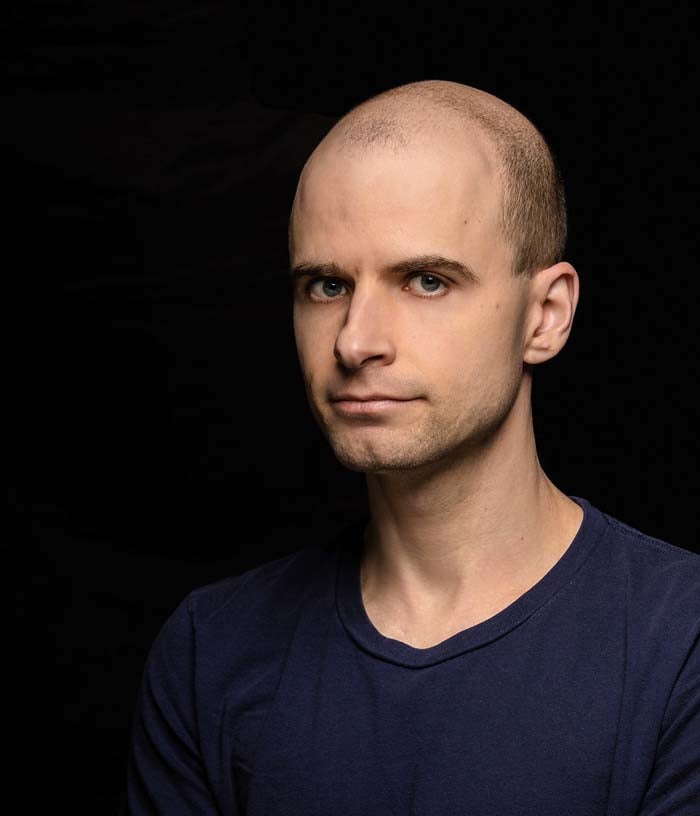
His MIT master's thesis was titled "Structural Design of Low Cost, Rapid Development Satellites." Astranis is the thesis as a company — in geostationary orbit.
Astranis's MicroGEO satellite weighs 350 kg and is about the size of a commercial washing machine. It can cover an entire medium-sized country with broadband from 35,786 km up.
The satellites use software-defined radio — operators can reprogram frequencies and coverage regions from the ground without touching any hardware. One platform, infinite configurations.
Before Astranis, McLinko worked on the Dream Chaser — Sierra Nevada's reusable spaceplane. He's one of the rare founders who has touched reusable spacecraft, cubesats, and GEO comms.
As part of MIT's TALARIS team, McLinko competed in the Google Lunar X PRIZE — an international competition to land a privately-funded spacecraft on the Moon.
Astranis is now a U.S. Space Force prime contractor for Protected Tactical Satcom-Global (PTS-G), Resilient GPS, and Andromeda — a significant defense vote of confidence in McLinko's architecture.
Traditional geostationary satellites are engineered for everything — wide beams, enormous power, decades-long lifetimes. They're designed by committees and built to survive anything. They also cost hundreds of millions of dollars and take years to build.
McLinko's bet was simpler: smaller and dedicated beats larger and general-purpose. A 350 kg satellite launched quickly, serving a specific customer in a specific region, generates returns faster than a multi-ton behemoth. The software-defined radio layer lets that satellite adapt without a second launch. The factory learns from each iteration.
He calls the massive traditional satellite the "Battlestar Galactica approach." Astranis builds the opposite: purpose-built, efficient, and replicable at scale.
The commercial satellite market was the first proof point. But Astranis's technology architecture — small, software-defined, radiation-tolerant, rapidly manufacturable — turns out to map directly onto what the U.S. military wants from its next generation of space infrastructure.
The company is now named Prime Contractor for three Space Force Programs of Record: Protected Tactical Satcom-Global (PTS-G), which provides jam-resistant communications for forward-deployed forces; Resilient GPS, which backstops GPS signals against adversarial jamming; and Andromeda, a classified high-orbit mission.
The $450 million Series E raised in May 2026 is partly aimed at accelerating Astranis's manufacturing capacity to meet this demand. Trinity Capital's $155 million credit facility adds runway for new factory capacity. At a $2.8 billion valuation, Astranis is no longer a startup testing a theory. It is a prime contractor with a fleet in orbit and a backlog that would keep the factory busy for years.
Know someone who'd find Ryan McLinko's story worth reading? Share it.