A guest checks out. The room smells of smoke. The hotel has a policy, a cleaning bill, and a customer who says the smell was already there. In that small triangle of disagreement, the no-smoking sign loses much of its authority. The smoke has dispersed; what remains is testimony. WYND Technologies has built a business around that awkward interval between an invisible event and an expensive argument.
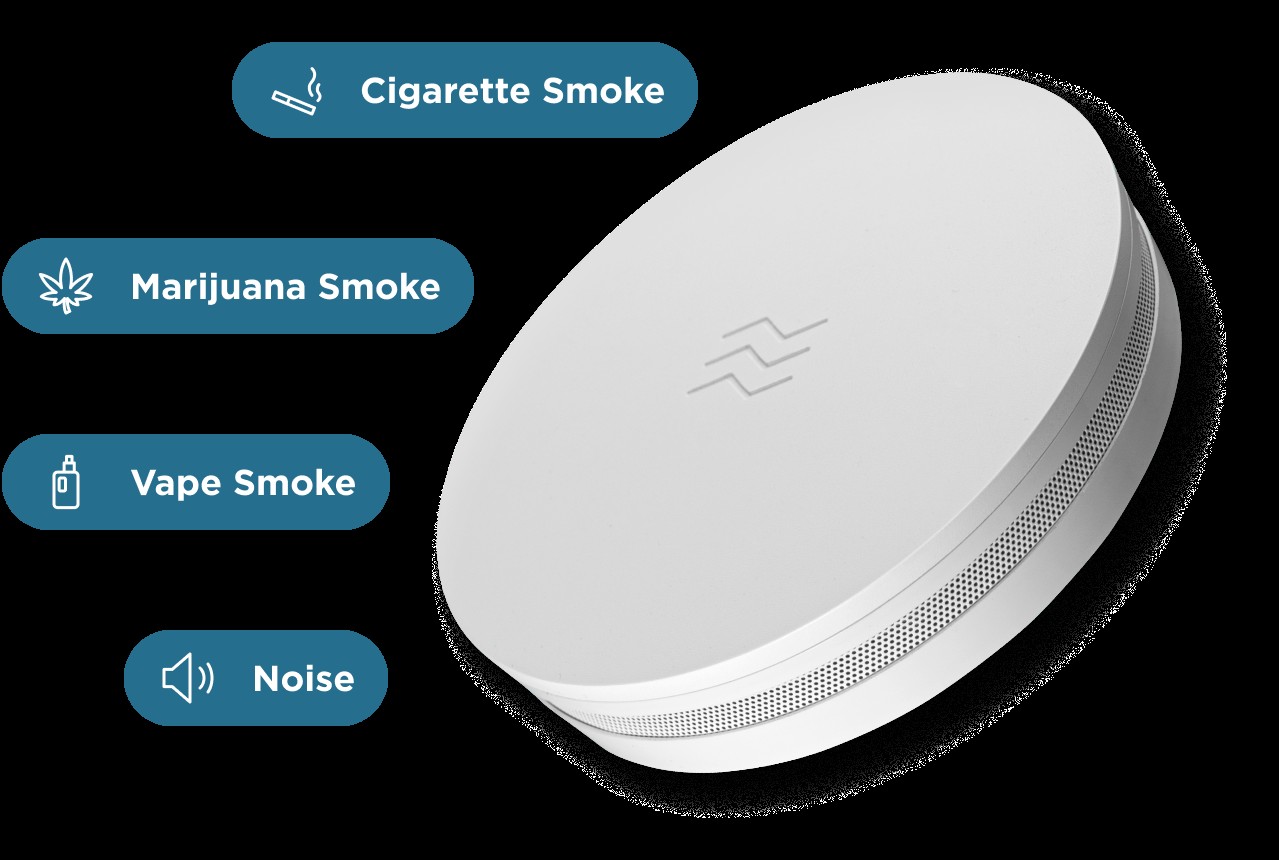
Its Sentry sensor sits in a room and looks for cigarette, marijuana, cigar, or vape smoke. It can also watch noise levels. When it detects a smoking incident, the system sends an alert and prepares a time-stamped report. The product does not clean the air. It gives a property operator a chance to respond while the incident is current, then a record to consult when the complaint arrives later.
In three breaths
- The originFounder Ray Wu’s account begins with the heavy smog he encountered in Beijing.
- The turnWYND moved from a personal purifier into building sensors and property operations.
- The bargainSentry pairs a device with a per-sensor subscription and incident reporting.
First, a bottle of cleaner air
The original WYND looked more like a bottle than a building system. Announced in 2016, it was a portable purifier with a detachable air-quality tracker. Wu had assembled a team with MIT alumni and former NASA engineers after an encounter with Beijing smog made the problem unusually immediate. The early pitch was personal: know the air around you, then filter the patch you occupy.

It was a good object for a photograph. TIME included Wynd in its 2016 inventions list; a crowdfunding campaign had already drawn more than $600,000 against a $50,000 goal. The company raised a $2.5 million seed round that September. This proved appetite for a handsome answer to polluted air. It did not prove that every air problem belonged on a desk.
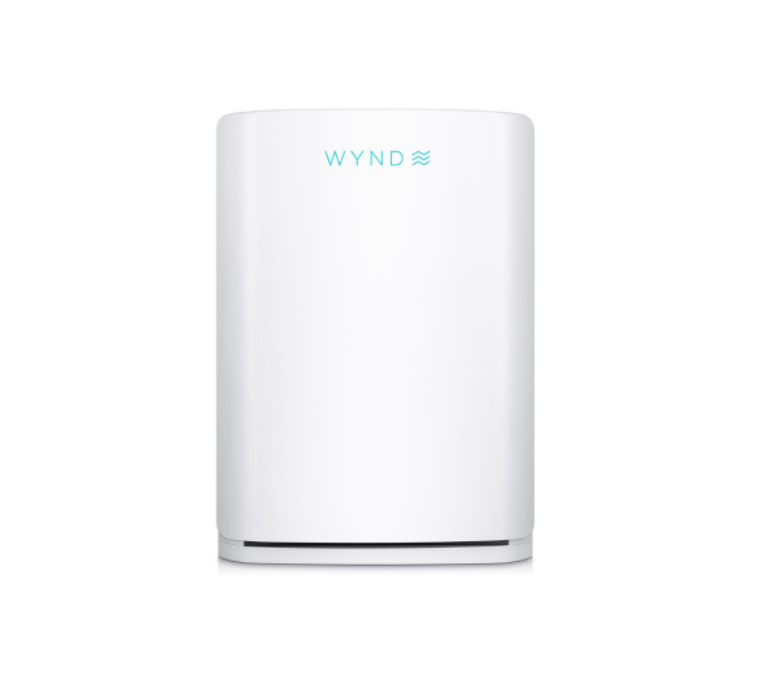
WYND’s later Halo monitor and Max purifier made the system room-sized. Halo tracks a collection of indoor conditions, including particles, carbon dioxide, volatile organic compounds, temperature, humidity, and noise. Max can adjust its fan in response to Halo readings. To a homeowner or facilities team, that pairing offers a straightforward loop: measure, decide, clean. It is the familiar clean-air business, but with a better memory.
A smell is an observation. A report is an argument.
Sentry takes WYND’s sensor expertise into a different office: the front desk, the rental-management dashboard, the housing manager’s inbox. Its airID system is designed to classify recreational smoke rather than merely note a rise in particles. Optional noise monitoring measures sound levels in decibels; WYND says it does not record or transmit conversations. The distinction matters in an occupied room. Operators want to know whether a rule was broken without installing a microphone that stores anyone’s words.
This is where WYND differs from a conventional fire alarm. A fire alarm is there to warn people of a dangerous fire condition. Sentry is there to detect a policy problem - a cigarette, a joint, or a vape - and document it for whoever runs the space. It also differs from a stand-alone noise monitor, which can hear the party but cannot identify the smoke. WYND combines those questions on one device, then attaches the operational machinery of alerts and reports.
“What we breathe matters.”Ray Wu, describing the original Wynd purifier in 2016
One company case study makes the administrative value unusually plain. A Washington short-term-rental host said an earlier smoke claim was denied because there was no evidence. After installing Sentry, the host received an alert, contacted the guest, and later submitted the device’s incident report with a cleaning claim. The platform accepted it, according to WYND’s account. This is a single customer story, and a sensor report cannot guarantee the same result in every dispute. Still, it reveals what the customer actually bought: a timely account of an event that used to evaporate.
The cost of knowing
WYND sells Sentry as a subscription for each device. At its public checkout in September 2026, the annual plan was listed at $180 per sensor, or $15 a month billed yearly, with hardware included. The monthly plan was listed at $50 per sensor with a one year minimum. The company recommends one device for each room a buyer wants to monitor. That detail changes the arithmetic: a hotel does not buy one clever box for a hundred doors.
Public Sentry checkout / September 2026
Annual plan, hardware included. The public monthly option lists $50 per sensor with a one year minimum. Multiroom deployments multiply the subscription.
A buyer should therefore count more than devices. How often do smoking disputes occur? What does a deep clean cost? How many nights can a room be unavailable? Does staff have a clear procedure for acting on an alert? A sensor cannot stop a guest from smoking, and WYND’s own FAQ says Sentry is designed for direct smoke detection in the monitored space, not secondhand smoke drifting from elsewhere. The useful test is whether faster response and better documentation pay for the monitoring footprint.
The room keeps acquiring new questions
The company’s 2021 $10 million Series A, co-led by DBL Partners and Greensoil PropTech Ventures, was earmarked for enterprise air-quality management. That funding helps explain the wider product map. WYND still sells purifiers and filters to consumers, but its sensor-and-software offering speaks to hotel groups, apartment managers, schools, assisted living operators, and short-term-rental hosts. The company says its technology has been deployed in more than 75,000 commercial and residential spaces. That is a company-reported figure, not a count of Sentry subscriptions.
Its product language keeps widening. In 2024, WYND introduced SmokeSignal Verified Reports, adding a named reporting layer to Sentry’s incident data. In February 2026, it announced ClimateGuardian, which extends Sentry to temperature, humidity, and volatile organic compounds. A device bought for smoke can now flag a hot room, an unusual humidity rise, or a chemical-air issue. It is a plausible expansion because the box and dashboard are already there, though the value of each new alert depends on whether somebody is assigned to respond.
There is a neat irony in WYND’s journey. The first product tried to make clean air portable. The newer one makes bad air accountable. Both start with the same proposition: people are poor instruments for measuring what they breathe, especially after the fact. WYND’s practical contribution is to turn a fleeting condition into a decision. For a guest, that might mean cleaner air. For a manager, it might mean an alert at 10:42 p.m. instead of a quarrel at checkout.