The dog walker had a logistics problem. Ben Johnson had a puppy, a banking job in Houston and a habit of booking help at the last minute. He counted roughly 15 dog walkers coming through his apartment building on a typical day. Each arrived for one animal, then drove away to find another. Johnson wondered what would happen if the dogs could share a walker. He went to the dog park and canvassed his neighbors. One person agreed. The experiment ended there.
It is a small, funny failure with a serious lesson. The residents all benefited from a cheaper, more predictable service, but none had the time or authority to organize everybody else. Years later, Johnson described finding the willing organizer: the property manager. Apartment managers already coordinate building access, communicate with residents and sell the advantages of living in one community. Spruce, launched in 2016, turned that position into the starting point for a home-services business.
- Residents in participating apartments can book housekeeping, small chores and selected partner services by app or web.
- Spruce works with local, vetted service businesses and concentrates jobs inside apartment communities.
- Property teams get a portal to manage professional access, track visits and support residents.
- The promise rests on density: less driving can make a short, inexpensive chore worth selling.
The fifteen-minute business
A full cleaning can absorb the time it takes to drive across town. Washing a sink of dishes cannot. That is the awkward math of on-demand housework, and it explains why an app alone does not solve it. Spruce makes the building the unit of work. When a cleaner is already on site, a bathroom scrub, laundry fold or sheet change can fit between larger appointments. Spruce says it offers more than 30 services, including 15 priced between $10 and $30. The current menu also includes one-time or recurring cleaning, move-out jobs and add-ons such as oven cleaning.
Johnson said in a 2022 interview that his original idea was to make one provider more productive inside one building. An investor in Spruce has estimated that clustering demand can lower home-service costs by 40 to 60 percent. That is an investor's estimate, not a published audit of every booking. Still, the mechanism is easy to grasp: a service professional spends more of the working day inside homes and less of it behind a windshield.
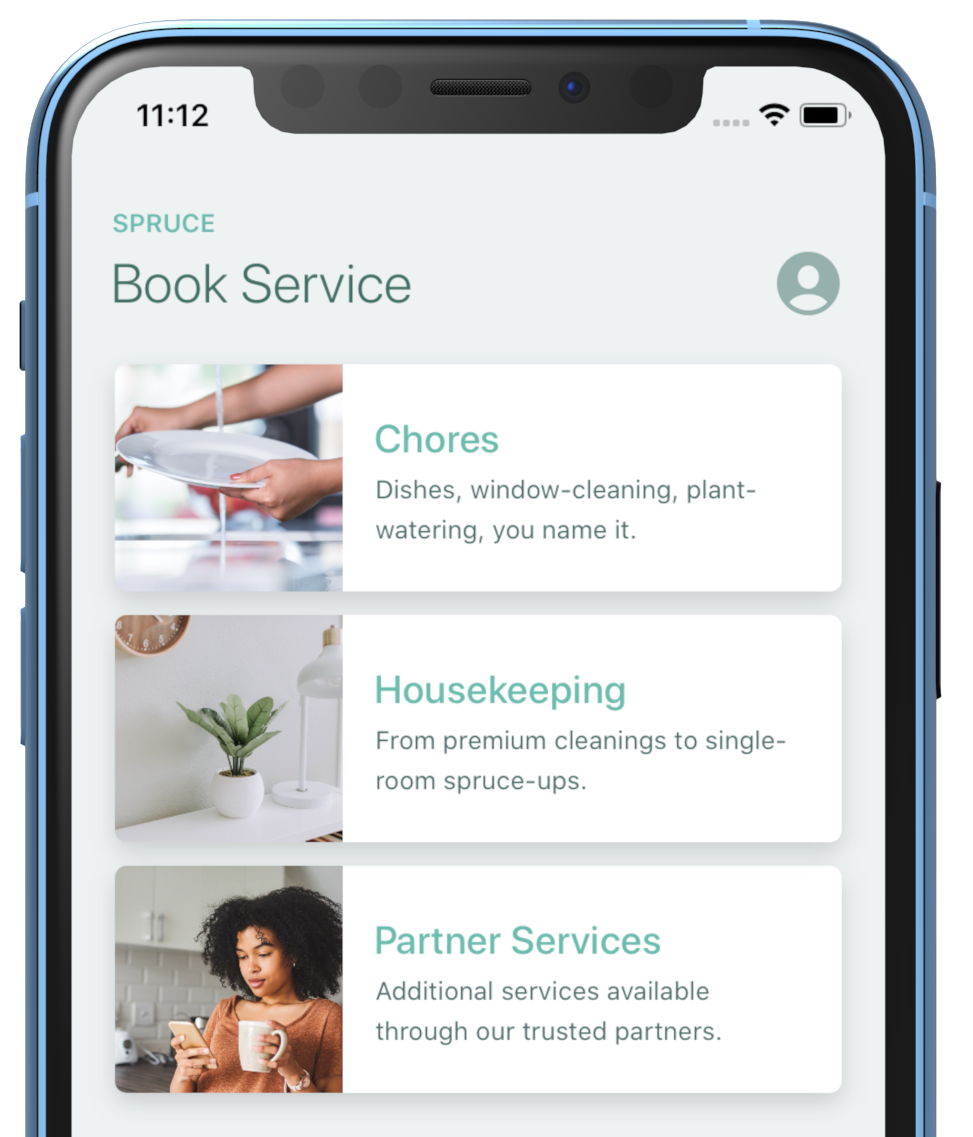
The app gives residents a practical way to use that density. They select a service and time, choose a one-off or repeat booking, then receive alerts when the professional is on the way, arrives and leaves. A cleaning can be broad or oddly specific. If the dishes are the problem, a resident need not buy a whole-house reset. The service catalog treats the untidy details of life as individual products.
The other customer holds the key
It is tempting to call Spruce a consumer app. A consumer uses it, but an apartment manager helps make it useful. Buildings have a problem that ordinary service marketplaces barely see: unfamiliar people coming through the lobby, asking for keys and moving between private units. Spruce says its property portal authenticates a service professional before staff authorize a key release. The portal also handles tracking, reporting, gift cards and support. Residents and staff receive status updates; professionals can post notes or photos about the work.
This is Spruce's difference from booking a cleaner directly or through a general marketplace. Spruce works through the community, uses established local service companies and lets neighbors rate the professionals. Its site says providers are background-checked and carry at least $1 million in general liability coverage. The arrangements vary by location: pet care, laundry and moving services, for instance, appear as partner offerings rather than a promise available on every block.
For a property owner, the appeal is partly safety and partly retention. Spruce says residents who use two or more services renew at an 81 percent rate, compared with an industry average of 52 percent. The numbers are company-reported and compare different groups, so they do not prove that a cleaner caused a lease renewal. The plausible idea is more modest: a familiar person who helps keep your apartment livable becomes one more reason that moving feels inconvenient. A relationship can be an amenity; it is harder to photograph than a swimming pool.
“Spruce's revenue model is based on the efficiency gain that we can create in the building.”Ben Johnson, founder, in a 2022 interview
Seven buildings before the leap
Johnson did not begin in real estate. He worked as an energy investment banker and tested the apartment idea while still employed. He has said that when he resigned, Spruce had signed seven apartment communities and had four employees. This matters because it separates the interesting observation from the hard evidence of demand. The failed dog-park coalition suggested a problem. Seven property agreements suggested a customer.
The company later scaled that arrangement with local providers. Spruce acquired Chicago apartment-services company The Minte in 2021; the two said they then covered more than 450,000 apartment homes. In July 2022 Spruce announced a $26 million Series B, bringing its disclosed total to about $40 million, and named board member Steven Pho CEO while Johnson moved to president. That year's announcements described service at more than 2,300 apartment communities and, by October, a network reaching more than 750,000 apartment units. These are dated company figures, useful for seeing the expansion rather than a live counter.
Spruce's stated mission is to build relationships and technology that help local businesses serve customers. That phrasing is revealing. Its provider page says local housekeeping and laundry companies pay no upfront signup or service fees, while Spruce handles customer service, sales, marketing and technology. The company has not published its take rate or unit economics. Johnson has said property managers do not need to pay a large annual fee to subsidize residents' services. The money-making theory is that better routing and fuller schedules leave enough value for the resident, the provider and Spruce.
What the dog park missed
The lesson available to copy is precise. Find a place where many people need a little help, where the work is too small to justify a separate trip, and where one institution can coordinate access and trust. Start with a narrow building or cluster. Ask the people who control the doors what they need to know. Recruit service companies that can keep quality steady. Only then make the booking button effortless.
The model depends on enough nearby jobs, a willing property partner and providers who can actually deliver. A scattered suburb, a building that bars outside professionals, or too few repeat bookings would weaken the density advantage. Spruce itself makes availability conditional on the community and ZIP code. That constraint is the point: what looks like a broad consumer convenience is built on a very particular piece of geography.
Johnson's neighbors were not wrong to ignore his proposal. Organizing a dog walker was work, and they had other things to do. Spruce found a way to give that work to someone with a reason to care. The apartment building was always full of small needs. The company figured out who could turn them into a schedule.