The dishwasher rarely breaks at a narratively useful moment. It gives up after dinner, when the sink is full and the question is no longer whether a pump has failed but who can be trusted to diagnose it. First American Home Warranty sells an answer to that second question. The company packages specified household systems and appliances into a renewable service contract, collects a monthly or annual fee, and coordinates eligible repairs through independent technicians. The proposition is half financial and half logistical: soften an unpredictable bill and remove some of the search from finding help.
That distinction matters. A home warranty is not homeowners insurance wearing casual clothes. Insurance is designed around covered events such as fire, theft or weather damage. A home warranty addresses selected items that stop working through normal use. The customer still pays a service-call fee, the contract still decides what qualifies, and a claim can still end in repair, replacement or a negotiated cash payment. First American's useful place is the awkward territory between a household emergency fund and the open market for local tradespeople.
A subscription for the noisy parts of a house
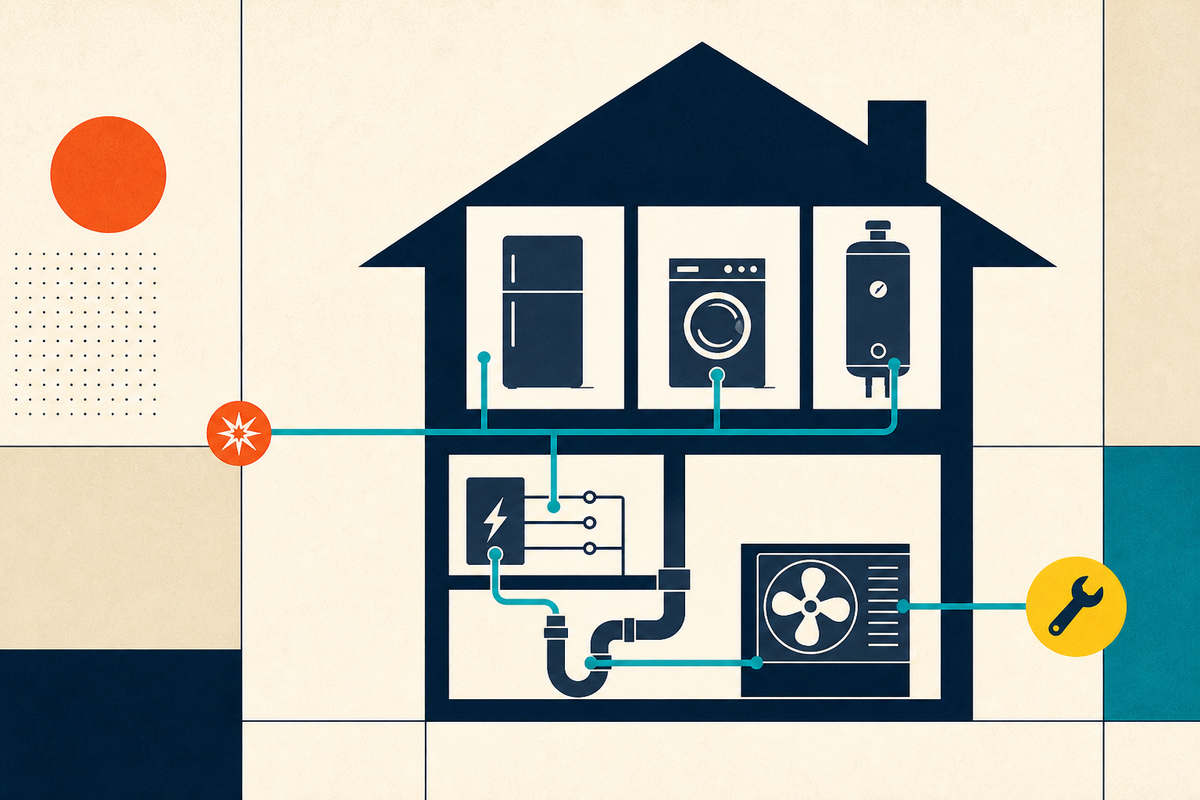
First American's current direct-to-consumer ladder has three levels. Starter covers a core group that includes plumbing, electrical and heating systems plus familiar kitchen equipment. Essential adds high-use items such as air conditioning, a water heater, washer and dryer, and a garage-door opener. Premium broadens the package again. Customers can customize coverage for features such as pools, spas, well pumps or an additional refrigerator. Names and availability are simple on the shopping page; the actual promise lives in the state-specific contract.
The headline conveniences are easy to grasp: the company advertises no inspection requirement, no age limit on covered home systems and no limit on the number of service requests. Those claims do not erase the rules. Covered equipment generally needs to be working when protection starts, and contracts specify caps, exclusions, access requirements and circumstances that may not qualify. An old furnace is not disqualified merely for being old. A failure outside the agreement can still be.
What the customer is actually buying
- A defined list of covered systems and appliances
- Budget protection against some eligible failures
- Diagnosis and repair coordination
- Access to an independent contractor network
- A monthly or annual payment schedule
- A service-call fee when help is requested
A claim illustrates the operating model better than a brochure does. The homeowner reports the problem. First American checks the contract and usually assigns an independent contractor. The technician diagnoses the failure; the company determines what work is authorized; the item is repaired, replaced or otherwise settled according to the agreement. Each handoff can save the homeowner a chore. Each also introduces a dependency, especially when local technicians are busy or parts are scarce.
“The real product is not the wrench. It is the arrangement that gets a wrench to the right house.”YesPress analysis
One contract, three jobs at the closing table
Homeowners can buy a plan directly, but the category has long been attached to real estate transactions. A seller can cover selected items while a property is listed and make the home feel less risky. A buyer can inherit a year of protection at the moment savings may already be depleted by a down payment, moving costs and the ceremonial purchase of seventeen extension cords. An agent can recommend or arrange a plan as a practical closing benefit.
That creates three customer jobs. For the homeowner, it is a way to trade a known recurring cost for help with some unknown repair costs. For the buyer or seller, it is a risk-transfer tool around the transaction. For the real estate professional, it can reduce anxiety and offer clients a number to call after closing. First American supports that channel with locally tailored plans and customizable materials for agents. The product is therefore both consumer subscription and business-to-business distribution.
Renewable coverage for people who prefer predictable payments and a coordinated repair route.
Plans designed around listing periods, closing and the exposed first months of ownership.
A practical client benefit that continues after the keys change hands.
The customers who benefit most are not defined only by appliance age. A cash-rich homeowner with trusted local tradespeople may prefer to self-insure. Someone with older equipment, little time to vet contractors and a strong preference for budget predictability may value the plan more. Geography matters too. First American Financial says its home-warranty operation serves 36 states and Washington, D.C.; plan details and technician availability vary by ZIP code.
Recurring revenue meets recurring entropy
The business makes money by collecting contract premiums and fees, then managing the frequency and cost of eligible claims. Premiums are generally recognized over the roughly 12-month life of a contract. The economic levers are familiar to anyone who has studied subscription businesses, with an actuarial twist: acquisition cost, renewal, price, service usage, repair severity, contractor rates and administrative efficiency.
In 2025, First American Financial's home-warranty segment reported $442.9 million in revenue and a 19.5 percent pretax margin. The provision for claims equaled 41.4 percent of home-warranty premiums, down from 46.4 percent in 2024 and 48.8 percent in 2023. The company attributed the latest decline primarily to lower claims frequency. These are segment figures from the public parent, not a freestanding valuation of the subsidiary, but they show a meaningful and profitable operation beside First American's much larger title business.
The parent relationship supplies a second kind of advantage. First American has roots in property records, title insurance and settlement services reaching back to the nineteenth century. The modern corporation works with home buyers, sellers, agents, lenders and other participants in real estate. Home warranty fits naturally at the edge of that network. It can meet customers during a purchase rather than waiting for them to search for coverage months later.
A broad promise, tested locally
First American competes with American Home Shield, Choice Home Warranty, Old Republic Home Protection, Cinch, 2-10 and AFC, plus the simplest alternative of all: keep a repair fund and hire contractors directly. Its differentiation rests on longevity, the financial backing of a public parent, real estate distribution, customizable tiers and the stated willingness to cover systems without an age cutoff. The service layer matters just as much. A warranty with a good technician available next Tuesday feels different from the same contract with no appointment in sight.
This explains why experiences in the category can diverge sharply. The contract holder, warranty administrator and independent contractor each controls part of the outcome. A customer may praise a prompt water-heater repair while another disputes an exclusion or waits through an HVAC backlog. Public reviews contain both stories. The responsible way to shop is to treat the sample contract as the product: compare service fees, coverage caps, exclusions, cash-payment rules, cancellation terms and responsibility for code upgrades before comparing slogans.
“No age limit” is a useful promise. “Read the contract” is the useful habit.The buyer's two-part rule
Culture sits one level up but still shapes the operation. First American describes a company-wide “People First” philosophy built around integrity, commitment, service, leadership and teamwork. It supports employee resource groups and community work in women's advocacy, housing and development, and human services. In 2026, the parent marked its eleventh consecutive year on the Fortune 100 Best Companies to Work For list. For a business that depends on call centers, authorization teams, salespeople and contractor managers, employee systems are not decoration. They are part of service delivery.
Between insurance, savings and a search box
Home warranties occupy a peculiar market position. They resemble insurance because they pool risk and pay for covered losses, yet they are generally sold as service contracts and regulated accordingly. They resemble maintenance memberships because customers pay repeatedly and request operational help, yet they do not promise routine upkeep for everything in the home. And they resemble marketplaces because a central platform routes demand to local providers, yet customers do not always choose the technician.
That hybrid is First American's expertise. The company must price household failure, interpret thousands of contracts, maintain service capacity across trades and geographies, and make a stressed homeowner feel that the process is moving. Technology can reduce friction through online requests, status updates and contractor management. It cannot make a compressor appear sooner or turn an excluded failure into a covered one. The durable edge comes from aligning the contract, the call center and the local network.
For customers, the product is best used deliberately. Inventory the expensive equipment in the home. Check its condition and any manufacturer coverage. Pull a sample First American contract for the correct ZIP code, then mark the limits that apply to the systems most likely to hurt the budget. Add the annual price and likely service fees. Compare that number with a dedicated repair fund and the value of having someone else coordinate the first call. The answer will differ from one house to the next, which is precisely why a personalized quote makes more sense than a universal verdict.
First American's current campaign gives the breakdown a character: Mr. Inevitable. The joke works because every homeowner has met him, usually holding a puddle, a blinking error code or a refrigerator full of newly endangered groceries. The company's place in the market is to make that arrival less improvisational. It does not eliminate household entropy. It sells a procedure for what happens next.