Imagine asking a hotel for extra towels. The request takes seconds. Somewhere between the front desk and your door, however, it becomes somebody else’s problem. Who heard it? Who owns it? Did the shift change? A pleasant answer at reception can conceal an unfinished job upstairs. ALICE by Actabl is built for that interval: the distance between being heard and being helped.
- ALICE connects hotel teams around assigned, trackable work.
- Its founders shifted their attention from the guest app to service fulfillment.
- The useful lesson: follow a request through the business before redesigning its entrance.
The app was looking in the wrong place
Founded in 2013, ALICE began with a plausible proposition: guests should order hotel services through their phones. Alexander Shashou, its co-founder and founding president, had grown up around his family’s British hotel businesses. He understood the appeal of making service easier to summon. But hotel research changed the diagnosis. Guests could already communicate requests. The difficulty was arranging the work needed to satisfy them.
In a later interview with investor 645 Ventures, founding CEO Justin Effron described spending the first year listening rather than selling. Early development consumed roughly $20,000-$30,000 a month. The company secured a pilot commitment before it had a product; two of three unpaid pilots eventually became paying customers. One proved a poor fit. Those are modest numbers, which makes them useful: a promise to try software and a willingness to pay for it are different forms of enthusiasm.
The shift was less theatrical than the word “pivot” suggests. ALICE kept guest communication, but gave staff coordination greater weight. A mobile request was useful only if the hotel could dispatch it, follow it, and remember it across departments. Knowing the customer’s job was part of the product.
“But one thing we could win at was support.”ALEXANDER SHASHOU / CO-FOUNDER / 2017
A request acquires an owner
Today, Alice sits in the hotel operations software market. Its housekeeping tools handle assignments and room status; service delivery manages requests; guest services supports concierge work; messaging keeps communication close to the tasks it generates. Buyers are hotels and management companies. Users include room attendants, supervisors, front desk agents, and concierges. The company explicitly targets luxury, complex, and multi-outlet properties, where a small request can involve several teams.
The distinctions are wonderfully unglamorous. Alice’s mobile housekeeping documentation separates dirty, started, clean, and inspected rooms. A supervisor can rush a room when a guest is waiting. Staff can record a Do Not Disturb condition and a return time. “Clean” and “ready” cease to be interchangeable guesses. That matters to the person at reception who must decide whether to hand over a key.
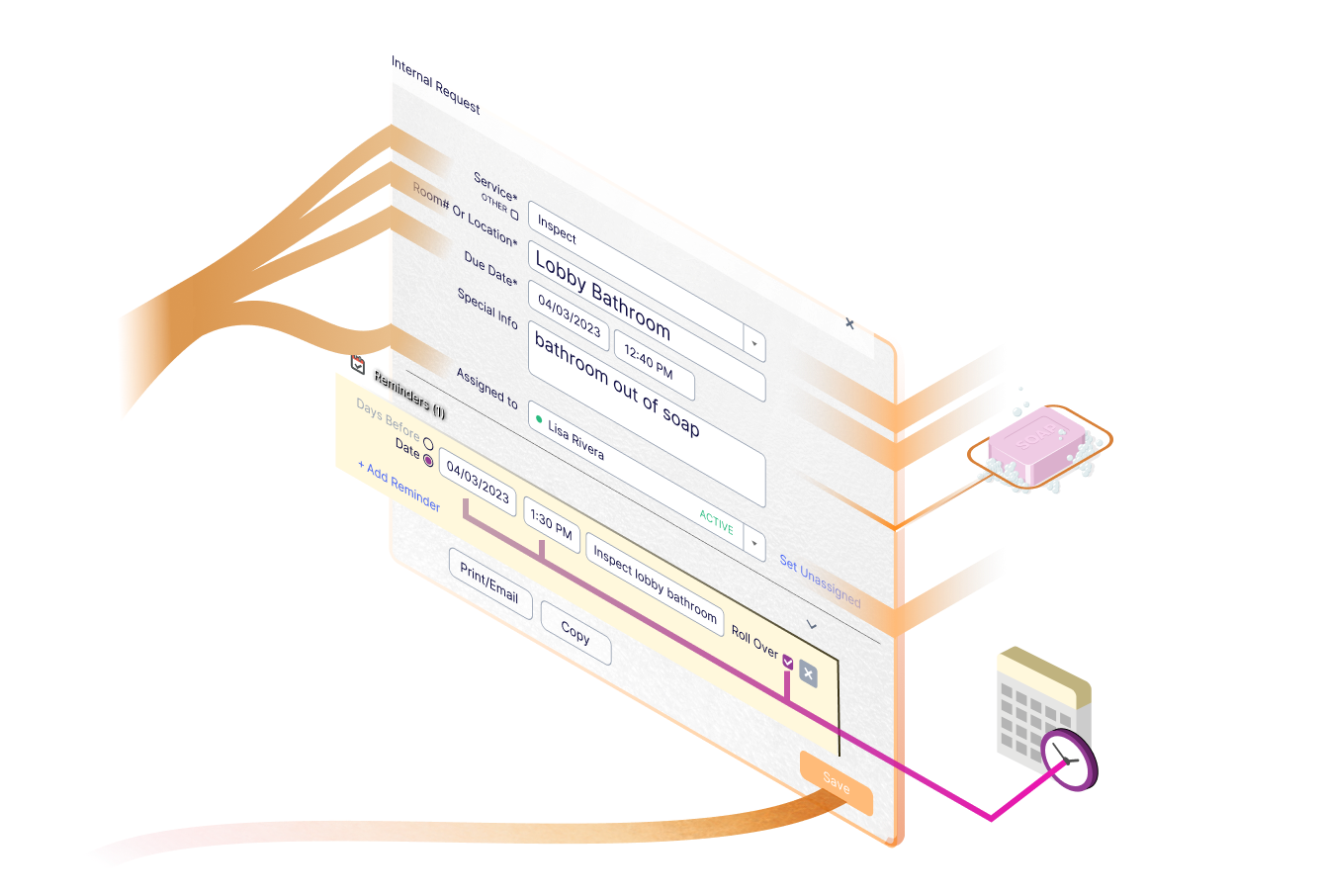
- 01RecordWhat needs doing?
- 02AssignWho owns it?
- 03CompleteHas it happened?
Front-of-house tools add a different sort of memory: local vendor information, guest records, logbooks, and itineraries. A concierge can organize reservations without leaving the next colleague to reconstruct the afternoon. The proposition is shared context across people whose jobs are quite different.
A palace puts the premise to work
Consider Royal Mansour in Marrakech. ALICE’s published case study describes 53 riads, 27 service teams, and four room attendants working on each riad. This is a more demanding coordination problem than a corridor of identical bedrooms. The implementation connected guest services, messaging, housekeeping, and service delivery, replacing paperwork and reducing internal calls.
The study reports a 15% improvement in property-wide checklist completion over six months in 2021. That is a vendor-published customer result, with a particular setting and period; it is not a forecast for the next hotel. Still, the example makes ALICE’s expertise tangible. The software must accommodate the property’s actual operating structure, including supervision and inspection, rather than assuming every hotel performs the same dance.
Royal Mansour, property-wide, over six months in 2021. Customer case study; not a universal benchmark.
Other relationships show where the company finds buyers. In August 2022, The Leading Hotels of the World selected Alice as one of its exclusive technology vendors for these operating functions. The collection then included more than 400 hotels in over 80 countries. That arrangement offered access to a network of independent luxury properties; it did not mean every member had installed the software. For an operator, the relevant question remains how the tools fit the particular hotel.
From Expedia’s cheque to Actabl’s toolkit
The business attracted capital as well as hotels. A $3 million seed round was followed by a $9.5 million Series A. In August 2017, Expedia supplied a $26 million Series B and became the majority shareholder. ASG acquired ALICE from Expedia Group in July 2021. The next year, Alice joined ProfitSword, Hotel Effectiveness, and Transcendent under the Actabl name.
That combination gives Alice a particular position against alternatives such as Amadeus HotSOS, hotelkit, and Flexkeeping, which also address hotel coordination. Its distinctive proposition includes the surrounding Actabl tools: business intelligence, labor management, and asset management. Clean Sync, for example, passes daily cleaning data from Alice into Hotel Effectiveness. Transcendent Rooms connects housekeeping to engineering work orders. The attraction is less repeated entry between related jobs.
ALICE earns its money through hotel software subscriptions. Features depend on the property’s subscription, and official product pages invite buyers to a demo. The purchasing question therefore includes modules, configuration, and adoption as well as the fee. The 2024 Housekeeping Refresh illustrates the ongoing work: its credit rules can account for assignments across multiple floors or a heavier load of checkout cleans.
Another integration follows the things guests leave behind. Staff can log a found item in Alice and pass it to BOUNTE, whose image-recognition technology helps label it. Actabl’s account includes positive feedback from Noble House Hotels & Resorts. The appeal is easy to understand: a forgotten jacket should not require the housekeeper to learn a second application simply to record it. Connections like this extend the original idea of keeping related work together.
Copy the investigation, then test the handoff
A reader can borrow ALICE’s method without buying ALICE. Choose one recurring request. Follow it from reception to completion. Write down each transfer, each owner, and each occasion when somebody asks for information already supplied. Then test whether a shared record removes that repetition.
There are conditions. Clean Sync requires both subscriptions, employee and cleaning-type mappings, and completed daily room boards. If those records are neglected, the integration cannot supply dependable reporting. More generally, a task list needs people who use it and enough staff to perform the work. ALICE’s history is a useful reminder to investigate the labor behind an agreeable interface. The towels still need carrying.