The trouble with a ten-class pass is that the eleventh class can look remarkably like the tenth. Same member. Same coach. Same cheerful arrival. Unless somebody counts, the gym supplies another workout and receives nothing in return.
Dan Uyemura recalled discovering dozens of people getting a free ride at his gym because nobody was actually checking their class passes. In Stripe’s account of the company’s beginnings, that oversight sits beside another frustration: months spent negotiating payment terms. An engineer running a gym had found a problem that neither a better workout nor a friendlier welcome would solve.
- The job: connect gym memberships, payments, bookings, and attendance.
- The customer: independent fitness businesses with recurring members and classes.
- The catch: a free subscription still carries processing fees; compare the whole bill.
- The lesson: inspect the handoffs where work, money, and information part company.
The pass nobody counted
PushPress emerged from that kind of friction. Its founders are Uyemura, now CEO; Chris McConachie, the product director; and Brian Aung, who heads fintech. Uyemura and McConachie had co-owned LAX CrossFit. Aung brought banking and programming experience as well as involvement in gyms. Their expertise covered both the business being managed and the machinery doing the managing.
The distinction matters. A calendar sees an appointment. A gym owner sees a person with a membership, a remaining class balance, a payment method, and perhaps a habit of booking Monday morning and disappearing by Thursday. Those facts have consequences together. Kept apart, they become chores.
The founders considered building payment infrastructure themselves and becoming a merchant-services business. They chose Stripe Connect instead. Stripe’s customer story says PushPress went more than a decade without needing payments engineers and describes expansion across 34 countries. The decision supplied infrastructure without making payments engineering the startup’s central occupation.
“The unification of payments to operations is critical.”Dan Uyemura · Stripe customer story
There is a useful restraint in that choice. The founders had a specific business problem to solve. Owning every component would have added engineering and compliance work before improving the gym owner’s day. They could concentrate on what happened between a purchase and a person walking through the door.
One member, four jobs
Today, the company reports serving more than 5,000 gyms and over half a million members. Its customers include CrossFit affiliates, strength gyms, martial arts academies, and boutique studios. This is business software for the people operating the facility; members encounter it through bookings, payments, communication, and workout records.
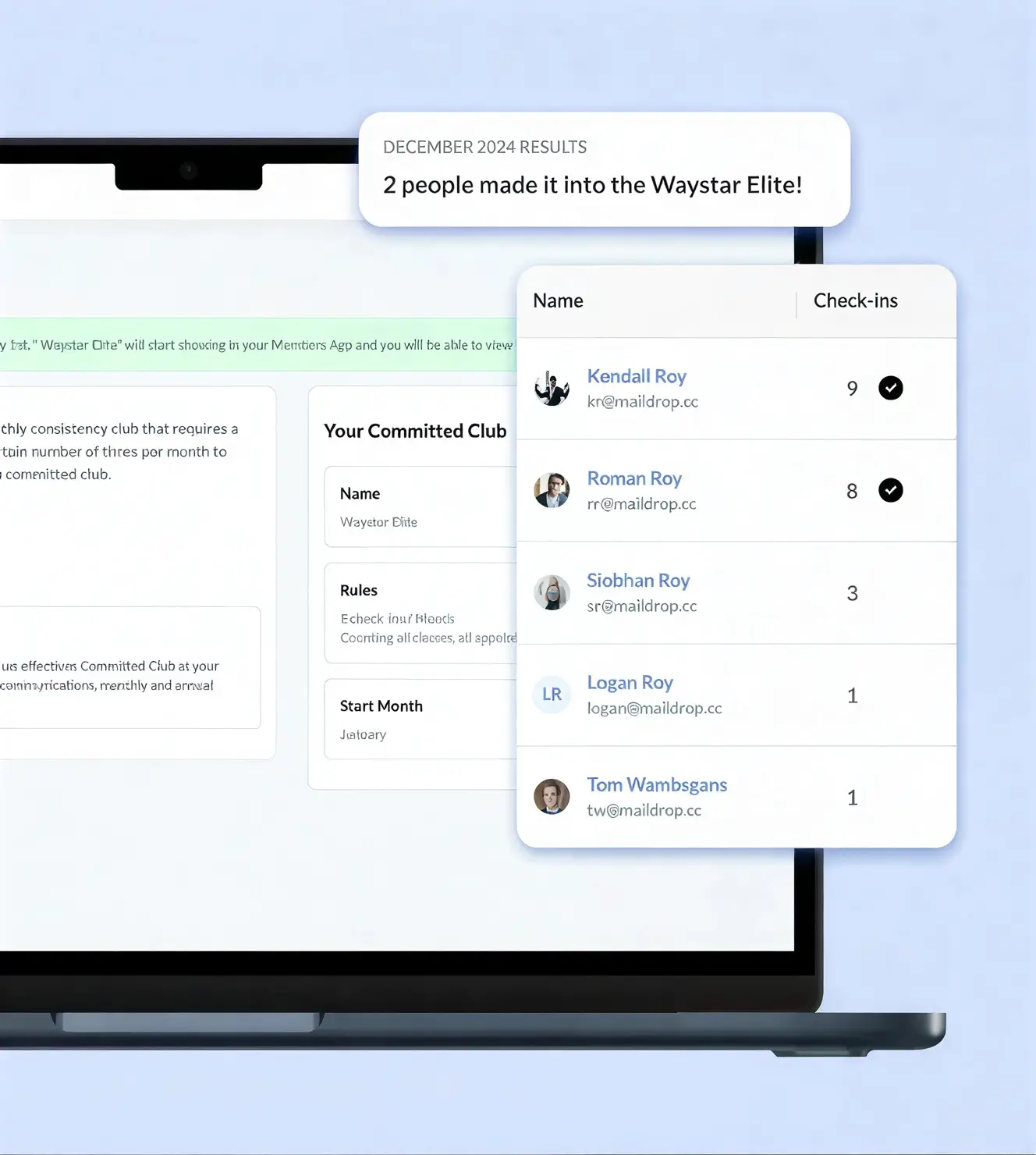
Core handles memberships, recurring billing, waivers, schedules, and check-ins. Members can book from an app; coaches can manage attendance from the Staff App. That shared record gives the owner a way to see who belongs in class and what their account looks like.
Grow attends to the person before and around the membership: lead capture, a sales pipeline, and automated email and text follow-up. A prospective member’s inquiry can enter an organized process rather than wait for the owner to finish coaching and remember the inbox.
Train delivers programming and records performance. Members can log results, review benchmarks, and see personal records celebrated with PR Confetti. Coaches can also assign habits such as hydration or mobility. Affiliate programming partners include PRVN, HWPO, Invictus, and Mayhem. The optional Branded App puts the gym’s identity on the member experience.
The market has plenty of alternatives. Mindbody, Wodify, and Zen Planner offer gym or studio management; SugarWOD and BTWB are alternatives for workout tracking. PushPress’s pitch rests on connected fitness workflows and modular purchases. That is a positioning choice, not proof that every rival mishandles the job. An owner should compare an actual day’s work in each system.
The arithmetic of free
The business model combines software subscriptions, optional modules, and payment processing. In the published US pricing, Core Free costs $0 a month with card processing at 4.99% plus 30 cents per transaction. Core Pro costs $159 a month at 2.89% plus 30 cents. Core Max costs $229 at 2.75% plus 30 cents.
For the same domestic card volume and transaction count, Free versus Pro becomes straightforward arithmetic. The rate difference is 2.10 percentage points. Divide $159 by 0.021 and the crossover is about $7,571 in monthly card volume. Above that, Pro’s subscription can be more than offset by the lower rate. This calculation compares the listed subscription and card fees only.
When does “free” cost more?
Pro is $51 less per month at this volume.
Illustrative US card calculation: subscription + percentage fee. Both plans add $0.30 per transaction, omitted equally. Excludes other fees, add-ons, and international rates. Listed prices checked October 1, 2026.Grow is listed at $329 a month, and Train starts at $79. A branded app is another optional expense. The sensible budget begins with the jobs the business needs done, then includes subscription charges, transaction costs, and paid extras. A new gym and an established gym can reasonably choose different combinations. PushPress also offers fitness-business insurance through GymInsurance.com, with quotes that depend on the coverage and business.
The founder who stopped coding
Software can make a business more orderly while the software business itself remains unruly. In a 2019 founder interview, Uyemura reported bootstrapping PushPress beyond $100,000 in monthly recurring revenue. He also acknowledged that greater attention to marketing, distribution, and sales would have accelerated early growth. Product quality had not made those jobs disappear.
By January 2022, his role was changing. In a post about leaving coding behind, he described a tiny final contribution: hiding cancelled membership plans by default. Repeated membership changes had cluttered customer profiles. Clients complained; the interface changed.
“Today, I wrote my last line of code, forever.”Dan Uyemura · January 13, 2022
It is an amusing farewell. A founder might prefer to depart the keyboard amid fireworks. Uyemura left after tidying a list. For anyone building software, the example is worth borrowing: document what customers struggle with, then ask whether a small change can remove a recurring annoyance. The spectacular feature can wait its turn.

More resources followed. PushPress announced an $11 million Series A in August 2022, led by Altos Ventures with Mucker Capital participating. In October 2024, a $20 million Series B brought Altos, StepStone, and Mucker together. The latter round targeted member and mobile experiences and additional products for gym owners.
The company’s stated reason for taking the first round was the capacity to help customers faster and more consistently. It marks a change from the bootstrapped independence celebrated in the earlier interview. The funding buys capacity; the customer still has to judge the resulting product.
Give the coach a better morning
PushPress’s 2025 recap reported more than 30 million check-ins, ten million scheduled classes, and a hundred feature releases. The numbers describe the volume of routine business passing through the platform. They also explain why apparently small errors matter: a minor inconvenience multiplied across daily classes becomes somebody’s regular job.
Its newer AI ambitions are easiest to understand through a concrete release. A July 2026 Member Intel update added attendance history and membership data to the Staff App’s coach context, plus a daily summary. Members changing plans had sometimes appeared to be new. The update aimed to recognize their actual history. It is available on Pro and Max.
That is a useful test for gym AI: does the coach arrive better informed? A familiar member returning after an absence deserves a different conversation from a first-time visitor. Software can supply the distinction. The coach still supplies the tact.
The September release notes are a reminder of the less glamorous work alongside it: corrected billing on paused memberships, clearer signed documents, and repaired integration triggers. A gym depends on these details. Promising intelligence does not retire the obligation to get an invoice right.

Borrow the habit, then buy the software
An owner can copy the founding insight without changing platforms immediately. Pick one paid service and follow it all the way through: inquiry, purchase, booking, attendance, renewal. Find where staff have to re-enter information or remember an unwritten rule. Assign responsibility for that gap. Then determine whether software can make the handoff dependable.
Connected records are useful only when people use them. A coach who skips check-ins produces unreliable attendance history. A beautifully timed follow-up cannot repair an unappealing offer. A workout leaderboard may delight one group and leave another indifferent. The purchase should fit the members, staff habits, payment mix, and class model of the particular business.
Before switching, ask for a demonstration using your awkward cases: a paused membership, a family account, a class pack nearing its end, a failed payment. Calculate the bill using your own transaction volume. Give the coaches time to learn the process. The aim is a Tuesday that runs more smoothly, with fewer loose ends waiting after the last class.
PushPress’s origin supplies a pleasingly practical place to begin. Sell ten classes. Know when the tenth has happened. Make the next conversation an informed one.
Website · Plans & pricing · Business of Fitness blog · Product updates
LinkedIn · X · Instagram · User community · YouTube videos & tutorials