A salon calendar is an unlikely place to look for a financier. It knows who is coming in for a trim, who cancelled and which chair is busy on Saturday. Yet it also knows something a financing application is trying to discover: whether a business is making money. Pipe’s second act begins with that observation. The useful information, and the customer’s attention, are already somewhere else.
That makes Pipe an interesting company for anyone who sells to small businesses. Its history is a study in how a financial product changes when you change its front door. The same broad ambition - turning tomorrow’s revenue into money available today - can produce quite different businesses depending on where the offer appears.
- The product: working capital embedded in business software, with payments tied to sales.
- The customer: platforms that serve small businesses, and the merchants using those platforms.
- The reset: a recurring-revenue marketplace became a partner-distributed capital business.
- The catch: flexible payment timing still comes with a financing fee.
The marketplace meets the appointment book
Founded in 2019 by Harry Hurst, Josh Mangel and Zain Allarakhia, Pipe initially offered a trading platform for recurring revenue. A company with dependable future receipts could exchange them for upfront capital without selling equity. SaaS businesses were a natural starting point: subscriptions made the future easier to describe.
Investors liked the proposition. In May 2021, Pipe announced a $250 million equity investment led by Greenspring Associates at a $2 billion valuation. Its announcement described expansion beyond SaaS into other recurring-revenue businesses. The ambition was expansive: revenue itself could become an asset that investors bought.
Then the operating question became harder. Luke Voiles arrived as CEO in February 2023 after running small-business finance operations at Square and Intuit. Pipe’s February announcement said more than half its trading volume already came from outside SaaS. The company had travelled beyond its original niche; it still needed a repeatable route to a much broader market.
Pipe dates its embedded capital relaunch to 2024. The new route runs through other companies’ software. In her year-end 2025 account, CEO Claurelle Rakipovic described the lesson as reaching owners inside their everyday platforms. Read as a distribution decision, the reset is unusually concrete: keep the financial capability, change where the customer encounters it.
A haircut is also a data point
Boulevard supplies software to salons, spas and other self-care businesses. Its users have growth plans involving equipment, staff and new locations, rather than the next venture round. Boulevard wanted financing based on business performance and delivered through a familiar interface. Pipe provided the infrastructure behind Boulevard Capital.
According to Pipe’s case study, the program launched in early 2024. Boulevard initially planned a three-month phased rollout; pilot results encouraged a full rollout within 30 days. In just over a year, the program advanced more than $25 million to hundreds of merchants. Those are company-published results, rather than an independent experiment. Even so, they describe a specific change in behaviour: a cautious launch became a faster one after customers responded.
“Pipe delivered the same seamless experience we provide our customers.”Matt Danna · Co-founder and CEO, Boulevard

The same logic appears in Housecall Pro, whose customers include home-service professionals. Pipe’s account says the partner valued prebuilt reporting dashboards, underwriting across differing revenue patterns and a launch completed within weeks. A contractor looking for equipment or seasonal payroll support can encounter capital within the software used to manage the business.
GoCardless adds a payments version of the story. Its UK pilot used Pipe’s hosted experience before moving toward a closer integration. Pipe reported almost £7 million advanced in the first three months. The sequence is useful: test whether merchants want the product, then invest in making it feel more native. A beautiful button with no takers remains a fairly expensive decoration.
The fee stays put. The payments move.
Pipe Capital is described by the company as a merchant cash advance: a business sells a portion of future revenue for cash upfront. Pricing consists of a flat fee determined for the offer. Collections take a percentage of sales, so payments decrease when sales decrease. Pipe advertises no monthly minimum, credit checks or personal guarantees for this product.
The two percentages deserve separate attention. The fee determines the dollar cost. The sales percentage determines how quickly cash leaves the business. Pipe’s help page gives an example of a $50,000 advance with a 10% fee: the fee is $5,000. That is an example, not a posted universal price.
The fee is 10% of the advance in this example. It is not a 10% annual interest rate.
That last distinction follows from the timing. Paying a fixed dollar fee over six months is economically different from paying it over eighteen. The absence of compounding interest makes the bill easier to state; it does not make time irrelevant. For an owner comparing offers, the total dollars, expected collection period and cash left after each sale all matter.
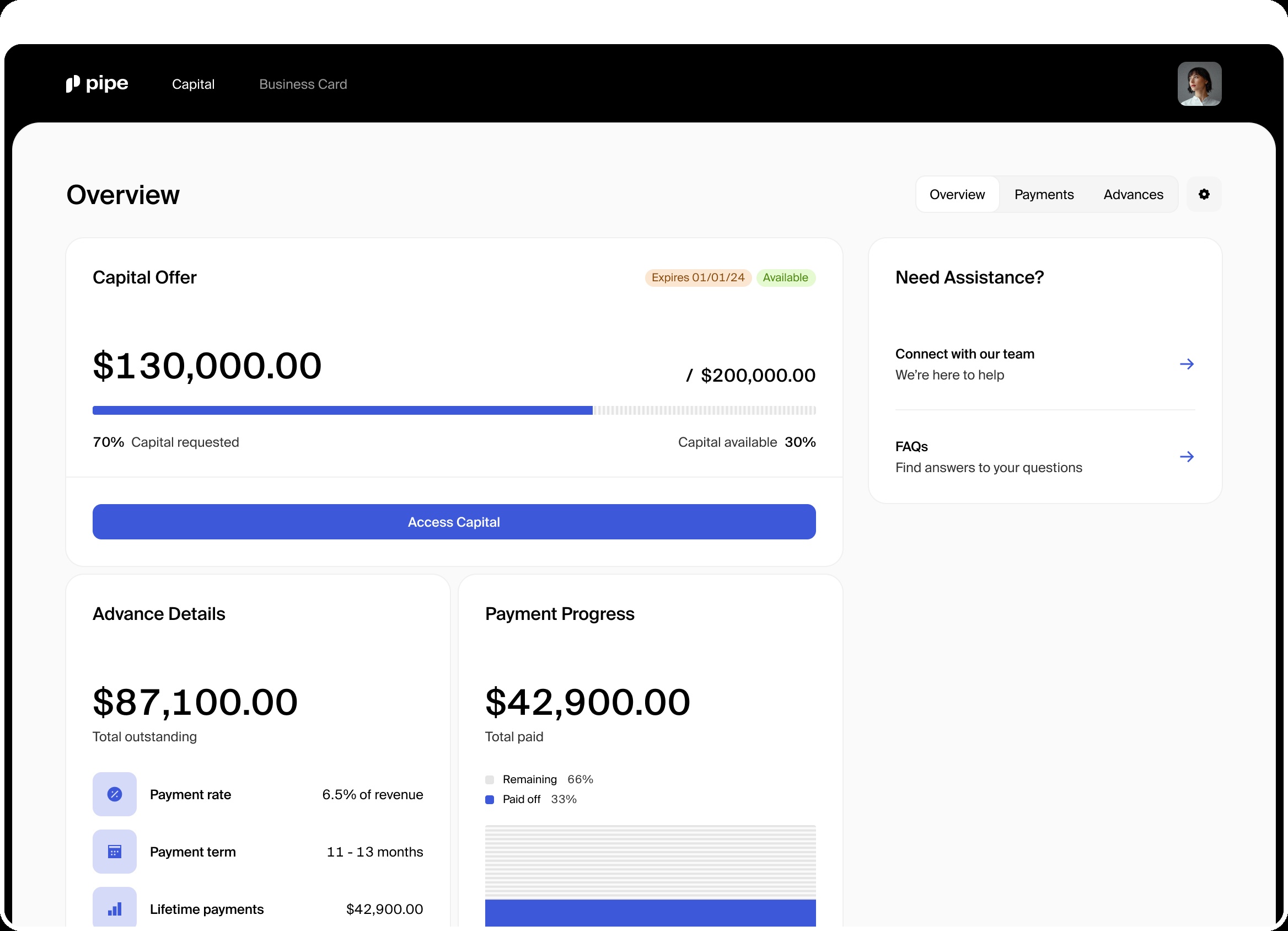
Access is also conditional. GoCardless’s support material requires at least four months of processing history before an offer. Owners provide business and ownership information, connect a bank and review the payment arrangement. The software shortens the journey, but eligibility and verification remain part of it.
The capital button has a crowded waiting room
For a platform, Pipe offers three integration routes: a hosted experience, a prebuilt embedded interface and a custom API approach. Its February 2025 developer announcement advertised possible launches ranging from a week for hosted flows to four weeks for an API integration. Those are best-case timelines; a partner’s data, design and internal review determine the actual calendar.
Pipe handles the financial operations behind the offer, and commercial arrangements can share revenue with the partner. That gives the platform two potential rewards: additional income and customers with money to invest in their businesses. It also gives Pipe access to transaction information and a distribution channel with an existing relationship.
Other companies understand this arrangement. Parafin markets white-label financing to platforms. Liberis describes embedded capital for SaaS operators. Stripe Capital offers financing within the Stripe ecosystem. Embedding a financial product is therefore a category, rather than a distinction Pipe owns outright.
Pipe’s case for selection rests on practical details: integration options, industry-specific risk models, support and the ability to use payments data from multiple sources. A platform comparing providers should examine which merchants receive usable offers, what those offers cost and who handles the awkward moments after launch. The most attractive demo is only the beginning of that conversation.
Growth is a number. So is the payroll.
By April 2026, Pipe reported more than 15,000 advances totaling over $300 million since its relaunch. An advance is a transaction, so this figure should not be read as 15,000 separate businesses. Its partners included Uber and Live Payments; Epos Now added another route to brick-and-mortar merchants.
That month’s $16 million equity round, led by Fin Capital and MaC Venture Capital, financed the company’s next phase. Separately, an expanded Victory Park Capital warehouse facility supplied capacity of up to $225 million. Equity and a credit facility do different work. Adding their face values into one heroic fundraising number would conceal how the business operates.
Pipe has explored adjacent problems too. It announced an embedded business card in October 2024 and acquired spend-management company Glean.ai in April 2025. Helping a business obtain money and helping it understand expenses fit together neatly. The current website gives capital the prominent position, however; the acquisition alone should not be mistaken for universal availability of an integrated suite.
There is a less comfortable part of the reset. Rakipovic’s December 2025 account acknowledged that costs did not fit the refocused business and that employees had been let go. Growth had returned, but the organization still needed reshaping. She became CEO that month, bringing experience building lending and business payments at Amazon. Fiscal discipline was part of the announced leadership transition.
Borrow the route to the customer
The transferable idea is to look for a financial problem inside an existing workflow. A platform can test a hosted experience, measure demand and deepen the integration after the evidence arrives. Boulevard’s accelerated rollout and GoCardless’s staged approach offer different versions of that sequence. Both put customer response ahead of architectural ambition.
For an owner, the useful question is whether capital funds an activity that can carry its cost while leaving enough cash to operate. Sales-based collections can help accommodate seasonality. Thin margins, weak transaction history or an unavailable partner program can make the fit poor. Money arriving quickly cannot, by itself, repair an activity that consistently loses money.
Pipe’s story ends, for now, at a surprisingly ordinary place: the screen a business owner already uses. A salon calendar, a contractor’s dashboard, a payments account. Its bet is that the distance between needing capital and finding it can shrink when the offer sits beside the evidence of a working business. Sometimes the consequential change is simply moving the door.
Open the next tab
Explore Pipe, the capital product and developer documentation. Follow the company on LinkedIn or X.
For more: the CEO’s account of the reset, company news and partner stories, and Rakipovic’s Women Leading the Way interview on YouTube.