A business can begin with something as modest as an ice cream. Lawrence Wosskow bought Bradwell’s in 1992, acquiring a Derbyshire enterprise whose story long preceded his arrival. Before the restaurant acquisitions, the property transactions and the investment portfolio, there was a product people could enjoy without needing to understand the balance sheet. That is a useful place to begin with someone whose career would eventually become associated with buying an entire roadside chain.
Bradwell’s had grown out of a village business. Noel Bradwell and his wife Betty had expanded its flavours and customer base, moved manufacturing into a barn at Wortley Court and introduced modern Italian equipment. They took the product beyond the village, including through a van with chimes. When Noel sold to Wosskow, the transaction included the barn. A business described in terms of brand and distribution still required somewhere to make the ice cream.
The purchase carried a personal connection, too. Wosskow’s mother had lived in Bradwell, and he had tasted the local ice cream at five. Noel stayed on as a consultant; Jane Bownes remained general manager. The new ownership therefore included people who already knew the enterprise. An acquisition changes who holds the shares. Keeping the people who know the machinery, the customers and the daily routines is another decision entirely.
Wosskow’s earlier working life had begun at Marks & Spencer after school in Sheffield. His later interests included the outdoor retailer Free Spirit and the Loseley ice-cream brand. Looking across those businesses, the recurring setting is ordinary consumer life: shopping, eating, choosing what to buy. The products were familiar. The scale and ownership arrangements were where the complications entered.
The lunch break as a business
Shopping centres provided the next setting. In 2005, Out of Town Restaurants Group was described as operating more than 80 sites, employing 1,600 people and generating turnover of around £30 million. Its brands included Margarita’s Family Restaurants, Macey’s and Potato Bake House. These were businesses serving the pause in somebody else’s day: the meal between shops, the drink before going home, the practical interruption that retail requires.
Wosskow and Simon Heath were the founders behind the group. The catering operation offered a different way into retail property from running a shop. A centre could bring together customers for dozens of retailers; food outlets could serve those customers without needing to persuade them to make a separate journey. The opportunity depended on the surroundings as much as on the menu. A baked potato has very little control over its own footfall.
In retrospect, that makes the move towards roadside catering easier to understand. Shopping centres and roads are different environments, but both gather people whose main purpose lies elsewhere. The restaurant has to make a detour worthwhile. It must fit the time available, the price acceptable and the reason for stopping. This is a reading of the commercial pattern in Wosskow’s career, rather than a claim that every acquisition followed one written theory.
By July 2005, he and Heath were in advanced discussions with Permira over Little Chef. The chain had been offered for sale the previous November. Convenience food outlets and expanding garage forecourts were part of the competitive pressure. The potential buyers brought catering experience, but the market they were entering was already changing. A recognisable name could open the conversation; it could not order lunch on a customer’s behalf.
A familiar sign, a difficult purchase
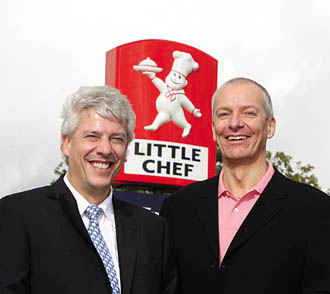
“What about Little Chef?” Wosskow recalled asking Heath. When interviewed in October 2005, he was in a stationary car on the M1. The setting supplies its own joke: an entrepreneur buying a roadside restaurant business while the road declined to let him proceed. The pair’s purchase, through The People’s Restaurant Group, had just completed. Contemporary coverage put the transaction at around £52 million.
Little Chef came with a place in British motoring life. The chain had been founded in 1958 by Sam Alper, taking inspiration from American roadside diners. Buying such a business meant taking responsibility for a familiar promise as well as a collection of sites. People knew the sign before they knew the owner. That familiarity was commercially useful, but it also gave customers something against which to measure any change.
The planned overhaul reached beyond a new owner’s name on company documents. Wosskow and Heath intended to reduce meal prices, introduce marketing campaigns and attract local residents around the restaurants. That last ambition matters. A roadside site need not live entirely on passing traffic; people nearby may become repeat customers. The question was whether the offer would be appealing enough to turn proximity into habit.
The property side was equally consequential. A proposed sale and leaseback with Nick Leslau did not proceed in late 2005. Heath said further work on the portfolio was needed before it would be ready. The arrangement would have separated ownership of buildings from their operation. In everyday terms, selling a restaurant’s premises can release money while creating a continuing rent bill. The cash arrives once; the obligation returns regularly.
The bill arrives
The Little Chef acquisition did not become a tidy turnaround story. By early 2007, the chain had entered administration and R Capital agreed a rescue purchase involving 196 branches. Around 40 outlets were expected to close. Those figures describe a change of ownership and a contraction, rather than a completed recovery under Wosskow and Heath. Any account of the purchase has to make room for that outcome.
A restaurant chain is particularly unforgiving of abstract optimism. Each branch must work as a place to eat, even when the argument for buying the group sounded persuasive. A national identity cannot serve a table. Nor can the price paid for the enterprise settle the question of what customers will pay for a meal. The Little Chef episode puts the purchase and the operation on the same page, with the distance between them plainly visible.
In August 2007, Wosskow returned to Out of Town, buying the business back from administrators. The plan was to double its size and create 600 additional jobs over three years. Those were announced intentions, not results to be awarded retrospectively. The programme included more outlets in existing shopping centres, its own brands and national names such as Subway and Costa Coffee in new centres.
The return is an interesting detail in a career often shortened to the Little Chef transaction. Wosskow went back to a business he had previously sold in 2002. Buying something familiar can bring knowledge of its customers and operating model, although familiarity cannot remove commercial risk. Here, the proposed expansion mixed established formats with new outlets. The next move was anchored in work he had done before.
A national identity cannot serve a table.On the practical work behind a restaurant acquisition
Another kind of premises
Property became a further chapter. A September 2009 transaction bulletin recorded a £4 million Royal Baths purchase in Harrogate involving Wosskow in a joint venture. The entry listed a 6,586-square-metre property on Parliament Street with various tenants. It is a compact description of a different investment object: space, occupiers and income rather than meals served during a shift.
There is a connection between the chapters without needing to pretend that they are identical. Restaurants operate within buildings; property owners provide the buildings in which tenants operate. An investor moving between those positions encounters the same address from another side of the contract. Location still matters, but so do the terms that govern who pays for occupying it. A dining room and a rent schedule tell different stories about the same floor.
Wosskow later put his own account into a memoir, Little Chef: The Heart of the Deal. A 2018 Morgan James edition runs to 225 pages. Its scope includes his career in catering, retail and commercial property. The choice of title gives the roadside purchase a prominent place in the retrospective. Little Chef remained the name through which a wider business life could be introduced to readers.
The book also changes the relationship between subject and audience. An acquisition is discussed through prices, ownership and trading conditions; a memoir gives its author room to arrange the experience in his own words. Reading the two alongside one another is useful. The transaction supplies dates and consequences. The personal account supplies a participant’s perspective, which is valuable precisely because it belongs to that participant.
- 1992Bradwell’s
Ice cream - 2005Little Chef
Roadside dining - 2009Royal Baths
Property venture
The road continues
Now based in the Bahamas, Wosskow is identified on LinkedIn with Private Equity. His public biography describes investment stakes in technology businesses internationally. The geographical shift is substantial: an early career rooted in British retail and catering now sits beside investing across borders. The description fits an investor with an operating past, rather than someone whose entire professional story began inside an investment firm.
His relationship with Little Chef has continued in public conversation. In April 2024, he appeared in the BBC Radio 4 programme Toast, presented by Sean Farrington, examining the chain’s disappearance. The episode also included Fiona Alper, widow of its co-founder, and Becky Parr-Phillips, who had risen from waitress to head of operations. Putting those voices together allows the business to be seen through ownership, origins and the work of running restaurants.
That is a fitting place to leave this career: with several perspectives at the same table. Wosskow’s story contains acquisitions, an attempted revival, a return to an earlier business and a move into other assets. Its interest lies in the particulars, including the outcomes that resisted the original plans. The ice cream could be enjoyed immediately. The larger deals needed time to reveal what, exactly, had been bought.