Brian Ruder builds spreadsheets with Claude. That detail might sound unremarkable in Silicon Valley, until the co-CEO of Permira supplies his review: “They're all really impressive, and they're all wrong.” At a May 2026 panel, he described the work required to check what the software produces. Even at the top of an investment firm, someone still has to inspect the cells.
It is a useful place to begin with Ruder. His career has followed technologies that change how companies work, from enterprise software to cloud subscriptions to AI. Yet the interesting part of his public arguments is often the practical question beneath the technology: what improves the business, who does the work, and how long will improvement take?
Since September 2024, he has shared Permira’s leadership with Dipan Patel as Co-Managing Partner and Co-CEO. The appointment widened a brief he had spent years developing in technology. It also brought a familiar investment problem inside his own firm: how to grow an institution while keeping the qualities that made it useful in the first place.
A philosopher arrives on Sand Hill Road
Ruder studied Philosophy with Mathematics at Harvard College and earned an MBA at Harvard Business School. It is a pleasing combination for an investor: one discipline asks whether an argument holds together; the other makes it harder to escape the arithmetic. The degrees do not explain every decision he has made. They do give his biography an opening more interesting than a list of transactions.
His investing career began at Hellman & Friedman. He later became a partner at Francisco Partners, covering software and services, before joining Permira in 2008. These were roles in which technology was something to assess as a business, with customers and ownership structures attached. The recurring subject was software; the job was deciding what capital could help it accomplish.
In May 2014, Ruder was head of Permira’s Menlo Park office when the firm named him co-head of its Technology, Media and Telecommunications team. His counterpart, Richard Sanders, was based in London. The arrangement put leadership on opposite sides of the Atlantic, with an expanding Menlo Park team and investment professionals across Europe, the United States and Asia.
Technology already had a substantial history at the firm. At that appointment, Permira reported more than $8.5 billion deployed across 32 TMT investments. Ruder was taking responsibility for an established operation, with the additional challenge of keeping it relevant as software businesses changed their products and their economics.
The cloud was a business-model question
Long before generative AI became an obligatory slide in investment presentations, Ruder was discussing the transition to cloud software. His distinction was concrete. Investors could back companies built for software as a service from the beginning, or help an established software provider move into that model. The second path required changing a working business while it continued serving customers.
He also pointed to the value of making an organisation’s existing data usable. That emphasis is revealing. There is an obvious appeal in discovering something entirely new. There is also a commercial opportunity in helping customers do more with information they already possess. For an enterprise software investor, a customer’s accumulated complexity can become a reason to buy.
In another discussion of disruption, Ruder treated technology as pervasive across sectors, with repeatable automation at its heart. That definition travels further than a software company’s headquarters. It raises questions about how a consumer business operates, how a service gets delivered, and where a company sits relative to a changing market.
The appeal of this view is its refusal to stop at a label. Calling a business technological tells an investor little about its durability. The harder question is whether a change will strengthen its position or make its offering easier to replace. Ruder’s investment history supplies several attempts to answer that question in practice.
Magento’s three-year chapter
Magento offers a compact example. Permira funds acquired the commerce software business from eBay in 2015. In May 2018, a Permira-backed company agreed to sell Magento Commerce to Adobe for $1.68 billion in cash. Hillhouse Capital, which had invested in 2017, also agreed to sell its stake.
During that period, Magento developed a cloud-first platform and expanded capabilities in order management, business intelligence and commerce across channels. Its growth work included strengthening partnerships and acquiring functionality. Those are product and operating decisions, with consequences for what a merchant can do after choosing the platform.
Ruder is listed among the Permira investors who worked on Magento. The outcome belongs to a wider group of managers and shareholders, but it helps explain the sort of ownership story associated with his career: a business leaves a larger company, develops independently, and finds a buyer whose own products give the acquisition a further use.
For a reader accustomed to thinking of private equity mainly through purchase prices, this is the more interesting middle of the story. Three years can sound brief on a fund timeline. Inside a software business, it can contain a platform change, a different set of partnerships, and a new place in customers’ plans.
Informatica: the long version
Informatica gives the same theme a longer clock. Permira funds invested in 2015, backing an enterprise data integration company with approximately $1 billion in revenue. The opportunity included moving its products to the cloud and changing a revenue model built around software licences and maintenance.
By May 2025, when Permira announced support for the Salesforce acquisition agreement, the company’s recurring revenue share had moved from roughly half at entry to more than 95 percent. Subscription annual recurring revenue was about $1.3 billion. Cumulative research and development investment during the ownership period reached $2 billion.
These figures describe a company’s transformation, rather than Ruder’s individual scorecard. He worked on the investment and served on Informatica’s board. Management, employees, fellow investors and advisers all belong in the account. The scale of the product spending nevertheless makes the strategic preference tangible: substantial ownership time devoted to changing what a business sells and how customers pay.
Salesforce completed its acquisition on November 18, 2025. Its rationale centred on data integration, governance, quality and related capabilities as foundations for enterprise AI. A business originally backed during the cloud transition had become relevant to the next technology transition, too. The customer problem had acquired a new urgency.
Sharing the chair, keeping the founder
Ruder’s own promotion followed a deliberate succession. Permira announced the change in June 2024, with Ruder and Patel taking over in September and Kurt Björklund becoming Executive Chairman. By then, Ruder had co-led the technology team until 2023 and served on the firm’s executive and investment committees.
The shared role gives his career another recurring relationship: leadership with a counterpart. Sanders had been his co-head in technology. Patel became his partner in running the firm. In November 2024, the new co-CEOs discussed the transition together with Moonfare founder Steffen Pauls, including take-private transactions and the way Permira approaches improving businesses.
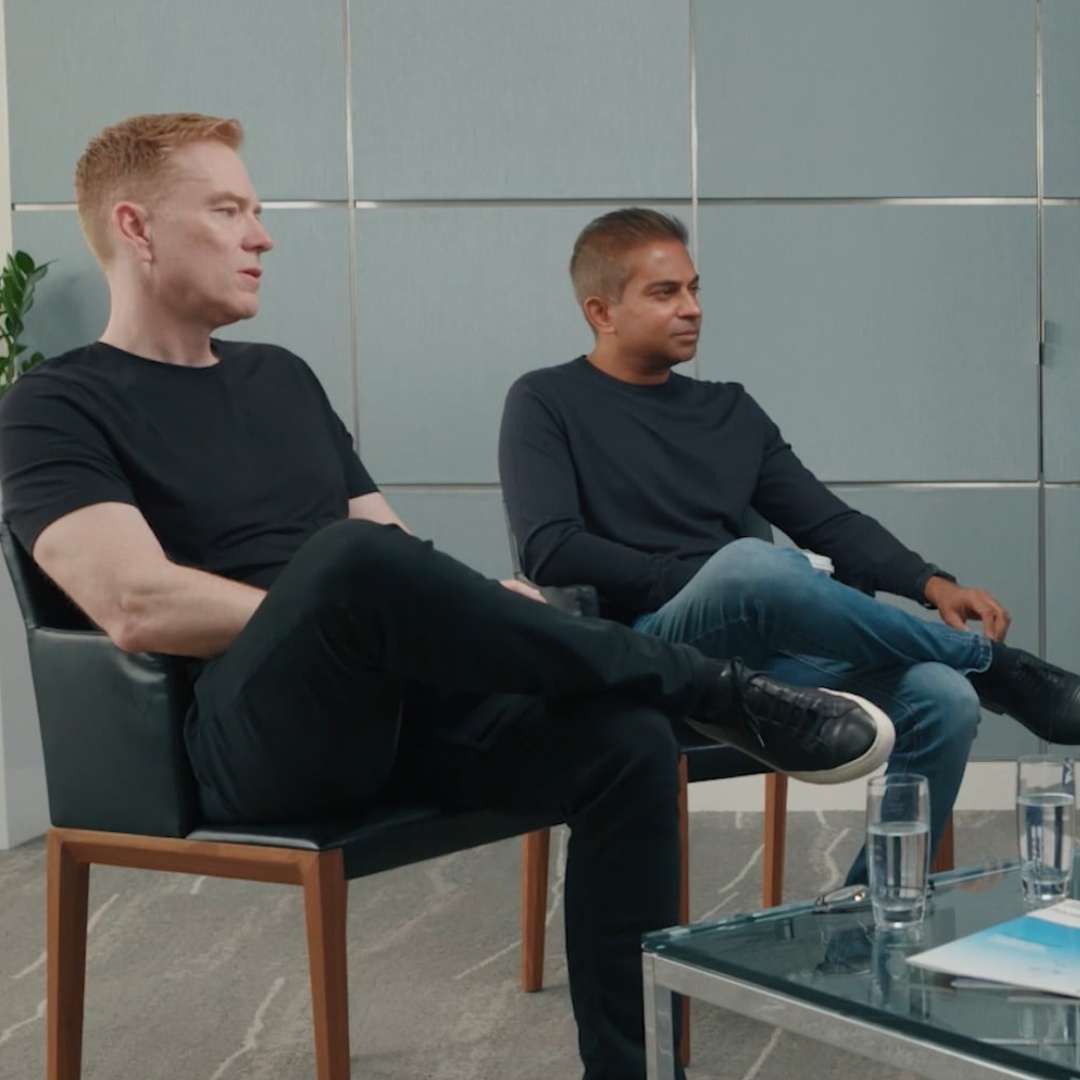
That autumn also brought the completion of Permira funds’ acquisition of Squarespace. The October transaction valued the company at approximately $7.2 billion. Founder Anthony Casalena retained a substantial majority of his existing equity, remained a major shareholder, and continued as CEO and board chairman.
The arrangement makes an ownership change compatible with continuity at the top. A founder can keep responsibility for the business while a new shareholder supplies a different capital structure and support. Squarespace provides a useful example from the opening months of Ruder’s co-CEO tenure, without requiring every company to follow the same leadership script.
The next owner needs room
Ruder’s discussion of exits in October 2025 had a distinctly social element. In his account, understanding a company requires time with employees and customers. A presentation can summarise a culture; conversations help reveal how it functions. There are parts of a business that decline to fit neatly into a spreadsheet, however impressive the spreadsheet may look.
“Ultimately, there’s no substitution for spending time with people.”
Brian Ruder / October 2025
He also argued for leaving growth potential for a subsequent owner and maintaining relationships with possible strategic buyers. The logic is straightforward: the next buyer needs a reason to believe the future remains attractive. An exit has two clocks, the seller’s and the buyer’s, and the seller controls only one.
This gives patience a practical meaning. Holding a company is useful when the time improves its prospects. A long calendar alone proves little. The task is to arrive at a sale with something a new owner can develop, and with people who understand why the business matters.
A wider audience, the same questions
As co-CEO, Ruder has also discussed bringing private-market strategies to wealth managers and their clients. In December 2024, he described the importance of distribution partnerships, technology and education. Subscription paperwork, capital calls and reporting were among the operational obstacles he identified. Access involves quite a lot of administration before it becomes an investment story.
He was equally clear that investors need to understand liquidity, transparency and fees. Those details matter when an asset class moves beyond its established institutional audience. A product can become easier to access without becoming suitable for every customer. The responsibility to explain it grows alongside the potential audience.
In September 2025, Ruder and Patel discussed Permira Wealth and the firm’s evolution with podcast host Michael Sidgmore. By October 7, 2026, Ruder was back on Bloomberg, describing resetting valuations and the application of technology experience to other businesses. The vocabulary had moved on to AI; the recurring question remained what a company could do with it.
His May panel supplied a smaller, funnier experiment. A Permira services team had given a sports-betting bot a couple of hundred dollars, which it proceeded to lose. Someone suggested building another bot to do the opposite. The story is a modest antidote to an industry fond of demonstrations. A working demonstration still needs a useful result.
Across these chapters, Ruder’s public account returns to products, ownership and judgment. There is room for ambitious technology and for the person checking its output. The next spreadsheet may arrive faster. The decision to trust it still takes work.