Right Now, Someone Is Drowning in Spreadsheets
Picture a fund manager in Chicago. She runs a $400 million real estate private equity fund. Forty-two limited partners. Three fund structures across two jurisdictions. K-1s due in six weeks. Her team is using Excel, a shared drive, and a prayer.
This isn't an edge case. Until recently, it was the norm. Private markets - private equity, venture capital, real estate, private credit - have long operated on infrastructure that predates the iPhone. Capital calls sent by fax. Investor reports assembled manually. KYC checks done in spreadsheets that no one can decipher three months later.
Juniper Square exists because someone finally got tired of watching that fund manager drown.
A trillion dollars in LP capital shouldn't be managed in Excel. Juniper Square decided to do something about that.
The platform serving private marketsThe Problem Nobody Wanted to Admit
Private markets are large, opaque, and operationally medieval. While public markets got Bloomberg terminals and electronic trading decades ago, the firms managing trillions in private capital were still emailing PDFs to investors and reconciling capital tables by hand. The irony is rich: the same institutions sophisticated enough to structure complex alternative investments were also the ones whose back offices looked like 1987.
The problem wasn't lack of ambition. It was lack of infrastructure. Building the plumbing for private markets is genuinely hard - every fund structure is different, every jurisdiction has different rules, every LP has different reporting preferences. The firms that tried to solve it either built too narrow a solution (a portal here, a document management tool there) or gave up entirely.
Three co-founders from San Francisco looked at this landscape and spotted the gap. Not a feature gap. An entire infrastructure gap.
The Founders' Bet
Alex Robinson, Adam Ginsburg, and Yonas Fisseha founded Juniper Square in 2014. Robinson came from product leadership at Microsoft and had spent time at New Energy Risk, a firm that was eventually acquired by XL Capital - he understood complex financial products and the organizations that use them. Ginsburg and Fisseha had worked together at Shopping.com (acquired by eBay) and Fanbase, which later became Nextdoor. Three people who knew how to build products at scale and sell them to sophisticated buyers.
Their bet was specific: if you could build a platform that handled every workflow - from the moment a GP starts raising a new fund to the moment they send the last K-1 to the last LP - you wouldn't just capture a market. You'd become the operating system for an entire asset class.
That bet is now worth $1.1 billion.
The firms building private market infrastructure weren't trying to build a feature. They were trying to build the rails that everything else runs on.
On Juniper Square's founding thesisThe Product: One Platform, Every Workflow
Juniper Square describes itself as a "connected software and fund administration" platform. That's accurate but undersells the scope. The platform covers the full lifecycle of private fund management, stitched together in a way that means GP staff don't have to transfer data between five different systems to close a quarter.
Fund Operations Platform
End-to-end software covering fundraising, investor onboarding, compliance, treasury, reporting, and business intelligence for private market GPs.
Fund Administration Services
Full-service administration combining expert staff with technology. 94% annualized retention of key fund accounting staff - they keep their teams together.
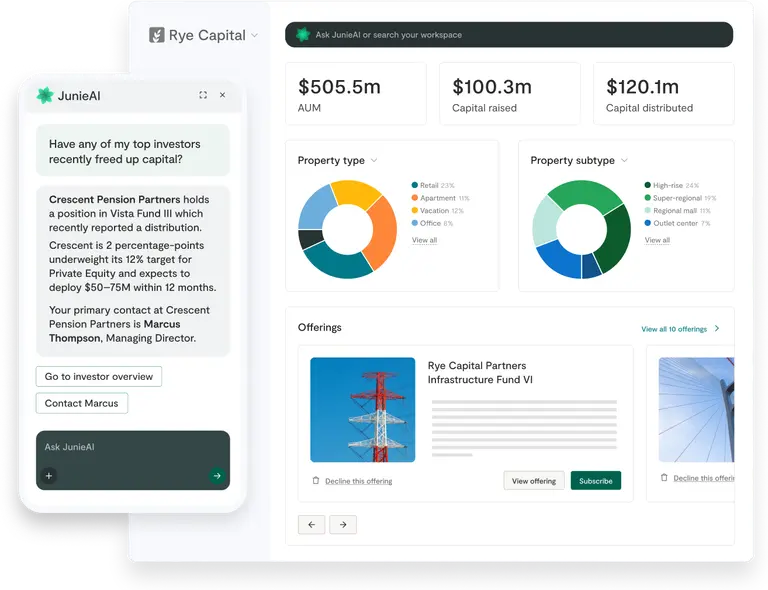
JunieAI
Enterprise-grade AI platform for private markets, including the first AI CRM purpose-built for investor relations and fundraising pipeline management.
LP Portal
Secure investor portal serving 700,000 LP accounts with real-time reporting, document management, capital calls, and distribution tracking.
Data Rooms
Digital due diligence rooms for secure document sharing during fundraising and deal processes. No more emailing ZIP files to institutional investors.
Compliance & AML/KYC
Automated regulatory compliance workflows including anti-money laundering, know-your-customer checks, and multi-jurisdictional fund reporting.
The JunieAI announcement in 2025 was the one that made people pay attention in a new way. It's not AI bolted onto an existing product - it's a ground-up AI layer built for the specific workflows of private markets: fundraising conversations, investor relationship management, and the kind of institutional memory that usually lives in one person's head and leaves when they do.
The Proof
Scale in private markets is measured differently than in consumer tech. Two thousand GPs sounds modest until you realize each one manages multiple funds, hundreds of investors, and years of compliance data. Juniper Square's 2,100+ GP customers collectively represent over 40,000 funds and 700,000 LP accounts - that's a significant slice of the entire private markets industry.
The retention story is equally telling. Private markets software is notoriously sticky - changing fund administration providers in the middle of a fund cycle is roughly as appealing as switching banks during a mortgage closing. The 94% annualized retention rate for fund accounting and investor services staff signals that clients aren't just staying out of inertia; the teams working inside the platform are staying too.
Customers include Jacobson Equities, Satori Capital, Avanath, DVO, Brazos Residential, and BGO - a range of managers across property types and strategies that illustrates the platform's breadth.
Revenue grew from $108.2M to $139.8M in a single year - a 29% increase in a market where most SaaS companies would take that growth rate and call it exceptional. Juniper Square treats it as table stakes.
The firms that win in private markets infrastructure aren't the ones with the most features. They're the ones who show up at quarter-end when nobody else does.
On the fund administration services modelThe Mission and the Money Behind It
The June 2025 Series D - $130 million at a $1.1 billion post-money valuation - was led by Ribbit Capital, which has now backed every major Juniper Square round. That kind of sustained conviction from a single investor is either a very good sign or a captive board arrangement. In this case, it reads as the former: Ribbit, known for backing transformative financial infrastructure businesses, clearly sees Juniper Square as category-defining.
The round included Fifth Wall (the real estate tech specialist), Redpoint Ventures, HighSage Ventures, and Blue Owl Capital. In September 2025, Nasdaq Ventures added a strategic investment to accelerate private markets technology innovation - a signal that the public markets infrastructure world is paying attention to what's being built on the private side.
The total raised since founding: $576 million. Eleven years. One unicorn. No pivot, no dramatic reinvention - just consistent execution on the original thesis that private markets needed proper infrastructure.
Why It Matters Tomorrow
Private markets are getting larger, not smaller. More capital is flowing into private equity, credit, and real estate as institutional and retail investors seek returns uncorrelated to public markets. The SEC's push to expand retail access to private funds will add millions of new LP accounts to the system. Every one of those accounts needs to be onboarded, reported to, and kept compliant with an increasingly complex regulatory environment.
JunieAI represents Juniper Square's bet on where this goes next. An AI that understands the specific language of fund operations - capital accounts, waterfall models, GP/LP dynamics, carried interest calculations - is a different product category than a general-purpose AI with a financial prompt. The AI CRM for investor relations, launched in October 2025, is the first product that lets fundraising teams manage their LP relationships with the kind of institutional memory that usually exists only in senior people's heads, nowhere else, until they leave.
The competitors are real - Carta, AppFolio, Yardi, Dynamo, Allvue Systems - but none of them have Juniper Square's combination of full-lifecycle software, managed services, and AI investment at this scale. The company built the foundation first, which means the AI they're building has actual data to run on.
Private markets are getting bigger and more complex. The infrastructure to run them has been the same since the fax machine. Something had to give.
The market opportunity Juniper Square is chasingBack to That Fund Manager in Chicago
She's still there, running her $400 million real estate fund. But the spreadsheet is gone. Capital calls go out through the platform, automatically routed to each LP's preferred delivery method. K-1s are generated in batch and distributed digitally. New investors onboard in days, not months. Her compliance team isn't manually reviewing documents at 11pm before a quarter close.
Her firm is still private equity. The deals are still complex, the returns are still uncertain, the relationships still matter more than the software. But the infrastructure layer - the part that should just work - finally does. Juniper Square didn't change what private markets are. They changed how much time fund managers spend fighting their own tools to do their actual jobs.
That's a different kind of company story: unglamorous, infrastructure-deep, and worth a billion dollars for exactly that reason.
Competitors
The field of private markets software is real but fragmented. Juniper Square's main competitors include: