Digitizing the $11.7 trillion private markets industry, one fund at a time. From 125 seed rejections to a $1.1 billion unicorn managing over a trillion dollars in investor equity.
Alex Robinson keeps a specific number in his head: 125. That's how many times investors said no before Juniper Square got its first yes. The $2 million seed round that finally came in - led by AngelList's Kevin Laws in fall 2015 - funded a company that now processes nearly one in ten dollars flowing through U.S. private equity. The math from no to trillion took about a decade.
Juniper Square, which Robinson co-founded in San Francisco in February 2014 alongside Adam Ginsburg and Yonas Fisseha, is the operating system for private markets: software and services that let general partners manage fundraising, investor relations, capital calls, reporting, and compliance all in one place. In an industry that spent decades running on PDF attachments and spreadsheet chains, that's a meaningful disruption.
"There's only one thing that matters in building a company, and that's building something that people want."
- Alex Robinson, CEO, Juniper SquareBefore Robinson was a unicorn CEO, he was a Seattle kid who'd fallen in love with atlases - specifically, with Spain. He lived outside Barcelona in high school, then Seville during his college junior year at the University of Washington. He speaks Spanish. He went to Stanford GSB for an MBA, expecting to land in clean energy. Then the government pulled the rug out from under his first company, and he had to start over.
His father was a dentist who invested in real estate on the side. Growing up watching deal documents pile up on kitchen tables, seeing capital calls arrive in the mail, Robinson absorbed the friction of private investment early. That intuition - that something deeply inefficient was hiding in plain sight inside alternative asset management - became the thesis for Juniper Square.
Robinson spent the fall of 2013 conducting more than 150 customer interviews before Juniper Square had a name, a website, or a single line of product code. That discipline is baked into the company's DNA. For the first 18 months, the team worked in near-obscurity with founding customers, building toward product-market fit rather than press coverage. The company didn't make a public announcement until January 2017, when it had 50 customers managing $25 billion in capital and 11 employees on payroll.
By that point, Robinson had already turned down two unsolicited acquisition offers - one valued near $100 million. His answer, recalled later: "If we sold the company, we would just be tortured for the rest of our lives with the question of what if." The conviction held. In June 2025, Juniper Square raised its Series D: $130 million at a $1.1 billion valuation, led by Ribbit Capital with strategic investment from Fifth Wall.
Today the platform serves 2,000+ GPs across 35,000+ funds, managing over $1 trillion in active investor equity. In 2026, Fast Company named Juniper Square to its Most Innovative Companies list for the first time. All three original co-founders are still at the company and still on the board together - a fact Robinson considers one of the company's defining features.
The current moment, in Robinson's framing: private markets are being reshaped by two forces simultaneously - the rise of the retail investor into alternative assets, and the breakthrough potential of AI. His response is JunieAI, an enterprise-grade AI platform built specifically for private markets GPs, and the acquisition of Forstone Luxembourg to enter the world's largest cross-border fund distribution market. He's building for the next decade, not the next quarter.
"The private markets are undergoing a once-in-a-generation transformation driven by two tsunamis of change: the rise of the retail investor and the breakthrough potential of AI."
- Alex RobinsonRobinson has a clear line about AI: "Every area inside of the GP should have an AI agent that is part of the team." And then the qualifier that separates private markets software from every other vertical: "It has to be right - always." In fund administration, an error isn't an inconvenience. It's a legal and financial event. The margin for hallucination is zero. That constraint - high technology, high service, always accurate - is the needle Juniper Square is threading.
What makes Robinson unusual isn't the funding story or the unicorn badge. It's the pace. Eleven years in, three original co-founders still running the company, a product that existed for three years before it made a press release. Juniper Square was built with the patience of someone who read too many real estate investment documents as a kid and got genuinely angry on behalf of every GP still faxing capital call notices in 2014. That specificity - the anger at a particular inefficiency in a particular industry - is usually what separates the companies that last from the ones that pivot until they disappear.
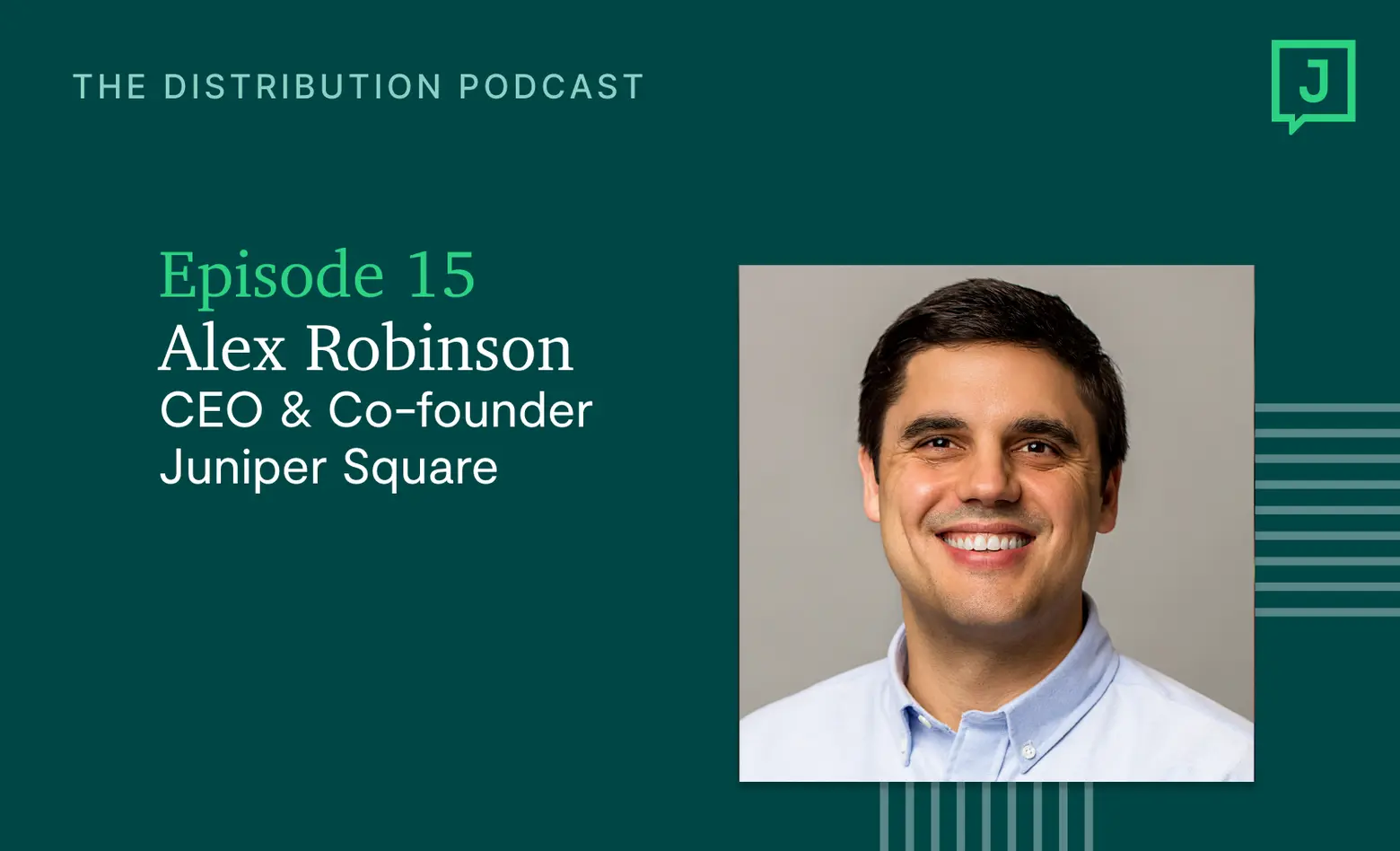
From 2002 to 2007, Robinson was a Senior Product Manager at Microsoft - working on OneNote, Office 365, and finance and strategy functions. He watched the company grow from 20,000 to 100,000 employees. He absorbed what scale looks like from the inside. Then he went to Stanford for his MBA, expecting to build something in clean energy.
In 2009, Robinson founded GreenDoor, a financial underwriting platform for PACE (Property-Assessed Clean Energy) renewable energy loans. The company was a market leader. Then, in summer 2010, federal regulators discontinued the subsidy program. Overnight. The business collapsed. Robinson calls it formative. He learned something most founders only learn theoretically: exogenous market risk is real, and it doesn't negotiate.
GreenDoor's team and assets were folded into New Energy Risk via acqui-hire. Robinson stayed on as Founding VP of Business Development, working alongside an experienced CEO on complex risk underwriting in renewable energy. XL Group/XL Capital acquired the company in 2013. He was now 30-something, twice-forged, and looking for the right problem to solve for the next decade.
In March 2013, Robinson was introduced to Adam Ginsburg - a former Nextdoor product lead - through a mutual friend named Joel Truher. Adam suggested Yonas Fisseha as the ideal engineering co-founder. Robinson had the market insight (his dad's kitchen table covered in real estate investment documents), Ginsburg had the product instincts, Fisseha had the engineering depth. They spent the rest of 2013 running 150+ customer interviews. They didn't incorporate until February 20, 2014. They didn't publicly announce until January 2017. Three years of building before the press release.
Bar widths proportional. Total: $576M across rounds. Series D led by Ribbit Capital with Fifth Wall strategic investment.
There's only one thing that matters in building a company, and that's building something that people want.
Every area inside of the GP should have an AI agent that is part of the team. But it has to be right - always.
If we sold the company, we would just be tortured for the rest of our lives with the question of what if.
Very high technology. Very high service levels. The two are complementary, not mutually exclusive.
The private markets are undergoing a once-in-a-generation transformation driven by two tsunamis of change: the rise of the retail investor and the breakthrough potential of AI.
Reduce the scope of the problem you're solving as much as possible to achieve meaningful progress with limited resources.
End-to-end investment management software for private equity, venture capital, real estate, and other alternative asset managers. Fundraising, investor relations, capital calls, reporting - all in one connected platform instead of a patchwork of spreadsheets and email chains.
High-touch fund administration powered by technology. Juniper Square's "high tech, high service" model combines software automation with human expertise - a deliberate rejection of the false choice between efficient machines and reliable people.
The company's enterprise-grade AI platform for private markets GPs. Designed to embed AI agents across investor relations, reporting, fund operations, and internal decision-making - with the zero-tolerance accuracy that financial operations demand. Launched alongside the Series D in 2025.
Robinson lived outside Barcelona in high school and in Seville during his college junior year. He speaks Spanish - a thread that connects a kid staring at globes to a CEO thinking about global private markets infrastructure.
His father was a dentist who invested in real estate on the side. Robinson absorbed the friction of private investment from age 12 - the mail-in capital calls, the paper stacks, the manual everything. That frustration became a billion-dollar software company.
Juniper Square had no website and no official company name for its first 18 months. The team built product with founding customers in near-obscurity before anyone outside knew the company existed.
Robinson received 125 formal rejections from angel and seed investors before getting the $2M seed round. He kept going. The investors who said no are now watching a $1.1B unicorn manage one percent of U.S. GDP in private equity.
All three Juniper Square co-founders - Robinson, Adam Ginsburg (Head of Product, ex-Nextdoor), and Yonas Fisseha (Head of Engineering, ex-Shopping.com) - are still at the company and still on the board after 11+ years together. Three people, one company, zero co-founder drama.
Juniper Square processes nearly 9% of the $11.7 trillion U.S. private equity ecosystem. Junier is an evergreen tree - the name was chosen deliberately. Resilient. Long-lived. Not a growth hack.