Gregory Bedrosian gives finance a surprisingly modest share of the credit. Asked to explain cross-border mergers and acquisitions, the managing partner and CEO of Drake Star divides the job into thirds. Finance and dealmaking receive one. Diplomacy receives another. Social psychology gets the last. For a banker, this is a rather generous allocation to subjects that cannot be made to behave in a spreadsheet.
The formula is a useful entrance to his career. He has worked at established financial institutions, helped build investment businesses, and become a leader of a technology-focused bank formed through a transatlantic merger. His work has moved between advising a seller and judging an investment, between entrepreneurs and institutions, between the machinery of a transaction and the people who must agree to operate it.
Read his public remarks across those settings and a pattern emerges: he keeps returning to the conditions around the money. Who supports a founder? What does a buyer inherit? How does a company become ready for its next owner? These questions give his career its continuity, even when the setting changes from an emerging-market investment committee to a conversation about college athletes.
“One part finance and dealmaking, one part diplomacy and one part social psychology.”
Gregory Bedrosian, on cross-border M&A
A way of thinking about deals, rather than a statistical measurement.
A career with more than one capital
Bedrosian studied economics at the University of Pennsylvania’s Wharton School and earned an MBA at Harvard Business School. His early professional experience included the leveraged buyout group at Salomon Brothers in New York and merchant banking at Credit Suisse First Boston in London. Those are two different vantage points on ownership: the financing of a purchase, and the business of putting capital behind companies.
He later co-founded Renaissance Capital and the Sputnik Funds, an emerging-market private equity business described as a $1 billion firm. These ventures placed him in a career concerned with investment across borders. London and Moscow were part of that professional geography. By 2020, Da Vinci Capital’s announcement of his investment-committee appointment described half his career as having been spent in Europe and emerging markets.
The geography matters because a cross-border transaction asks people to agree across different institutional settings. A valuation can be translated into another currency; assumptions about authority, timing and trust require more care. His three-part formula recognizes this extra work. Diplomacy and psychology are given equal billing with the financial mechanics, rather than being treated as pleasant extras after the serious people have finished calculating.
It also helps explain the range of rooms he enters. In November 2014, he joined a Columbia University conference on the BRICS countries and global governance. The subject included how those economies were building institutions. A banker speaking alongside academics and policymakers can sound like a detour from dealmaking. In Bedrosian’s case, the institutions surrounding a business were already part of the job.
The founder needs a neighbourhood
At the Russia Forum in New York in 2015, Bedrosian was asked what would most help entrepreneurs in Russia. The forum took place amid political tension between Russia and the United States. His answer looked beyond the national argument to the practical surroundings of a young business: mentors, examples of entrepreneurs who had succeeded, angel investors, and legal and venture-capital infrastructure.
His brief phrase was “it’s all about the entrepreneurial ecosystem.” He applied the same principle to Silicon Valley, Western Europe and China. This was a specific answer to a specific question, with a wider implication: a founder’s prospects depend partly on the network of people and institutions available when a difficult decision arrives.
There is something pleasingly unglamorous about that list. The founder gets the magazine cover. The lawyer, mentor and investor community get the job of making the next stage possible. Bedrosian’s answer distributes the credit. It allows ambition its place while asking who will help ambition survive its first encounter with paperwork, financing and the demands of expansion.
His connection to Harvard extends beyond his degree. He has served on the business school’s alumni board, and his current professional biography lists him as an adviser at Harvard Innovation Labs. That advisory role fits the ecosystem argument: experience becomes useful to a new company when someone can pass it along. The public record shows the role; his 2015 remarks explain why such a role belongs in his view of entrepreneurship.
Then the adviser had a merger of his own
Bedrosian co-founded and led Redwood Capital Group. In September 2016, Redwood Capital and Europe’s LD&A Jupiter announced a definitive agreement to merge into Drake Star Partners. The announcement positioned the combined business around technology, media and communications, with Bedrosian as co-CEO in New York and Marc JR Deschamps as co-CEO in London.
The arithmetic behind the announcement was unusually revealing. The predecessor firms reported more than 274 transactions since 2004, with 70 percent crossing borders. The new firm’s announced office network reached nine cities in seven countries. These were figures about the participating firms’ work and reach, rather than a personal deal tally for Bedrosian.
The merger gave the adviser a direct stake in the organizational question he discussed with clients: how do you make separate businesses work together? In the launch announcement, his emphasis was on access to multinational corporations, financial investors and growing companies, together with international execution. The stated ambition was to make the combined network useful to clients pursuing transactions across countries.
An office list is easy to print. A working relationship across offices is a more demanding proposition. The distinction gives the merger an interesting place in his story. His recipe for cross-border work would have to be relevant inside the firm as well as across the negotiating table. The bank’s own formation made its international argument concrete.
of the predecessor firms’ reported transactions were cross-border.
More than 274 transactions since 2004. Historical firm figures.What comes with the purchase
Bedrosian’s comments about diligence offer a less ceremonial view of his work. In a January 2015 discussion published by WISeKey, he described cybersecurity checks entering acquisition closing checklists alongside financial review and conversations with vendors and customers. He pointed to the risk of buying a business that had neglected security investment and inheriting the resulting problems.
It is an acquisition question with an everyday logic: what else is included in the price? The accounts show one part of a company. Systems, practices and unresolved obligations show other parts. Bedrosian’s observation puts the buyer’s future experience into the transaction, before the signatures make that experience expensive to revise.
There is continuity between that concern and his later discussion of sports technology. In both, the quality of an organization’s technology affects how a buyer should assess it. A deal concerns a functioning business, with habits and capabilities as well as revenue. The attractive headline number still has to live with everything underneath it.
Industry recognition followed his cross-border work. He received the M&A Advisor Leadership Award in 2016 and was inducted into its Hall of Fame. His current biography also records the 2021 Global M&A Leadership Award. These honors mark how the dealmaking industry has recognized his career. The diligence comments reveal something more practical about it: attention to the liabilities and capabilities that survive the celebratory announcement.
An investment committee, then a traffic light
In June 2020, Da Vinci Capital announced that Bedrosian would chair the investment committee of its third-vintage emerging-technologies fund in a non-executive role. The remit included evaluating and recommending portfolio companies, along with strategic advice on investor relations, governance and transaction execution. The appointment brought his advisory experience into the selection and oversight of investments.
That assignment also kept an emerging-market thread running through his work. His current biography lists the Da Vinci investment-committee chairmanship alongside a senior advisory position at MEP Capital, which focuses on media and entertainment credit and private equity. These roles connect financing decisions with businesses in sectors he also encounters as an investment banker.
When he turned to the outlook for 2023, he used another compact teaching device: a traffic light. He grouped the forces behind M&A into strategy, finance and confidence. Strategy was green; finance and confidence were yellow. The image allowed a distinction that a single cheerful or gloomy forecast could easily lose. A company could have a sound reason to buy while finding the financing environment uncomfortable.
The same outlook introduced his M&A barbell. At one end were early businesses needing cash to reach profitability; at the other were well-financed companies whose hopes of a public listing had been disrupted. Between them, he highlighted companies with consistent revenue and cash-flow growth. This was his assessment for that period, and it illustrates his habit of making complicated market conditions legible through an ordinary object.
Follow the money beyond the scoreboard
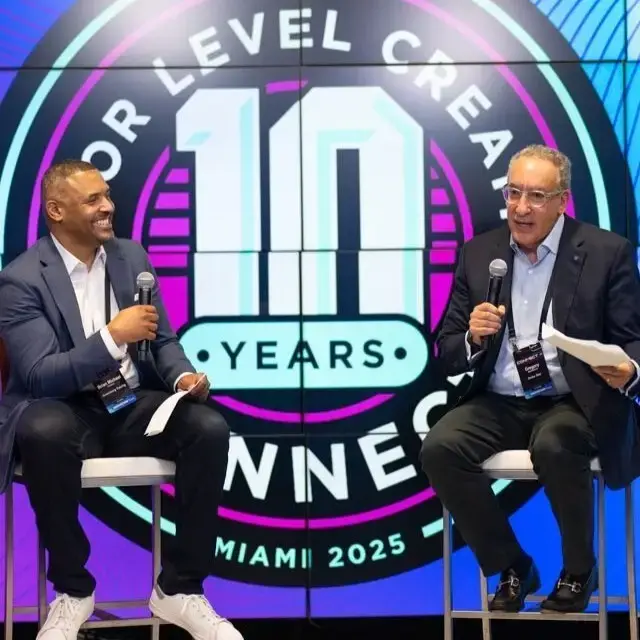
By 2025, sports technology had become a visible subject in Bedrosian’s public appearances. At MLC CONNECT in Miami, he opened the event with a fireside discussion of global technology M&A and sports technology. The photograph catches him at the right of the stage, microphone in hand, with the event’s anniversary graphics looming behind the conversation.
On October 7, 2025, he appeared on Next League’s Know What Is Next podcast with CEO David Nugent. Their subject was where money was moving in sports: private equity, youth sports and emerging leagues. The episode’s agenda reached beyond media rights into data strategy, fan payments and venues that could earn revenue throughout the year.
For anyone used to treating sports finance as a succession of television contracts, that is a broader map. A fan’s payment experience, an organization’s data systems and the use of a facility all become business questions. In the podcast discussion, youth sports appeared as an area where technology, payments and facilities were attracting investment interest. Operational detail moved into the foreground.
The conversation also considered sovereign capital and its longer investment horizons, together with buyers’ expectations of technological and organizational maturity. These subjects sit comfortably beside Bedrosian’s earlier concern about what a buyer inherits. The categories have changed; the question of readiness persists.
His public activity in 2026 continued that sports focus. In a recap of the PEAK SportsTech Conference in Las Vegas, he described a main-stage conversation with Stephen Denton, CEO of Opendorse, about US college sports and the name, image and likeness economy. It was another setting where athletes, operators, technology platforms and capital met in the same business discussion.
The people left in the equation
Bedrosian’s career is easy to turn into a list of firms, degrees and awards. The more interesting story lies in the connections among them. Emerging-market investing brings institutions into view. Advising entrepreneurs brings support networks into view. Acquisition diligence brings the buyer’s future responsibilities into view. Sports technology brings everyday operations into a discussion often dominated by spectacle.
His formula gives those connections a language. Finance supplies a necessary part of the work. Diplomacy acknowledges the parties who must reach agreement. Psychology acknowledges that those parties arrive with expectations and concerns of their own. The numerical symmetry is memorable, but its real use is to prevent any one discipline from claiming the whole transaction.
The next owner will still need a business that functions. The founder will still need people who can help. The international firm will still need colleagues who work together across its office list. Bedrosian’s public remarks keep making room for these less photogenic requirements. A spreadsheet has many talents. Persuading everyone around the table to mean the same thing is a talent it has yet to acquire.
Continue the conversation
- Gregory at Drake Star ↗
- LinkedIn ↗
- X / Twitter ↗
- The Next League conversation ↗
- The 2016 merger announcement ↗
- His 2023 M&A outlook ↗
- The entrepreneurial ecosystem discussion ↗
- Da Vinci investment-committee appointment ↗
- Cybersecurity and acquisition diligence ↗
- Bloomberg Live conversation ↗
- Drake Star events ↗
- Historical personal blog ↗
- Drake Star on YouTube ↗