An empty market presents an awkward question: what is something worth when almost nobody will buy it? In October 2008, Craig Cerny put his name to an answer. As chief executive of Harrington West Financial Group, he co-signed a two-page letter about fair value accounting. It concerned mortgage securities, disappearing prices and the difference between a thin market and the payments an asset might still produce. The prose was decidedly unfit for a cocktail party. The problem was anything but academic.
That letter offers an unusually concrete entry into Cerny's career. Today he is chief executive of TerraNova Capital Equities and TerraNova Capital Partners. Earlier, he worked in corporate finance, investment management and community banking. The sequence puts him on several sides of the same financial question: how should money be valued, supplied and put to work?
The interesting part of this history lies in its changes of position. A corporate finance employee works inside a business. An investment manager considers assets for a portfolio. A bank chief must answer for an institution. An adviser helps another company make its next move. Cerny has held roles in each setting. His biography becomes more legible when those jobs are read together, with their different obligations intact.
Greeting cards, pizza and the corporate ledger
Cerny's early employers included Hallmark Cards and Pizza Hut Restaurants, where he worked in corporate finance. The names carry a pleasingly ordinary contrast: messages for special occasions and dinner for an ordinary evening. His work belonged to the financial side of those businesses, before his later roles in investment management and banks.
He earned a Bachelor of Science in Finance and an MBA at Arizona State University's W. P. Carey business school. His subsequent employment at Smith Breeden Associates ran from April 1985 to December 1996. There he became a principal and board member, working in bank consulting and investment advice.
That position linked financial markets to the institutions holding financial assets. Interest rates affect the value of investments and the costs of funding them. For a bank, those changes can arrive on both sides of its balance sheet. Advice on that relationship requires attention to what an institution owns as well as how it pays for it. A loan may produce payments over many years while the funding supporting it has a different timetable. The amounts on the ledger are only the beginning of the description. Timing and contractual terms help explain what those amounts mean. That is the financial setting in which Cerny worked before and during his move into bank leadership.
By February 1992, Cerny also held the chief executive and president positions at Harrington Financial Group in Richmond, Indiana, and leadership positions at its subsidiary, Harrington Bank. The dates overlap with his Smith Breeden employment. The career was already moving between advising institutions and running one, rather than proceeding through a tidy queue of unrelated jobs.
- Corporate financeHallmark Cards · Pizza Hut
- Investment managementSmith Breeden · 1985-1996
- Bank leadershipHarrington institutions
- Strategic adviceIntegrity · founded 2010
- Investment bankingTerraNova · CEO from 2020
A bank chief has more than one number to watch
Community banking gave Cerny a different set of responsibilities. He later served as chairman and chief executive of Harrington West Financial Group and held senior leadership roles at Los Padres Bank. The Harrington businesses placed his banking career in the Midwest and Southwest.
A 2006 description of how Harrington West assessed his performance gives some texture to the job. Profit appeared alongside capital position, asset quality, franchise value, investment results, strategy execution and efficiency. Those measures pull attention in several directions. Earnings describe a period. Capital provides a cushion. Asset quality asks whether borrowers and investments will perform as expected.
The list also included franchise development. A banking business has relationships, locations and operating costs as well as financial instruments. Making it larger and making it sound are related ambitions, but the measures used to judge them are different. Even a satisfactory earnings number cannot answer every question on that list.
For Cerny, this was a sustained operating chapter. His later career description records 18 years as chairman and chief executive across two publicly traded community banking institutions. The advisory work that followed therefore came after years of being responsible for the business receiving capital, with the reporting and governance obligations that accompanied it.
October 2008: when the price became the argument
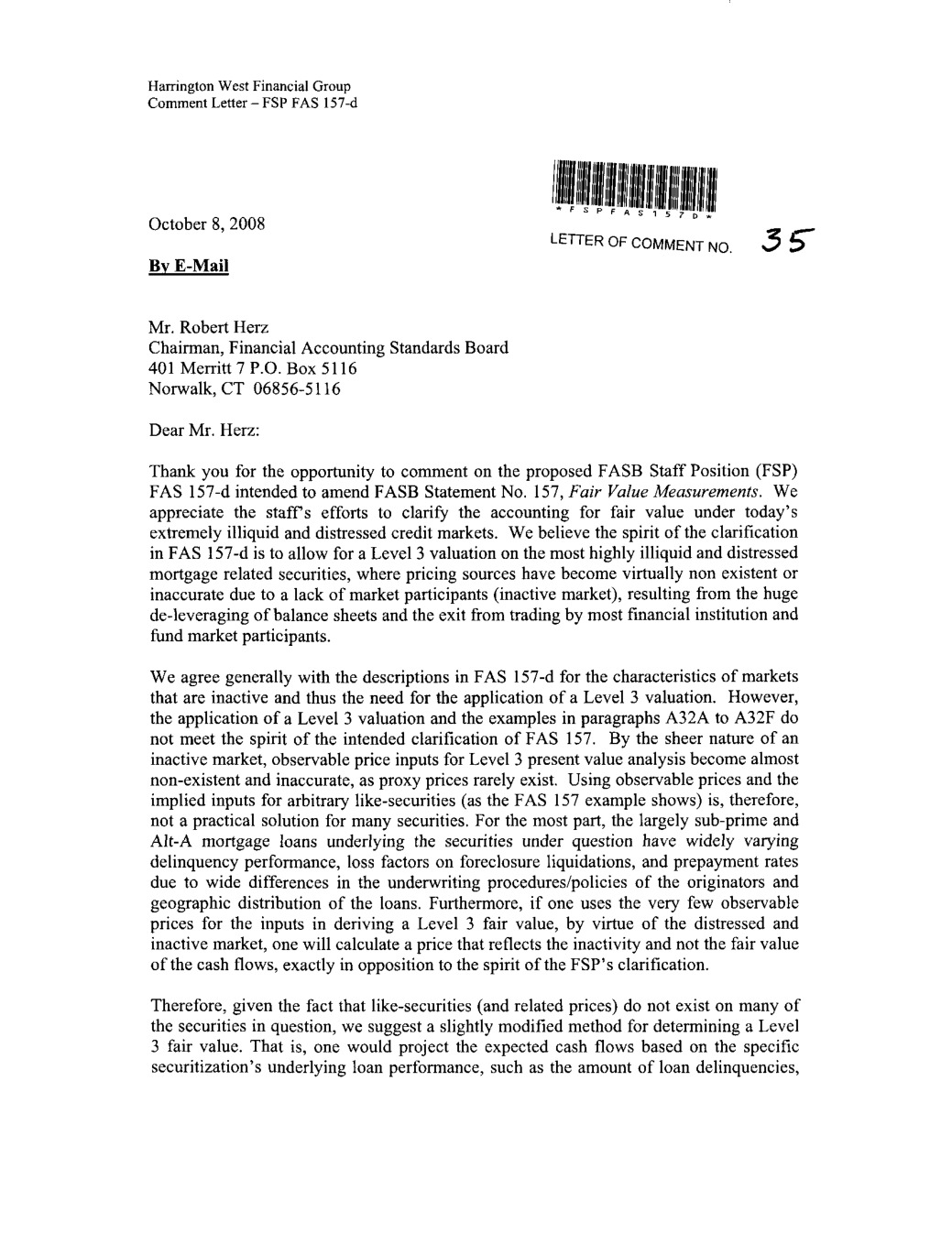
The accounting letter, dated October 8, 2008, was addressed to Robert Herz, chairman of the Financial Accounting Standards Board. Cerny signed it with Harrington West's chief financial officer, Kerry Steele. They questioned how proposed fair value guidance would work in an inactive market.
Their proposed approach started with the performance of the underlying loans, estimated the resulting payments and discounted those payments for risk. The distinction was consequential: a distressed price could reflect the absence of trading as well as the economics of the asset. A number printed with great precision could still require considerable judgment.
It was an institutional argument made by two executives, rather than a personal manifesto. Its interest for this profile is the specificity of the question Cerny was working on. He was dealing with a balance sheet at a moment when the meaning of its measurements was contested. Financial reporting had become part of the operating problem.
A valuation is an estimate made under a set of assumptions. It cannot create a buyer, supply fresh capital or guarantee a borrower's next payment. Accounting, liquidity and financing meet at the same balance sheet, but they perform different jobs. The events that followed at Harrington West make it necessary to keep those distinctions visible.
“one would project the expected cash flows based on the specific securitization's underlying loan performance”
Harrington West comment letter, co-signed by Craig Cerny and Kerry Steele · October 2008
The capital raise, and the closure that followed
In late 2008, Harrington West completed a two-stage equity placement with Concordia Financial Services Fund. Concordia's investment amounted to $10 million, divided between common and preferred stock. After the second closing, its stake was reported as 20.1 percent on an assumed-conversion basis.
Cerny described Concordia as a passive, supportive investor and said the business plan and management team would remain unchanged. The transaction involved more than finding a willing investor. The second closing depended on regulatory and shareholder conditions, which were satisfied in December. The mechanics of ownership mattered alongside the amount of money raised.
The banking chapter later reached a hard ending. On August 20, 2010, the Office of Thrift Supervision closed Los Padres Bank, and the FDIC became receiver. Pacific Western Bank assumed all deposit accounts. Fourteen former branches reopened under Pacific Western on the following Monday.
That outcome belongs in Cerny's story alongside the capital raise and the accounting argument. Neither earlier event erased the eventual closure. For depositors, the transition preserved their accounts at another institution; for the bank, it ended independent operation. A career that includes bank leadership during this period contains both efforts to secure capital and the limits of those efforts.
From running the institution to advising it
Cerny founded Integrity Financial Advisors in 2010. Its work concerned capital solutions and strategic advice for banks and middle-market companies. After the bank leadership chapter, his next business returned to helping other institutions with their financial decisions.
He joined TerraNova in 2015 and became chief executive in August 2020. His work there has included equity, debt and merger-and-acquisition engagements. The firm separates its investment banking activities in TerraNova Capital Equities from the advisory and merchant banking work of TerraNova Capital Partners. Cerny leads both companies.
The categories describe different decisions for a client. Raising debt introduces repayment obligations. Raising equity changes ownership. Buying or selling a business brings valuation, negotiation and transaction structure into the same conversation. A financing discussion can therefore become a discussion about what the owners want the company to become.
One client account makes the work less abstract. Daniel DelGiorno, chairman and chief executive of Cyber Safety and Advanced Cyber Security, credits Craig and the TerraNova team with helping provide working capital through preferred equity and bridge debt from late 2017. The account names a practical need and the instruments used to address it. It describes financing as support for commercialization, with Cerny working alongside a team.
An older banking career in a newer capital market
Cerny's present role sits within a firm whose work extends into energy and technology. In August 2023, TerraNova announced that it had advised on, and acted as sole placement agent for, the sale of a majority interest in Composite Advanced Technologies to Apollo-managed funds. CATEC supplies compressed-gas transportation and storage equipment.
In February 2024, TerraNova posted its engagement to help finance CalEthos's planned data-center campus in Imperial County, California. The development was described as a 300-megawatt project using geothermal and solar power, with a planned cost of $5.2 billion. That figure described the proposed development; the announcement concerned a financing mandate. Cerny leads the firm, while these announcements identify other bankers in the transaction details.
These projects put contemporary business ambitions next to familiar financing questions. A storage-equipment company has owners considering a sale. A proposed campus needs a capital structure before its plans can become operating assets. Technology changes the object being financed; it leaves plenty of work for advisers sorting through ownership, obligations and timing.
Cerny is based in Scottsdale, while TerraNova operates from New York. His career connects those locations with an earlier Indiana banking chapter and years in investment management. Across that history, the financial questions have grown, changed and sometimes ended badly. The two-page letter from 2008 remains a useful place to begin: with an executive examining what a number means before deciding what can be done with it.