Rasha Qamheyeh has a name on a patent for determining the phase of signals in a wireless power system. She also has a name on a mentoring roster for women entrepreneurs. The two documents belong to rather different filing cabinets. Read them together, though, and they suggest a career spent attending to the arrangements that allow something useful to happen.
At Ossia, that meant working with technology intended to deliver power wirelessly, and with the business relationships around it. At Event Horizon, the incubator she founded, it means helping technology startups with the foundations of a company. In mentoring programs, it means sharing experience with women who are building businesses of their own.
Qamheyeh studied physics, then finance. In July 2026, she returned to the language of her first discipline to consider a familiar business puzzle: why do organizations full of talented people sometimes struggle to perform? Her essay, Why Talented Teams Underperform, introduces resonance as a way of thinking about how a system responds to the energy available to it.
She presents this as a possibility, with the modest wording a scientific analogy deserves: “Perhaps organizations behave in much the same way.” The question is consistent with her professional interests. An organization contains people, ideas and resources. How those elements interact can be as consequential as having them in the first place.
The invention and the business around it
The scientific part of Qamheyeh’s background has a concrete record. Her undergraduate degree is in physics from the University of Jordan. She completed an MBA at New York Institute of Technology in 2004, following study from 2002 to 2004.
In January 2016, when Molex announced an investment in Ossia, Qamheyeh was identified as Ossia’s director of business development. The announcement concerned Cota, Ossia’s wireless power technology, and described a relationship involving both direct investment and the possibility of working with an established manufacturer.
That distinction mattered to the announcement. Molex brought engineering capabilities, manufacturing operations and a sales presence across markets. A young technology business needs ways to reach customers as well as ways to demonstrate its invention. Qamheyeh’s statement welcomed the investment and the strategic relationship together.
Her involvement also reached into the technical record. A patent granted on February 6, 2018, names Qamheyeh with Douglas Williams, Hatem Zeine and Dale Donald Mayes. Its title is Systems and methods for improved phase determinations in wireless power delivery environments. Patent titles seldom arrive dressed for dinner, but this one tells you exactly which problem the inventors were addressing.
The apparatus compares an incoming signal with different phases of a reference signal and uses the results to determine relative phase. Another patent in the same family was granted in April 2020, again naming the four inventors. These are shared technical credits, placing Qamheyeh among the people contributing to the underlying invention.
In 2017, she was identified as Ossia-Japan managing director in coverage of a Vital Voices awards gala in Washington. The detail brings her commercial and community commitments into the same photograph of her working life. Wireless power and women’s leadership were already occupying it at the same time.
Qamheyeh’s name appears alongside Williams, Zeine and Mayes on a patent addressing phase determination in wireless power delivery.
An incubator with practical nouns
Qamheyeh’s Event Horizon describes its work through a set of services: business operations, intellectual property, investment strategy and access to capital networks. It supports technology startups with social impact, using strategic planning to develop milestones for different aspects of a business.
Those services cover questions that sit around an invention. How will the business operate? What intellectual property needs attention? What strategy will guide investment? Which relationships might help a company find capital? Event Horizon’s description puts these subjects together rather than treating a technical idea as a finished company.
The vocabulary is usefully workaday. Operations means someone has to organize delivery. Milestones mean progress has to become specific. Intellectual property brings ownership and protection into the discussion. An idea may be elegant; the business supporting it still has appointments to keep.
Event Horizon’s wider mission includes engineering responses to climate change and technology with broad social benefit. Its ambitions are expressed in terms of scalable business foundations. Scale here is an aspiration for the work, rather than a reported count of people already reached.
Qamheyeh’s other roles have also placed her inside young companies. In 2022, she was identified as AgribotAI’s cofounder and chief operating officer. She has also worked at Kumbaya. The recurring subjects are technology and the organization of a business around it.
operations
property
strategy
networks
The four areas of support described by Event Horizon.
A seat at the mentoring table
In a 2019 reflection, Qamheyeh recalled attending her first Vital Voices event four years earlier. What impressed her was the organization’s lasting involvement with women in their communities, including the resources and relationships that helped them develop their businesses.
She described those connections through the language of an incubator. Her interests in business foundations and women’s leadership met in the same practical concern: access to people and knowledge that can help an enterprise grow. She served on the Vital Voices Northwest Council from September 2016 to March 2024.
The commitment took several forms. Qamheyeh and Hatem Zeine were named as founding members of the Global Headquarters for Women’s Leadership in 2023. She also served on the board of Every Woman Treaty, from January 2022 to November 2024.
In October 2022, the Global Ambassadors Program paired her with Cecilia Flores, cofounder and chief operating officer of Webee, an enterprise software company working with AI and the Internet of Things. The program brought women business and nonprofit leaders to Washington for strategic planning and mentoring with experienced executives.
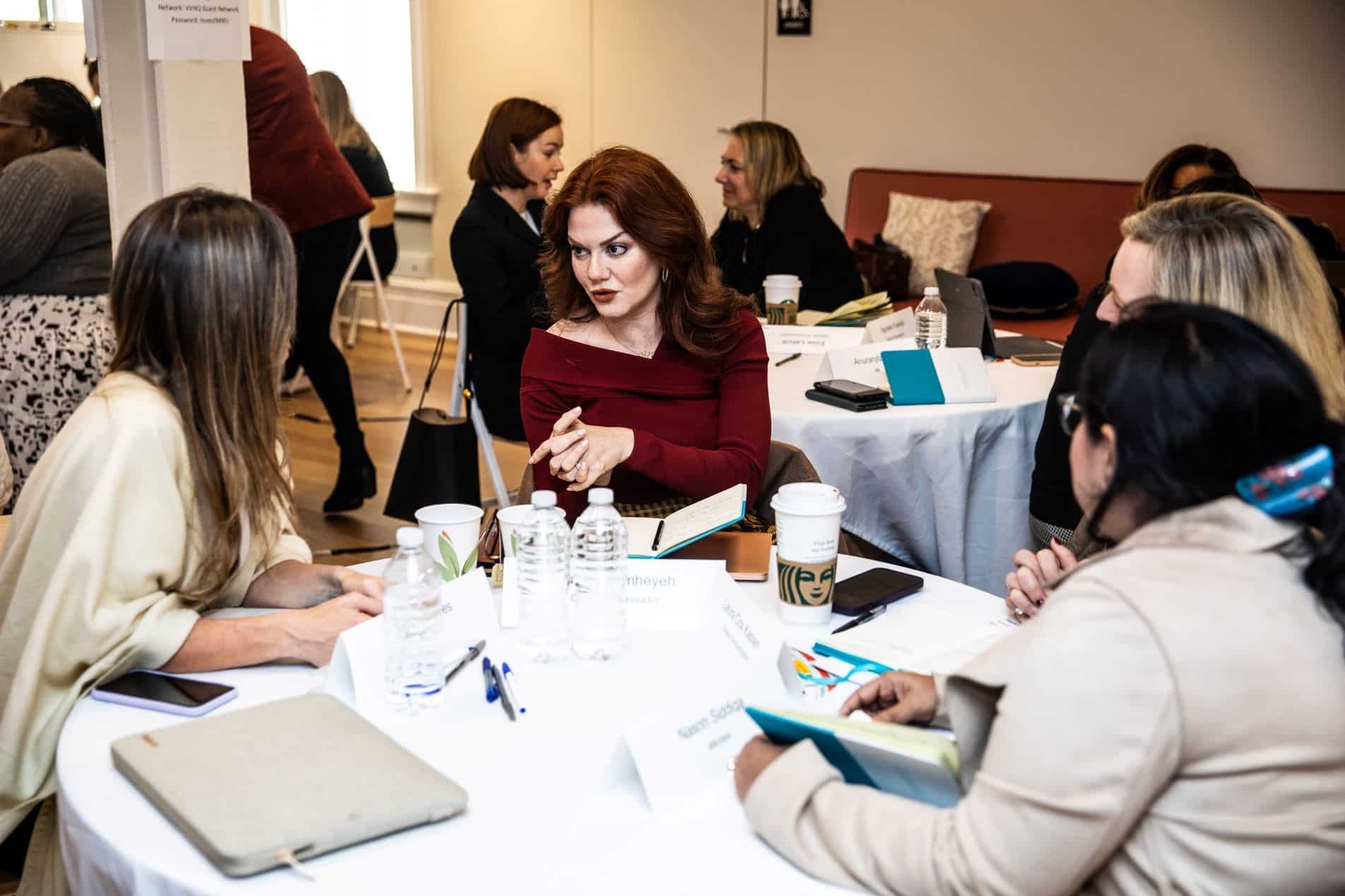
Her participation in PowerUp extended that interest to a program designed for women-led ventures preparing to scale. In June 2023, she joined a Startup Grind Boston panel about the gender funding gap alongside investors and startup practitioners from several regions. The discussion introduced PowerUp’s strategic and financial planning approach.
The panel roster included Pauline Koelbl, Tamara Abdel-Jaber, Bryony Cooper, Jacqui Bloom and Joanne Gan, with Victoria Yampolsky moderating. It placed Qamheyeh in a conversation about the resources available to women founders, a subject that her mentoring work approached through individual relationships as well.
Twenty-two alumni in Colombo
During the week of August 25, 2024, Qamheyeh joined a gathering in Colombo, Sri Lanka, for alumni of the Fortune-State Global Women’s Mentoring Partnership. Twenty-two participants from four countries across South and Central Asia came together to exchange experience and discuss business and leadership challenges.
Qamheyeh led sessions on corporate leadership, business valuation, and strategic expansion and impact. The subjects brought executive decisions and financial questions into one week of teaching. Participants were also welcomed by U.S. Ambassador Julie Chung and representatives of the American embassy in Sri Lanka.
Training subjects: corporate leadership, business valuation, strategic expansion and impact.
The gathering included conversations with local women leaders, including journalist Dilrukshi Handunnetti and social entrepreneurs Sandra Wanduragala and Selyna Peiris. A visit to Hatch, a coworking space and incubator, introduced participants to founders working within Colombo’s entrepreneurial community.
These details give the mentoring chapter a particular setting and content. Qamheyeh’s contribution was a series of business training sessions, alongside a program of meetings and visits. The week brought her experience into contact with people building enterprises in different countries, with different markets and challenges.
The Fortune-State mentoring program ceased operating in early 2025. The Colombo week remains a completed chapter of her work, with its participants, location and teaching subjects attached.
Who gets the credit?
In 2025, the Jordan Embassy in Washington recognized Qamheyeh as a Jordanian-American success story. Her response made room for the people behind that description. She thanked the mentors who had guided her, the friends who had inspired her and the collaborators continuing to build alongside her.
“For the good of many, not the credit of one.”Rasha Qamheyeh, on sharing her embassy recognition
She shared the recognition with those people. It was a public expression of gratitude, consistent with the attention she has given to mentoring and to connections across communities. A personal honor became an occasion to acknowledge a group.
Her later writing about organizational performance returns to the group from another direction. Physics supplies the analogy; companies supply the question. The patent record, Event Horizon’s business services and her mentoring commitments each provide a different place to consider how people and resources work together.
Qamheyeh’s career contains technical contributions, commercial roles and commitments to women’s entrepreneurship. Keeping all of them in view makes the portrait more specific. There is an inventor on the patent, a founder behind the incubator and a mentor at the table. In each setting, there is useful work to do before a promising idea can grow.