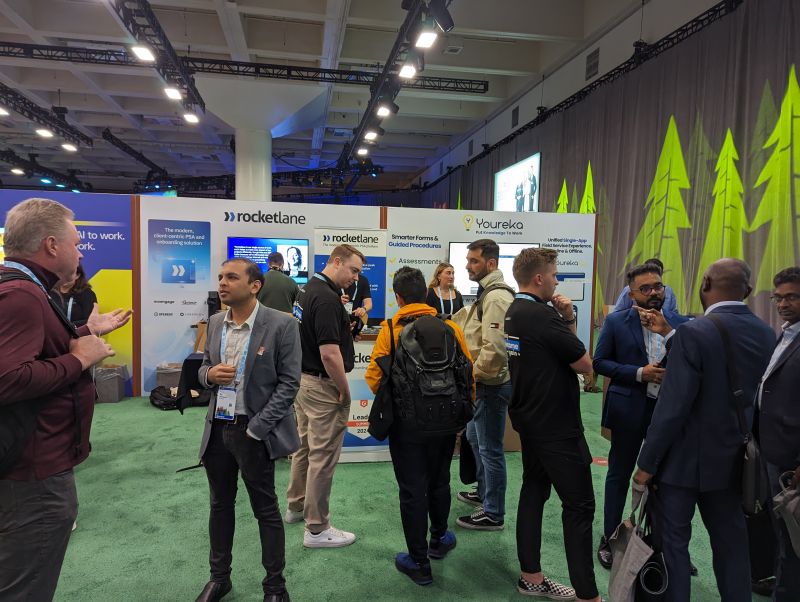
There is a photograph from Dreamforce in which Rao Adavikolanu is standing slightly left of center, jacket open, badge hanging, one hand holding a paper cup. Around him, the Rocketlane booth is doing what booths are supposed to do but rarely look as if they are doing: attracting actual conversation. Nobody has paused for the official picture. A man gestures. Another leans in. The green convention carpet is gloriously unflattering. Rao looks less like a chief marketing officer posing beside a brand than an operator checking whether the brand has a pulse.
This is an apt place to meet him. Adavikolanu has spent a career moving between the machinery behind marketing and the people it is meant to reach. Before the executive titles, before demand generation and paid search, he was an applications developer at Marimba. He completed a master's degree in computer science at the University of Louisiana at Lafayette in 1999, then spent roughly four years programming at myCFO. His first professional language was code.
By 2004, he had crossed into search engine marketing at LSF Interactive. Then came Oracle, where he directed global paid-search advertising; Alteryx, where he ran inbound demand generation; Intacct; Apttus; and CMO posts at Clarizen and Pilot. Rocketlane hired him as CMO in 2024, around the time the company announced a $24 million Series B. The nouns kept changing - software, search terms, leads, pipeline, category - but the grammar remained technical: define the audience, instrument the work, observe the result, improve the next version.
The campaign as a piece of software
A 2014 Alteryx campaign offers a compact demonstration of his method. Search advertising was bringing in data-analytics students when the company needed working analysts and decision-makers. More narrowly targeted keywords cost more without consistently solving the mismatch. It was the marketing equivalent of a program returning valid output for the wrong user.
Adavikolanu and the Alteryx team used LinkedIn Sponsored Updates to separate audiences by skills, groups, company and job title. Analysts could receive a software download; executives might see a Gartner report. The same piece of creative was tested against multiple groups, then tuned according to cost per click, click-through rate and cost per lead. His advice was blunt and practical: “Tune your creative to each audience so that you get maximum resonance and CTR.”
The results mattered, but so did the refusal to confuse precision with dullness. One of the stronger campaigns was “Analytics Unchained,” a set of humorous competitive videos. The team also borrowed the familiar Dummies format, with permission from Wiley, for e-books about predictive analytics and big data. Adavikolanu's instruction to marketers was equally direct: “Make the copy pop out to your potential viewer.” The analyst and the showman were not rivals. One made sure the joke reached the right room; the other gave the room a reason to notice.
Good marketing has architecture. It also needs a door somebody wants to open.
myCFO
Oracle
Intacct
Pilot · Rocketlane
A category with work clothes on
Rocketlane gives that combination a new canvas. The company started by bringing project management, customer collaboration and resource planning into one environment for onboarding and professional-services teams. It operates in an industry full of sturdy abbreviations, including PSA, for professional services automation. The strategic problem is not merely selling features. It is making buyers see an old function differently.
Professional services is where an elegant sale encounters the untidy facts of implementation. Data must move. Systems must connect. New users must change habits. A delayed launch can make an expensive product feel useless before it has had a fair trial. That gives Rocketlane's category story an unusual burden: the software is sold to delivery teams, but the experience it shapes belongs to their customers. Every promise crosses an organizational border.
The company's current phrase is “the Outcome Era.” Its argument is that professional-services software should no longer stop at recording tasks, budgets and utilization. With Nitro, Rocketlane says agents can take on parts of configuration, migration, testing and documentation. Human teams remain responsible for judgment, alignment and the customer relationship. The proposed shift is from a system that watches work to one that helps execute it.
For a marketer, this is fertile and dangerous territory. Artificial intelligence can turn a plain sentence purple before lunch. Adavikolanu's public framing stays close to labor: agents handle repetitive, time-consuming work; people focus on customers. When he shared Rocketlane's March 2026 Series C, he wrote that the meaning extended beyond the money. The round was evidence, in his telling, of a move toward agentic PSA.
The evidence around that story is larger than a tagline. Rocketlane's 2026 financing was $60 million, led by Insight Partners, bringing total capital raised to $105 million. The company said revenue had more than doubled in the prior year, average deal size had grown 4.5 times since 2023, and its customer base had passed 750. Capital is not customer value, of course. It is permission to keep attempting the argument at greater scale.
Plumbing, with confetti
Behind the public category campaign sits machinery that would be familiar to the software programmer Adavikolanu once was. A published Rocketlane case study describes more than 100,000 HubSpot records enriched with live data, a meeting-alert system that supplies context when a call is booked, automated ideal-customer list building, website-visitor identification, and agents for research, personalization and routing. Rao called the outside builders “a great extension of my team.”
This is not a glamorous list. That is why it matters. Many marketing organizations decorate a leaky pipe. Adavikolanu's public record suggests he likes the pipe. At Pilot, his account of a colleague's paid-search work praised business ownership and reported that those campaigns produced 30 to 40 percent of company pipeline and annual recurring revenue in several months. The compliment was really a statement of taste: craft earns trust when it accepts responsibility for an outcome.
There is also a management idea hidden in that preference. A full-stack CMO cannot personally write every line, run every event or tune every campaign. The job is to create conditions in which specialists can connect their work to the whole. The colleague who owns search should understand revenue. The automation partner should understand the customer profile. The event team should know what question the category is trying to answer. Technical fluency becomes less a private advantage than a shared map.
Yet Rocketlane does not communicate like a spreadsheet with a login. It announced the Series C with a music video and a Caesar joke: “They came. They saw. They C'd.” Its conferences give professional-services leaders a room of their own. At PropelX London in 2025, Rao reported three times the prior year's attendance despite a transit strike. The caterer called two hours before lunch because the crowd had outrun the order. He described this as a good problem, the sort of line only an event organizer can deliver without irony.
The lesson here is more specific than “brand and demand belong together,” a phrase now polished smooth by repetition. Rao's version has edges. Build a provocation. Segment the audience. Test the creative. Clean the records. Invite the community. Stand at the booth. Watch for the moment the caterer panics. Each act provides information to the next one.
The funnel is a model. The crowd is the weather. A capable CMO learns to read both.
The engineer's useful suspicion
Adavikolanu's route from developer to CMO is tempting to turn into a conversion story, as if code were an apprenticeship he escaped. The more interesting reading is that he kept it. His unit of work expanded, but the engineer's useful suspicion of vague answers survived. Who is the user? What action are we designing for? Which signal tells us it happened? What failed, and for whom?
Those questions matter more as the object being marketed grows less concrete. Paid search offered a click. Demand generation offered a lead. Category creation asks an industry to update its picture of itself. Rocketlane wants professional-services teams to imagine humans and agents working side by side, with software performing parts of delivery that once lived in checklists, weekend work and individual memory. That promise will be judged in outcomes, exactly as the company's language insists.
Rao's work now sits at that junction: explaining a technical change without letting the technology become the protagonist. His public posts return to professional-services leaders, delivery teams, customers and community. Even the Dreamforce photograph carries the point. The product signage is visible, but conversation fills the frame.
Twenty-seven years after his master's degree, the code is no longer on his screen. It is distributed through the operation: the data model, the campaign logic, the automated handoffs, the feedback loops between a crowded room and a CRM. His task is still to make a system behave. Only now, the system includes taste, memory, software, salespeople, customers and occasionally an alarmed caterer. Marketing has worse definitions.