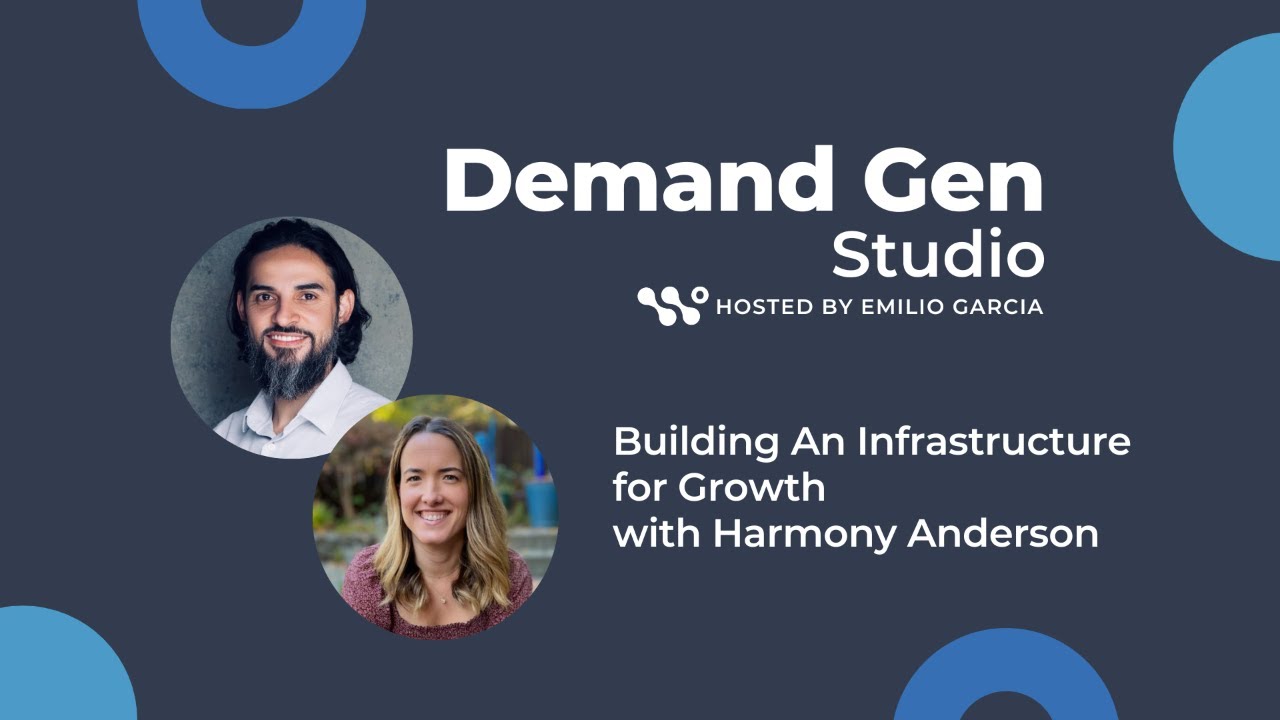
Every marketing department has a junk drawer. Harmony Anderson simply gave hers a meeting agenda. For more than a decade, she has run a ritual called RAM, short for Random Acts of Marketing: the stray swag order, the urgent favor, the executive whim that arrives without an objective but somehow with a deadline. One favorite involved booking a hotel room for a salesperson's spouse at a conference. Another involved replacing Marketo with Pardot out of executive spite. Corporate life offers few pleasures as reliable as an acronym that tells the truth.
The ritual began when Anderson's team was spending nights and weekends on everything except the work it had promised to do. Naming the chaos did not banish it. It made the theft of attention visible, and visibility made the team's time defensible. This is a small story about a meeting, but it contains the operating system of her career: turn the vague into something observable, protect the people doing the work, and connect activity to revenue before everyone gets very busy congratulating themselves.
Now the chief marketing officer of GrowthX AI, Anderson has arrived at a larger version of the same problem. Artificial intelligence makes production nearly effortless. It can generate campaigns, code, copy, ads, and variations at a speed that once required a roomful of specialists. The new junk drawer has no bottom. Her concern is no longer whether marketers can make enough. It is whether they can decide what is worth making.
“The future belongs to marketing teams with great taste, strong judgment, and incredibly high standards.”Harmony Anderson on marketing after automation
The career began in the pipes
Anderson's résumé reads like the layered anatomy of modern B2B marketing. Early acquisition and digital roles at Gemvara, Everyday Health, and LogMeIn led to growth work at ThousandEyes. At Outreach, she ran global demand generation and events. At Engine, then called Hotel Engine, she led revenue marketing. Armada gave her an edge-computing story to translate. Superhuman expanded her remit across product marketing, demand generation, revenue operations, community, and growth product. Each stop brought her closer to the whole machine.
Her education at Babson College had supplied the entrepreneurial grammar. A 2011 project took her to Ghana, where she helped lead a five-day business-plan curriculum for 90 high-school students and joined a six-person consulting group working with SustainaMetrix on artisan businesses. She later spent nearly seven years volunteering as a leadership and teamwork coach at Babson. The through line is practical rather than ornamental: a strategy becomes useful when someone can act on it.
That instinct was tested abruptly in 2020. Outreach had planned 225 in-person events. The pandemic erased the calendar. Anderson's team moved the program online, drawing more than 13,000 people to one virtual event and reaching tens of thousands across the year. The program generated six times the pipeline of its in-person events. What could have been a pale imitation became a more measurable business engine because the team rebuilt the follow-up, personalization, and sales handoff around the new format.
The episode sharpened a conviction that still appears in her interviews: good ideas fail when the infrastructure beneath them is flimsy. A team may have crisp creative, disciplined plays, and a clever campaign. If leads disappear between systems, none of it compounds. Marketing operations, in her telling, are not the unglamorous work behind the campaign. They are the conditions that let the campaign become a business result.
Five weeks, not ninety days
Anderson's preference for motion also shapes how she enters a company. The standard executive script recommends a 90-day listening tour. At Superhuman, she launched a major campaign within five weeks. Shipping early, she has argued, reveals more than extended observation: which people rise to the work, which assumptions fail, where the machinery jams. The first campaign becomes a live diagnostic.
This does not make her a devotee of speed at any cost. Her comparison between AI content and fast fashion is precisely a warning about speed divorced from standards. Cheap abundance normalizes disposability. When every team has access to similar models and can summon ten versions in seconds, output loses its scarcity. The advantage moves upstream to taste, context, and the nerve to reject work that is technically complete but strategically empty.
Her own adoption of AI was not immediate. Anderson has called herself a “dino millennial,” a technology laggard nudged into the future by one uncomfortable conversation with a former boss and CEO. The embarrassment was useful. She began using AI across her day, then found herself in the inverted role: the marketing leader trying to help other skeptics see what the tools could do. The conversion did not erase skepticism. It made the skepticism more precise.
“You can have the best creative, the best plays, the best programs, but if your infrastructure is not built to handle and manage leads, everything breaks down.”Harmony Anderson on the machinery beneath demand
A website gains two new readers
For most of Anderson's career, website content, organic growth, and SEO occupied perhaps five percent of her attention. She believed they mattered, but other levers mattered more. Agencies and freelancers handled algorithm changes and blog production while her teams worked the funnel. The arrangement delivered. Then the audience changed.
Marketers once wrote primarily for buyers. Search engines became a second reader. AI agents are now a third, analyzing, comparing, and shortlisting vendors from much of the same public material. The corporate website, in Anderson's formulation, can no longer be treated as a destination refreshed by occasional campaigns. It has become a living system that must keep pace with a company's products, market, customers, competitors, and voice.
One website, three demanding readers
That realization pulled her from a job she loved at Superhuman into GrowthX AI in April 2026. It was the third time she had moved from customer to employee, a pattern she jokingly calls “the ultimate cheat.” The product interview had already happened. She knew the value from the buyer's chair, believed the vision, and could begin with conviction rather than a stack of onboarding decks.
At GrowthX AI she joined chief executive Marcel Santilli, a marketing leader she had known and respected for years, and co-founder Daniel Lopes. The company combines AI-driven workflows with expert strategists. Its stated thesis is “service as software”: knowledge work is structured, observed, improved, and reused rather than sold as a pile of hours. In June, Anderson helped introduce GrowthOS, which organizes company context, website intelligence, strategy, execution, and learning into a closed loop.
The pairing matters. A blank platform can merely relocate work onto the customer. An agency can deliver work without leaving behind a system that learns. GrowthX is trying to splice the two models, putting agents on repeatable production while human strategists steer. Anderson's role is partly to market that answer and partly to embody its customer: an experienced operator who does not want to become a workflow engineer just to practice her craft.
Same team, same dream
The systems language can make Anderson sound mechanistic until she discusses the people inside it. She considers marketing and sales tension avoidable, a failure of leadership more often than an inevitable departmental feud. Her alignment work begins during interviews. She wants to understand a sales partner's history, the team's strengths, what keeps the leader awake, and what they genuinely dislike about marketing. Revenue may be the shared scoreboard, but trust is the connective tissue.
She is equally candid about the friction of leadership outside the neat boxes of an org chart. A recent family vacation through three European cities was the first time she had taken two full weeks away from work. Her young daughter's favorite part was simply spending time with her mother. Anderson wrote about the moment without polishing it into a productivity lesson. She described the familiar arithmetic of a working parent: leaving work aware of what remains undone, ending the day wishing for more family time, and sometimes feeling deficient in every role despite strong support. Her conclusion was plain: take the vacation.
That candor belongs beside the dashboards. Anderson's version of operational rigor is not worship of efficiency. It is an attempt to make room for valuable work and the people capable of doing it. RAM protects a team's focus. Infrastructure prevents good leads from vanishing. AI handles repetition. Clear alignment removes manufactured conflict. The machine earns its keep by giving judgment somewhere to operate.
There is an irony in the destination. After years of treating organic content as a necessary side function, Anderson now markets a system built around the website. But the reversal is less a contradiction than the point of an operator's career. Good operators notice when the old hierarchy of attention no longer matches reality. They move the neglected problem to the center, then build around it.
Anderson's wager is that the next marketing advantage will not come from generating the most material. It will come from understanding a buyer, preserving a voice, choosing the right story, and maintaining enough context for both machines and people to recognize why it matters. Automation raises the ceiling on production. It also raises the tax on mediocrity. Somewhere in the weekly meeting, another Random Act of Marketing is waiting to be named.