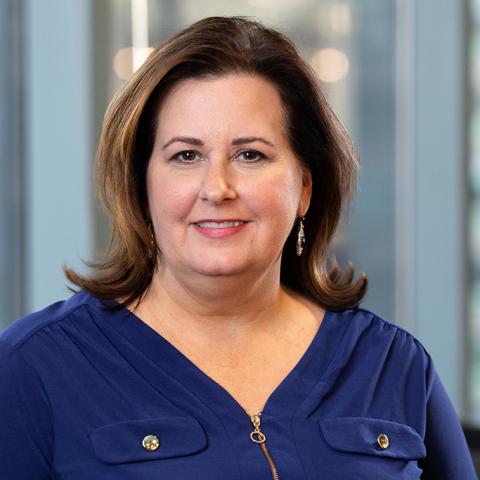
Long before Wendy White had a pipeline review, she had leaflets. In the U.S. Army, where she served as a psychological operations officer, the media plan might also include a loudspeaker, television or radio. The job began with target-audience analysis: who is listening, what matters to them, and what might persuade them to act? White has called it her first exposure to marketing. The vocabulary was different. The central problem was not.
The connection could sound like a polished origin story assembled after the fact, except White's career keeps returning to it. At Intel, she learned to describe technology in the customer's language instead of reciting product features. At Motorola, she led marketing for research, software and early-stage technology. At Egencia, TigerConnect and Daxko, she built growth systems around audiences, operations and evidence. Today, as Daxko's Chief Marketing and Partner Officer, she argues that a CMO should be a business executive first and a functional specialist second.
“What a modern CMO needs to do is to be really deeply integrated into the overall market and business strategy of the company.”Wendy White, The B2B CMO Podcast
That means having an opinion about customer success, sales structure and software procurement, rather than waiting for someone to ask about the next trade show. It also means accepting the awkward part of influence: a marketing leader must make the work visible, measure its impact and explain the result. White was saying as much at Motorola two decades ago. Her language then was crisp: marketing should equal margin.
An eclectic apprenticeship
White's biography has the pleasant untidiness of a person who did not mistake a straight line for a plan. She studied Russian at the Defense Language Institute. She trained at the John F. Kennedy Special Warfare Center and School. She spent 12 years as a military intelligence officer, including active duty during the Gulf War. Somewhere before the corporate ascent, she also worked for Tim Burton on The Nightmare Before Christmas. One imagines a career counselor reaching for a larger sheet of paper.
After active duty, White reached a crossroads. Continue in uniform, or turn toward business? She earned an MBA from the University of California, Davis in 1994, adding it to a BA from UC Berkeley, and joined Intel while still in the Army Reserve. The chipmaker was expanding into servers, enterprise solutions and unfamiliar markets. White moved from corporate communications into the work of creating those markets.
At Intel she became close to the sales organization charged with influencing large companies and government agencies. Her team armed those sellers with tools and messages, but she resisted leading with the machinery. The customer might care about increasing share of wallet, improving operations or managing risk. The product earned attention only after entering that world. In 1996, her work earned an Intel Achievement Award.
Motorola recruited her to market innovation itself: R&D, standards, software and young businesses. She reported into both the technology and marketing sides, a useful perch for someone determined to keep those dialects mutually intelligible. Microsoft and CenturyLink followed, along with venture-backed companies such as identity and fraud specialist iovation. Large organizations gave her scale. Startups gave her speed. Neither cured her of wanting both.
The route, in five turns
From a house of brands to one front door
In 2018, White joined Egencia, Expedia Group's corporate-travel arm, to lead global marketing. She modernized its go-to-market engine, then moved in 2021 to TigerConnect as CMO. Daxko came next. She joined in 2022, and the company announced her appointment the following February with a demanding brief: lead end-to-end marketing, digital professional services, channels and partnerships while helping a portfolio assembled through acquisitions find a common identity.
The portfolio included software for membership, payments, scheduling, marketing and operations. Many products had retained their original navigation, design and brand. Customers did not always know how much the larger company offered. The issue sounds cosmetic until one imagines living inside it: different visual cues, separate support paths, uncertain handoffs and a product family whose members do not appear related at dinner.
White helped bring those products under the Daxko name while keeping familiar product names. The visible changes included branding across software, email addresses, websites and documentation. The more consequential ambition was coherence: smoother movement between products, more consistent workflows, clearer support and direct access to specialists. In White's telling, customer feedback from surveys, advisory boards and conversations sat at the center.
“We’re not making changes in a vacuum - customer feedback is at the heart of this.”Wendy White, on Daxko's unified customer experience
Her involvement in a YMCA customer advisory board fits the same pattern. A board is a listening device with names and chairs. It gives customers a route into strategy before a launch becomes an announcement. White's version of brand building is less perfume counter than switchboard: connect what the company can do with what customers are trying to accomplish, then remove the static.
A marketing department that never sees midnight
White calls one element of her global operating model “follow the sun.” Work passes across time zones, supported by explicit processes, documentation and project systems. A team in one country finishes its day and hands the baton to colleagues whose morning has begun. By the time White opens her laptop, a project can be waiting for approval rather than a kickoff.
The appeal is not simply 24-hour motion. Without discipline, a global relay becomes a long game of telephone. White's model depends on clear briefs, shared definitions and visible work. It is military staff work translated into Asana cards, though considerably fewer leaflets are involved.
Global talent + documented handoffs + human judgment = speed without the scramble.
AI now occupies the next lane in that relay. White has discussed using systems trained on brand guidance, customer calls and previous campaigns, along with workflows for research, targeting and content production. Her teams have experimented with enriched account data, off-hours lead qualification and orchestration tools. She has even gone looking for “AI whisperers,” people who can draw useful work from the technology without surrendering taste or responsibility.
Her enthusiasm comes with guardrails. Human review protects brand voice. Teams start small, automate what slows them down and pay attention to privacy and accuracy. The goal is to give people leverage, not to hold a séance in which software conjures a strategy. White's own career makes that hierarchy clear: tools change quickly; audience understanding remains stubbornly human.
When the answer engine becomes the buyer's lobby
White's newer argument is that AI changes not just production but discovery. Buyers increasingly ask language models to assemble shortlists and explain categories. A website is no longer the only front door. Reputation travels through trade coverage, customer reviews, community discussion and whatever an answer engine chooses to cite.
That makes public relations newly operational. Earned coverage can influence how a machine describes a company. Direct traffic, share of relevant citations and sentiment across customer communities become useful complements to familiar brand surveys. White has proposed a broader measurement matrix before boards begin asking why their dashboards cannot see the new buying journey.
The paradox is delicious. As content becomes almost free to manufacture, credible material becomes more expensive. White recently advertised a Daxko role with a blunt observation: “In the age of AI, content is everywhere. Authentic insight is not.” She wants customer outcomes, operational data, executive expertise and original research, the things a text generator cannot obtain merely by wearing out the return key.
This is also where the odd pieces of her story settle into alignment. Military intelligence taught her to study audiences. Intel taught her to translate technology into business value. Startups taught her to experiment. Global companies taught her to build repeatable systems. Daxko gives her a portfolio large enough to require orchestration and close enough to everyday operators that empty language is quickly found out.
The useful life outside the funnel
White's commitments beyond the quarterly number reveal the same preference for creating access. She co-founded Women in Cloud and served in that role from 2017 to 2019, part of an effort to connect women entrepreneurs with opportunities, mentoring and resources. As a Girl Scouts leader, she organized a Day of Science for more than 400 girls. More than 50 women engineers and technologists volunteered to run experiments and help participants earn science badges.
There are lighter constants too. White is a college-football fan and a hiker who has enjoyed the trail with her family and two dogs. These details rescue a long executive résumé from its natural habitat, the conference lanyard. They also suit someone whose alumni profile was titled “it's all about the journey,” a phrase that might sound decorative if her route had not included the Army, a stop-motion skeleton, several of technology's largest companies and software for the local gym.
The ambition ahead is not mysterious. White wants marketing closer to the consequential decisions and AI closer to the actual work. She wants a many-product company to feel like one company, a global team to work as one team, and a brand to earn trust through evidence. The future she describes is highly automated and stubbornly accountable. It still needs a person who understands the audience, chooses the message and signs her name to the result.