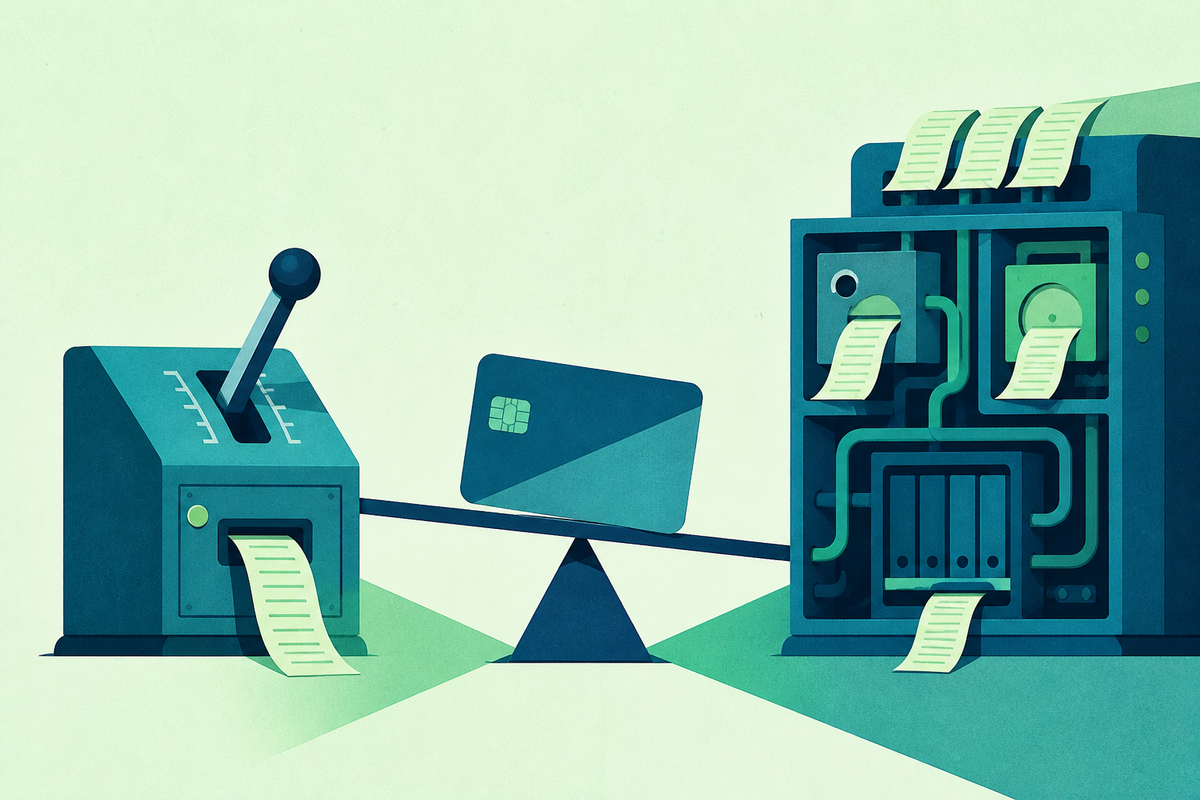
A company card used to be a rectangle with a limit and a monthly reckoning. Now the card arrives attached to a policy engine. It knows who may spend, where the money can go, which receipt is missing and what accounting code belongs on the transaction. Ramp and BILL Spend & Expense both sell this earlier, tighter form of control. Their demos can begin to rhyme. The decision gets clearer only when you stop looking at the card.
Ramp asks a finance team to make spend management the center of a new operating layer. BILL asks the team to bring spend into a home that can also contain accounts payable and receivable. One company remained independent and expanded its perimeter. The other product was Divvy, acquired by Bill.com in 2021 and absorbed into a public company's financial-operations suite. Similar functions now carry different organizational consequences.
That is the useful frame for a buyer. A feature grid can confirm minimum requirements. It cannot tell you which vendor's map of the finance department resembles your own.
The card is only the front door
At the everyday level, the overlap is real. Both products issue physical and virtual company cards, apply limits and merchant controls, collect receipts, show transactions quickly, support reimbursements and connect to accounting systems. Each promises to move policy from a PDF into the payment itself. An employee gets room to act; finance gets a boundary around that room.
Ramp's current public pricing puts corporate cards, travel and expense, bill pay, basic accounting automation, reporting and vendor management in its Free plan. Its Plus plan is listed at $15 per user per month plus a platform fee, adding deeper reviews, approval logic, accounting support and multi-entity controls. Enterprise is custom priced. Procurement is an add-on to Plus or Enterprise. Those packaging details matter because they show where a free foothold ends and a more elaborate finance system begins.
BILL also advertises Spend & Expense at no software cost, paired with the BILL Divvy Card and subject to credit approval. Its product pages emphasize budgets, real-time controls, automated receipt matching, transaction coding, reimbursements and integrations including QuickBooks, NetSuite and Xero. The larger BILL platform gives AP, AR, spend and expense a shared login and a centralized list of urgent tasks. For an existing BILL customer, that adjacency may be more valuable than one extra toggle in an expense screen.
An acquisition changed the question
Bill.com announced its agreement to buy Divvy in May 2021 for approximately $2.5 billion in cash and stock. A later filing recorded total consideration around $2.3 billion after acquisition accounting. The strategic language was plain: Bill.com wanted customers to manage more business-to-business spending in one place, while Divvy customers had asked for a wider payments platform.
The software did not vanish. BILL now calls it BILL Spend & Expense, explicitly notes that it was formerly Divvy, and still puts the Divvy name on the card. The brand archaeology is revealing. Divvy's original proposition was a modern card and budget product. Within BILL, those functions also become an attachment point for payables, receivables and the accounting relationships around them.
“Our expanded platform will provide more automation and real-time information to SMBs.”René Lacerte, BILL founder and CEO, announcing the Divvy deal
That can simplify procurement. It can also deepen dependency. The same connection that removes duplicate users, exports and approvals can make a later separation harder. Neither effect is hidden or sinister. It is the normal bargain of a suite: fewer seams today in exchange for a larger migration if the relationship stops working tomorrow.
Two routes toward the finance command center
- Card + spend control
- Expense + travel
- Bill pay + treasury
- Procurement + enterprise
- AP + payment network
- AR + cash workflow
- Divvy card + budgets
- Unified financial operations
Free software still has an engine
There is no mystery behind giving away a capable card product. Ramp says it earns revenue primarily from card use and Ramp Plus subscriptions. A merchant pays an interchange fee on a purchase; Ramp receives a portion through the card ecosystem. BILL's public filings describe Spend & Expense revenue as interchange revenue from BILL Divvy Card transactions. The card is both a control surface and an economic rail.
The incentives mostly point in a productive direction. Useful controls can make a company comfortable moving more legitimate spend onto cards. Cleaner transactions create more volume, and more volume creates more interchange. But buyers should understand the loop. Rewards, credit terms and free software are not isolated gifts. They are parts of a system designed to become the preferred route for company spending.
Ramp's paid modules add a second motion. Its free product lowers adoption friction; Plus, Enterprise and procurement monetize teams that need more complicated policy, entity and workflow machinery. BILL can make a different bundle argument: expense software may be free, while the surrounding AP and AR relationship includes subscription and transaction economics. The price of either choice is therefore larger than the card line item.
Center of gravity, not a product rating
Editorial assessment of product positioning based on public packaging. Bar length is directional, not a performance score.
Buy around the exception queue
The polished path is easy: issue a card, set a limit, swipe, match a receipt, sync the books. A serious evaluation should spend more time on the ugly path. What happens when an employee changes departments mid-month? When a receipt arrives after the lock? When one transaction belongs to two entities? When the ERP rejects a field? When a reimbursement is urgent? When a vendor must be paid without taking a card?
Run those scenarios with real finance operators, not only the executive buyer. Measure the number of corrections, approvals and support tickets. Ask each vendor to price the exact version that passed the test, including platform fees, payment fees, implementation, advanced integrations and add-ons. Rewards should come last. A fraction of card spend can be pleasant; a broken close arrives twelve times a year.
Spend control is the project, independence from the existing AP stack matters, and the team wants one platform that can expand into travel, procurement or treasury on its own terms.
The company already runs BILL, AP and AR consolidation is the project, and fewer logins, permissions and handoffs matter more than maintaining a separate spend layer.
A company starting fresh may prefer Ramp's coherent, product-led route. A small or midsize business already deep in BILL may rationally value the suite connection. A more complex enterprise may discover that neither marketing page answers its entity, geography or ERP questions. The outcome depends on the operating model, not on a universal winner.
The choice behind the choice
Expense management is becoming less about documenting money after it leaves and more about shaping the conditions under which it can leave. Ramp and BILL both understand this. Their controls can replace some chasing with rules, some spreadsheets with live budgets and some month-end reconstruction with transaction-time data.
What differs is the home they propose for those controls. Ramp wants its standalone platform to become increasingly comprehensive. BILL wants Spend & Expense to make a comprehensive suite feel complete. Put another way, Ramp is trying to earn the surrounding workflow; BILL bought the missing piece and is integrating it.
The practical move is to decide which architecture you want before you sit through either demo. Map the handoffs your team hates. Mark the systems you are unwilling to replace. Price the edge cases. Then let the product compete on that field. Cards are easy to compare. Homes are harder, and that is what these companies are really selling.
Frequently asked questions
Is BILL Spend & Expense the same product as Divvy?
It is the successor to Divvy's spend-management product. BILL calls it formerly Divvy and continues to use the BILL Divvy Card name.
Are Ramp and BILL Spend & Expense free?
Both advertise free entry-level spend and card software, subject to eligibility and terms. Ramp also sells Plus and Enterprise tiers. BILL sells adjacent AP and AR plans and transaction services.
What is the main practical difference?
Ramp is a standalone finance platform expanding outward from card and spend controls. BILL Spend & Expense sits inside a broader suite that also covers accounts payable and receivable.
Which is better for an existing BILL customer?
BILL may reduce handoffs through a shared platform login and connected workflows. Teams should still test controls, accounting sync, support and total pricing against Ramp.
What should a finance team test?
Use real scenarios involving receipt exceptions, budget changes, approval routing, reimbursements, failed accounting syncs, multi-entity rules and vendor payments.