On a weekend morning in 2014, a customer needed help setting up ScheduleOnce. She reached the chief executive. Rami Goraly sometimes took support calls when his team was unavailable, and the questions were useful to him. The caller, writer Elaine Pofeldt, had stumbled into a small demonstration of how he worked: close enough to the software to hear where somebody got stuck.
A support queue is an unusually candid place to meet a company. Nobody calls to admire the strategy. They want a setting explained, a connection made, an appointment to appear where it should. For a founder interested in product decisions, that conversation has an advantage over a polished presentation. The customer supplies the awkward part.
Goraly was already an experienced software executive. Yet here he was, helping with the everyday business of getting people into meetings. “The product is really important to me,” he said that year. It is a modest sentence. Over the following years, acquisitions, new products and public demonstrations would give it considerably more substance.
The jobs before the calendar
His working life had already taken him through several varieties of software business. Between 1996 and 2004, Goraly worked in the United States, founded Accept Software Corporation and served as its CEO. The company developed enterprise product-planning software. He subsequently led SweetIM in 2004-2005 and the telecommunications business Telrad Connegy in 2005-2006.
At RadView, he became vice president of marketing in June 2006, CEO in April 2008 and a director that December. His earlier management roles included Cheyenne Software and Check Point. His education combined economics and accounting at Tel Aviv University with an MBA from Cass Business School in London. The career record puts business operations and commercial judgment alongside the software.
That history gives the scheduling venture a different texture from the familiar first-startup tale. Goraly had experience of running companies before this particular product found an audience. A calendar problem was another problem to understand. Previous job titles could hardly persuade a stranger to book an appointment.
One appointment at a time
He began the business that became OnceHub in 2006. His brother Gilad joined as CTO in 2008. Goraly’s later account describes an early focus on group scheduling, followed by a narrower approach built around one-on-one appointments. He dates the first revenue to five years after the start. A product designed to save minutes took years to find its footing.
That is a useful distinction in a founder’s life: persistence can include changing the thing one is persisting with. Keeping the company alive and keeping its initial product assumptions are separate decisions. In this case, the calendar remained; the way into the market changed.
Goraly describes himself as analytical and says he explored possible business ideas rather than beginning with a scheduling irritation of his own. His concise lesson from building companies is equally measured: “You can control the process, not the outcome.” There is room in that formulation for effort, judgment and the possibility that neither guarantees a reward.
“You can control the process, not the outcome.”
Rami Goraly
By 2014, ScheduleOnce was serving professionals whose appointments were central to their work, including coaches and financial planners. Its attraction was understandable. A service business can have a persuasive website and still make the next step tiresome. Every email proposing another time adds work before the conversation has even begun.
The appointment also needed to travel. A 2014 partnership with Cirrus Insight connected ScheduleOnce bookings in Google Calendar to Salesforce records. The benefit was less visible than the booking page itself: the meeting could become part of the customer record without another manual transfer. Goraly was already talking about scheduling as part of lead generation and customer interaction. The connection matters to his story because it locates the calendar inside a business process. A time agreed with a customer is useful; a time agreed and recorded where the team works saves a further piece of administration.
The interview that needs a whole day
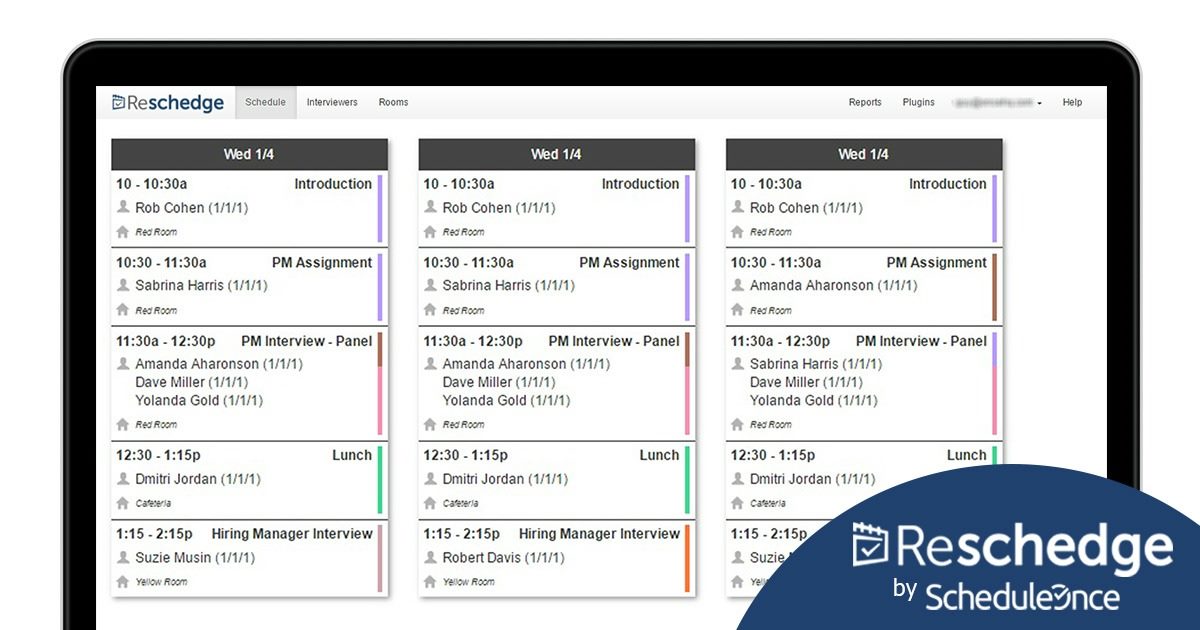
Finding a time for two people is one problem. Arranging a candidate’s day with several interviewers introduces a small bureaucracy of its own. People are available at different hours. Rooms matter. The sequence matters. A change to one appointment can make a carefully assembled day unravel.
In January 2017, ScheduleOnce acquired Reschedge from HireVue. Reschedge brought technology for coordinating demanding interview schedules, extending a product already used for earlier recruiting conversations. Its founder, Jonathan Kennell, had worked at Google and studied at MIT. The acquisition brought a more specialized scheduling problem into Goraly’s business.

He had been watching Reschedge since its 2013 arrival. The acquisition announcement connected that interest to ScheduleOnce’s work with recruiting departments. It was an expansion built around a recognizable customer requirement: the first screening call and the full interview day belonged to the same hiring process, even if arranging them demanded different machinery.
Goraly’s explanation of the coordination problem kept the focus on the person waiting for a finished schedule. Hiring managers wanted the meeting arranged. The software’s sophistication had a practical destination: fewer arrangements left for someone else to untangle.
A bigger name for more particular meetings
By March 2019, the company needed a name with room for another product. Goraly announced InviteOnce and the change from ScheduleOnce to OnceHub. His explanation drew a distinction between receiving many bookings through a standard configuration and arranging an individual meeting with its own requirements.
ScheduleOnce served the first kind. InviteOnce was built for the second. An existing prospect or customer might need something too particular for the usual setup. Personalization could solve that problem, provided creating the arrangement did not become another chore.
Goraly’s announcement therefore emphasized flexibility and speed together. That pairing is revealing. More options can make software more capable while also making it more work. The job was to let a user express a meeting’s requirements without spending the afternoon configuring the meeting about the meeting.
OnceHub became both the company name and the platform joining its products. In a career viewed through corporate titles, this is a rebrand. Viewed through the customer’s day, it marks an attempt to accommodate the difference between an open invitation and a particular conversation.
A company without a commute
The organization behind these products also had to coordinate people at a distance. In March 2020, OnceHub published a webinar in which Goraly discussed seven years of working from home. The announcement traced the company’s first employee hire to 2013 and described more than 150 employees across five continents.
Those figures belong to that moment. The longer point is that the company had accumulated years of distributed working experience by the time Goraly presented the session. Its arrangements were established enough to become the subject of a retrospective, complete with questions from the audience.
There is an agreeable symmetry here. People building tools for coordinating appointments were themselves working across geographical boundaries. The everyday requirements of a remote organization give time zones and availability a significance that an office wall clock cannot quite capture.
Let the buyer stay curious
Goraly’s writing looks beyond sales teams. In 2018, he described scheduling for universities: admissions interviews, faculty office hours and tutoring. A professor’s open office hours could be quiet one week and crowded the next. Booking ahead offered students a clearer expectation of when they would be seen.
His examples were specific about the differences between meetings. An undergraduate admissions conversation might need one adviser online; a graduate interview might require several people on campus. The appointment’s purpose determined the arrangement. A single empty square on a calendar said very little about whether the right meeting could happen there.
In October 2024, he applied a similar attention to context in an essay about AI sales chatbots. Some website visitors were ready to engage. Others were still researching, gathering information at their own pace and keeping their distance from a salesperson.
His argument was that an AI conversation could help the second group explore an offering without first revealing their identity or committing to a human discussion. The interesting choice is to respect the buyer’s hesitation. Curiosity has a timetable of its own. A sales process can make room for it.
An editorial guide to the recurring problems in his work.
Still interested in the settings
His recent public work remains close to those operational details. An August 2026 article accompanies a webinar with Goraly and OnceHub’s chief go-to-market officer, Aviram Hinenzon. The session examines organizational booking operations, including reports that help teams understand the appointments they receive.
The accompanying walkthrough considers four areas: capacity at particular times, workload for individual hosts, where bookings originate and what happens to them afterward. A rising meeting count is a beginning. A manager still needs to know whether the right people can accommodate the demand.
Another webinar for financial advisers frames meeting location as a business decision, drawing on more than a million bookings. Virtual, in-person and hybrid arrangements each carry consequences for how a practice serves clients. The topic brings the work back to something a booking link can conceal: two people agreeing on Tuesday afternoon have yet to settle where Tuesday afternoon will find them. The software has to respect that distinction.
This is recognizable territory for the executive who was fielding support questions in 2014. The product has acquired more ways to engage people, and the questions have grown more detailed. He is still appearing in demonstrations where the settings matter.
On LinkedIn, Goraly describes himself as “A serial software entrepreneur finally turned lucky with OnceHub.” The joke is economical. It allows for the earlier attempts without turning the eventual business into proof that every previous decision was wise.
Luck may get a line in the biography. The rest of the record contains the work: companies run, assumptions revised, products expanded, customers heard. And somewhere in that sequence is a weekend caller who wanted an appointment tool to behave. For a career spent making it easier to reach someone, answering the call was a fitting use of time.
Follow the conversation
Explore Goraly’s work and watch him demonstrate the product.