The modern business meeting begins with a tiny hostage negotiation. Tuesday is bad. Wednesday works, except after three. Which three? Whose time zone? Someone sends a link, someone else asks for a phone call, and a promising customer disappears beneath seven polite emails. OnceHub built its first act around ending this ritual. Its more interesting second act begins with the admission that finding an empty rectangle on a calendar was never the whole problem.
OnceHub is scheduling software for people whose meetings have consequences. A solo consultant can publish a polished booking page. A sales organization can screen a prospect, ask about territory and company size, then distribute the meeting across an eligible team. A university can route a student to the right adviser. A clinic can manage appointment data within a compliance-conscious setup. The newest version of the idea answers telephone calls with an AI agent that uses the same availability and routing logic as the web experience.
That breadth is the company's advantage, and its tax. OnceHub makes the strongest case when “book a meeting” is really shorthand for a small operating system: identify, qualify, match, schedule, notify, connect, record and follow up. If all you need is a 20-minute coffee link, this can look like bringing an airport control tower to a picnic.
The booking link was the wedge, not the destiny
Rami and Gilad Goraly founded the business that became OnceHub in 2006. The company says it was customer-funded from day one, an unfashionable sentence that explains much of the plot. There was no funding round demanding a theatrical reinvention every eighteen months. The product could accumulate slowly around a stubborn problem. In 2011, the journey centered on ScheduleOnce, a direct name for software that removed scheduling back-and-forth.
By 2019, that name had become a cage. ScheduleOnce became OnceHub, signaling a move from a single-purpose utility into what the company calls customer engagement. The rebrand matters because scheduling links had become abundant. Calendly made them a familiar habit; Acuity, YouCanBookMe, Microsoft Bookings and others offered variations. Competing on “pick a time” alone meant fighting over a feature that increasingly felt like plumbing.
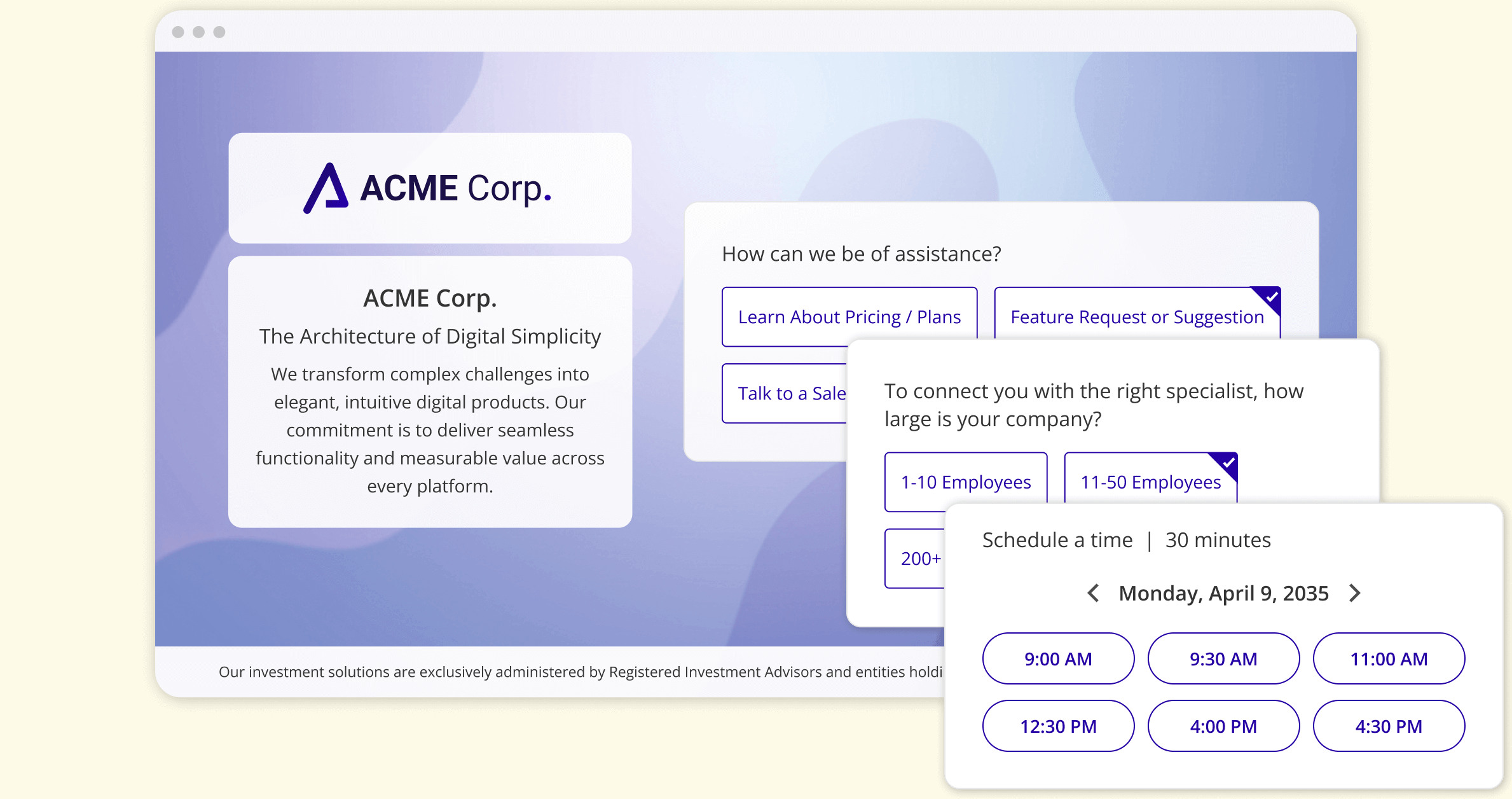
OnceHub moved toward the mess surrounding the slot. Its Booking Calendars handle one-to-one, multi-host, group and concurrent meetings. Booking Hubs present several calendars through one destination. Routing Forms collect answers before revealing availability. Teams can distribute meetings by round robin, maximum availability, priority or user attributes. Chatbots can answer questions and pass a visitor into live chat, an instant meeting, a future appointment or a useful resource.
The customer who outgrew “free”
The cleanest illustration comes from a job where missed appointments have human weight. United Way of California helps residents file taxes and claim credits. Its network used OnceHub to book 33,000 appointments during the 2023 tax season, according to the organization's 2023 customer story. Different meeting types let clients indicate language preferences, and qualification questions were translated into Spanish. Custom notifications replaced work that would otherwise become its own full-time job.
United Way had already used OnceHub's booking pages before moving to a paid plan. What changed its mind was not a shinier calendar. Growth made customization and a customer success manager worth paying for. The organization also connected OnceHub to an internal portal through Airtable, letting partners see appointment notes, contact history and client needs in a place they already used. This is the company's business model in miniature: offer the simple action free, then charge when coordination becomes organizational.
The less time they have to spend scheduling appointments and rescheduling is more time on the ground actually helping Californians and their communities.Mandy Nand, United Way of California
Osaic, a network supporting more than 11,000 financial professionals, found a different limit. Its coaching group initially used surveys, email and manual calendar invitations for 20 to 30 monthly meetings. A calendar-oriented competitor failed first because it could not adequately handle group and pooled collaboration. OnceHub's distribution, integrated conferencing, reminders and enterprise support fit the job. The result, Osaic said, was more engagements, fewer no-shows and many fewer rounds of phone tag.
What the phone taught the product team
OnceHub's latest adjacency is charmingly circular: after years of using web pages to eliminate phone tag, it has taught the calendar to answer the phone. Phone Booking launched in October 2025 with a dedicated number tied to a user's existing calendars. A caller can schedule against real-time availability or leave a detailed message that arrives as a transcript. Businesses can forward missed calls to it or place it inside an existing phone menu.
The instructive part is what OnceHub did not ship first. Chief Go-to-Market Officer Aviram Hinenzon said the team began by exploring a full, complex AI conversation. It changed course after recognizing that the breakthrough was useful behavior with zero setup. The phone agent already knew the customer's booking logic. That was more valuable than demanding another grand configuration project.
We realized the real breakthrough was creating a product that delivered significant value with zero setup for the user.Aviram Hinenzon, OnceHub
This is a sharper AI strategy than stapling a chat box to a pricing page. The model is not the moat; the accumulated rules are. Availability, buffers, meeting types, qualification paths and team distribution already exist in the account. A new interface can borrow them. The website visitor types. The caller speaks. The scheduling engine makes the same operational decisions underneath.
Where the product earns its keep
The price of replacing the receptionist's clipboard
OnceHub sells subscriptions by seat. Its Basic plan is free and includes one user, one connected calendar and one booking link. On annual billing, the public Schedule tier begins at $10 per seat per month and adds unlimited booking links, calendars and meetings, plus more capable team scheduling. Higher tiers add routing and conversational engagement; large organizations can negotiate Enterprise contracts with security reviews, single sign-on, dedicated success support and other controls. The company offers a 14-day trial of its Engage tier without requiring a credit card.
The integration list is deliberately unromantic: Google and Microsoft calendars, Zoom, Teams, Meet and Webex; Salesforce and HubSpot; Stripe and PayPal; Zapier, Make, APIs and webhooks. This is where scheduling products win or lose. The date picker is visible, but automatic calendar events, video links, CRM records, reminders and payments are the labor customers are actually trying to avoid.
Regulated buyers get another reason to tolerate configuration. OnceHub publishes controls and documentation around HIPAA and HITECH, FERPA, GDPR and PCI DSS, and eligible accounts can sign a business associate agreement. Buyers should still read the boundaries: the company's phone-AI terms have specifically treated AI features separately from its BAAs. “Compliant platform” does not make every workflow compliant by magic.
Five moves worth stealing
- Start with one frequent annoyance whose value is obvious in a sentence.
- Keep the rules layer separate from the interface, so new channels reuse old work.
- Charge when coordination appears: more people, more routes, more controls.
- Move one step before and after the core action. Qualification and follow-up are defensible adjacencies.
- When AI adds setup, look for context the customer has already supplied.
When it will not work
OnceHub's weakness is visible in its strength. Reviewers regularly like its flexibility, support and calendar connections, but some describe a learning curve or missing edge-case features. Sophisticated routing only pays back when the organization truly has routes. A freelancer with one calendar may get the same outcome from a simpler free product with fewer settings. A business that refuses to standardize meeting types will merely automate its confusion.
The practical test: count the decisions currently made between an inquiry and a confirmed conversation. If the answer is one - “find an open time” - keep shopping simple. If the answer includes fit, geography, language, specialist, urgency, channel, payment or regulation, OnceHub begins to make sense.
Voice AI carries its own conditions. It must respond quickly enough to feel natural, recognize the range of callers a business serves and recover gracefully when conversation escapes the script. Some customers will always prefer a visible calendar. Some calls should reach a human immediately. The useful design is not “AI replaces reception”; it is an explicit ladder of outcomes, including the human handoff.
OnceHub now occupies the broad middle between a humble booking link and a full customer-service platform. It is more operational than Calendly's popular shorthand, less sweeping than a CRM, and most legible where customer-facing teams have complicated calendars. The company's wager is that scheduling remains a category only if you define it generously: not the moment a time is selected, but the whole little journey that earns the meeting.
That makes the phone agent more than a novelty. It tests whether nineteen years of product decisions can become infrastructure for a new interface. If the same rules can govern clicks, forms, chat and calls without asking customers to rebuild their business four times, OnceHub has something sturdier than an AI feature. It has a reusable point of view about how people should reach one another.