In 2008, Ashhad Syed built a product for a future that had not arrived. The idea was to let businesses conduct live chat from the new generation of smartphones. It sounded sensible. The hardware was exciting; the behavior was plausible. There was just one stubborn problem: businesses were not ready to run customer conversations from their phones.
Founders can spend years trying to educate a market into wanting the original idea. Syed did something more useful. He watched the people orbiting the product and noticed a different pain. Online advertisers were paying to bring visitors to their sites, then losing the visitors who did not want to call or complete a form. Chat was not the destination. It was the least awkward door into a sales conversation.
That observation became ApexChat, later renamed Blazeo. Syed found his commercial counterpart, Jim Bert, on Partnerup.com, a matchmaking site for entrepreneurs. They launched a managed service: the software put a chat window on a customer's site, while trained agents answered around the clock, asked qualifying questions and sent usable leads back to the business. Blazeo says the company has now served more than 35,000 businesses and generated more than 15 million leads.
01 / The useful missThe first product failed. The customer problem survived.
What failed first was precise: smartphone-operated live chat. What changed the founders' minds was not a trend report. It was the discovery of advertisers who already had traffic and a measurable leak. Those customers had spent money creating intent. A missed visitor was not an abstract engagement problem; it was wasted acquisition cost.
Blazeo's early answer was deliberately operational. Instead of giving a law firm or home-services company another tool to staff, it supplied the staff. Agents could cover nights and weekends, collect contact details, ask a short set of industry-specific questions and deliver the conversation. The company grew largely through word of mouth and did not hire its first salesperson, David Scheppler, until 2013.
That boundary matters. The old ApexChat proposition was not expert advice. It was rapid first contact. A chat agent did not need to diagnose the broken furnace or assess a personal-injury claim. The agent needed to keep the visitor present, collect the right information and move the conversation to someone who could make a decision.
02 / The product grew legsA chat window becomes an intake operation
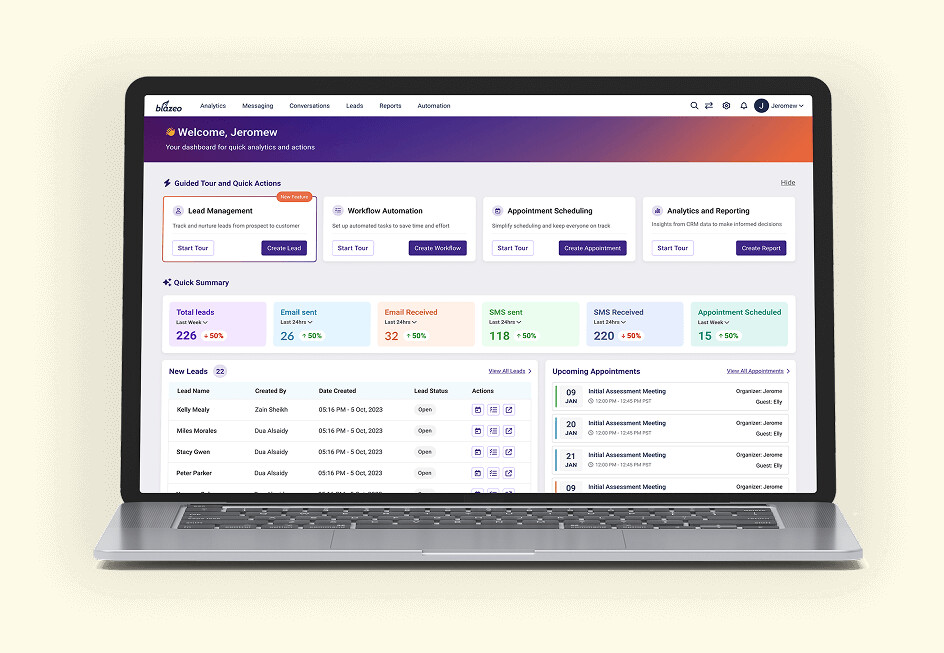
The modern Blazeo product follows a lead farther than the old name suggested. SmartHub is the center: a workspace for contacts, conversations, appointments, workflows and reports. Around it sit managed live chat, a generative AI chatbot, SMS and email communication, Voice AI, a U.S.-based call center, appointment scheduling and a retainer-signing flow for legal clients.
Engage
Chat, text, email or phone catches the inquiry.
Qualify
AI or an agent asks the agreed intake questions.
Route
The lead, transcript and context move to the right team.
Commit
Book a meeting, transfer a call or start a retainer.
That sequence explains where Blazeo fits in the market. It is not simply an Intercom, LiveChat or Tawk.to alternative. It also competes with AI receptionists, outsourced call centers, scheduling apps, legal-intake specialists such as Ngage and Smith.ai, and pieces of a CRM. Its difference is the bundle. Software answers immediately and keeps records; people provide the fallback when a high-value conversation gets odd, specific or delicate.
The customers are businesses where a single inquiry can be worth real money: personal-injury firms, roofers, HVAC contractors, medical practices, colleges, real-estate agents, automobile businesses and the marketing agencies that serve them. Those agencies can white-label the chat service and add it to client websites. Named customer logos on Blazeo's site include Farah & Farah, Owens Corning, Beacon Solar, Milan Institute and O'Connor Tax Group.
03 / The billWhat it costs - and what you are actually buying
Blazeo publishes a low entrance price and makes the more complex tiers sales-assisted. Managed live chat starts at $49 per month. The entry plan is aimed at sites with 1 to 500 monthly visits and includes one user; higher plans add qualifiers, users, routing, CRM integrations, secure leads and other controls. The page advertises unlimited customer interactions across the chat plans.
Per month. Higher tiers add traffic capacity, users, routing, integrations and compliance features.
Per month. Plans include minute allowances, with published overage rates and enterprise options.
The pricing logic is easiest to understand in verticals with expensive leads. If a $49 chat layer saves one viable roofing estimate or legal consultation, the subscription can pay for itself. Voice is more labor- and usage-sensitive, so the plans begin at $249 and meter included minutes and overages. Enterprise packages are custom.
This is a software-plus-service business, not pure self-serve SaaS. That distinction is important for buyers and investors. A company is paying for the interface, automation and reporting, but also for trained coverage, script tuning and escalation. Blazeo's public employee numbers illustrate the operational weight: its own materials say 400-plus people across four offices and remote locations, while LinkedIn uses a 51-200 company-size band. The exact number is fuzzy; the human operation is not.
04 / Human on purposeThe AI is fast. The escape hatch is the feature.
Blazeo now speaks the language of conversational AI, but its more defensible position is not “the bot replaces the receptionist.” The company describes a hybrid system: AI handles volume, repeated questions and immediate qualification; live agents take over when a conversation requires judgment or reassurance. The phone product applies the same idea to Voice AI and U.S.-based receptionists.
This matters in legal, medical and home-service intake because the first conversation can move quickly from routine to consequential. An automated system can gather a zip code, appointment preference or type of matter. It should not improvise an answer it cannot support. The valuable design choice is a visible, context-preserving path to a person.
A 2026 case study captures the economic version of that shift. An unnamed personal-injury firm had been using pay-per-lead live intake. Costs moved unpredictably, duplicate or weak inquiries were still billable, and after-hours coverage varied. Blazeo replaced the first contact with unlimited AI conversations under a predictable plan, structured the intake and passed complete details into the firm's workflow. The public case study does not disclose a dollar saving or conversion lift, so the honest result is narrower: every inquiry received an immediate response, staff had less manual work, and the client stopped auditing whether each conversation deserved a fee.
05 / The copyable bitSteal the workflow, not the vocabulary
A small business can copy much of Blazeo's operating logic before buying a platform. First, list the moments when intent decays: an unanswered evening call, a form without a reply, a no-show without a reminder. Second, define the five or six questions that determine whether a lead belongs with sales, support or nobody. Third, make the next step possible inside the conversation - book the slot, transfer the call or send the document. Finally, measure the handoff, not merely the chat count.
Blazeo learned the marketing version of this lesson, too. The company once struggled to explain why its service converted better in the legal market. It worked with Crisp to produce peer testimonial videos and placed them on the site, in sales emails and in competitive follow-up. Crisp attributes more than 50 new accounts to that campaign. The copyable idea is mundane and strong: when the product is a service that prospects cannot inspect, let customers show the operation in use.
A smartphone chat prototype misses the market; ApexChat turns toward managed lead capture.
After word-of-mouth growth, the company hires its first salesperson.
ApexChat becomes Blazeo because calls, AI, SMS and scheduling no longer fit the old name.
SmartHub and vertical AI-intake products push the company from chat widget toward conversion system.
06 / The honest limitWhen the system will not save you
Blazeo cannot manufacture demand. A site with little qualified traffic, a weak offer or a team that ignores routed leads will simply automate the discovery that nobody was ready to buy. The model is strongest when traffic already exists, response speed matters and the value of one conversion is high enough to justify managed coverage.
Public reviews also mark the edges. Customers regularly praise support, simplicity and improved lead flow. Historical complaints mention an antiquated backend, limited reporting, constrained widget customization and too little control over how representatives speak for the company. Blazeo's newer SmartHub interface appears designed to answer some of that criticism, but buyers with complex analytics or exacting brand requirements should test those workflows rather than assume the bundle covers them.
Conditions that help
- Existing paid or organic traffic
- High-value inbound inquiries
- Simple, defined qualification rules
- A team ready to act on routed leads
Conditions that break it
- Low demand or weak product-market fit
- Questions that require expert judgment immediately
- No internal follow-up discipline
- Reporting or brand controls beyond the chosen tier
The March 2024 rebrand was therefore more than cosmetic, even though customer plans and logins stayed the same. “ApexChat” described the wedge. “Blazeo” gave the company room to sell the whole route from first hello to booked work. Whether that expansion becomes a focused conversion platform or a crowded collection of adjacent tools will depend on the quality of the handoffs.
The origin remains the cleanest guide. Blazeo did not win by insisting that the smartphone product was right. It separated a bad timing assumption from a durable human preference. People wanted a quick conversation without making a call. Businesses wanted the lead without building a night shift. Everything since - agents, AI, calendars, phone coverage and signatures - is an attempt to shorten the distance between those two wants.
Keep exploring Blazeo
Product pages, company channels and an archived demonstration library from the ApexChat years.