The first place Md. Nizam Uddin wanted to visit on the internet was NASA. In 2001, while he was in class seven, he paid 300 taka at a cybercafé to explore a world he had encountered in science magazines. His family’s village in Pabna would get electricity in 2003. He had reached the space agency’s website before a power connection reached home.
It is a pleasingly ambitious first search. Most people have used a computer to put off doing something; Nizam was trying to find the people sending things into space. He wanted to become a scientist. Engineering came later, followed by entrepreneurship, a failed education venture and a rented house in Rajshahi where a software business began to take shape.
Today he is co-founder and CEO of weDevs, the company behind Dokan and a collection of WordPress and SaaS tools. The through-line is access: first his own access to knowledge, then customers’ access to software they could use to start something. Along the way, he had to learn the rather earthbound business of running a company.
300 taka, one very distant destination
Nizam grew up in Jagannathpur, a village in Chatmohar, Pabna. He describes a family that was financially comfortable and serious about education. His grandfather was a teacher and scholar. Teachers coming from outside the village stayed at the family home. A shortage of infrastructure coexisted with a considerable supply of people willing to teach him.
A scholarship in class five took him to Pabna Zilla School and its hostel. The move widened his sense of what was possible. At the Annada Govinda Public Library, he read across subjects and found the science magazines that introduced him to NASA and the internet. The library gave his curiosity somewhere to go before the cybercafé gave it a connection.
His father encouraged good academic results and good character while leaving room for independent decisions. Nizam remembers that freedom as an influence on how he thinks. His education continued at Government Science College in Dhaka, then in Computer Science and Engineering at the University of Rajshahi. The ambition changed shape as his surroundings changed; the habit of looking for an explanation survived.
- 2001A first internet visit
NASA, via cybercafé - 2012A rented house
weDevs in Rajshahi - 2013A premium plugin
A full-time business - 2025A WordCamp stage
AI and WordPress
A rented house with customers abroad
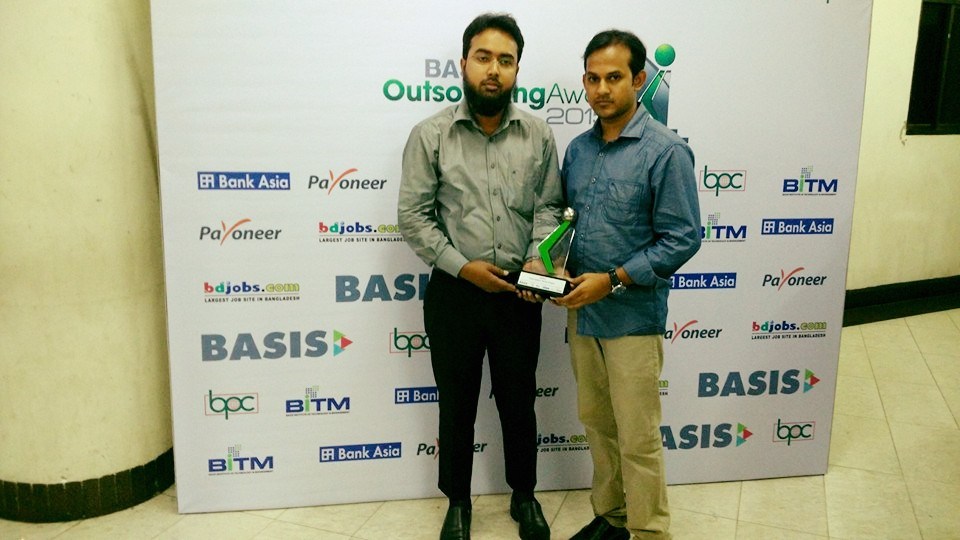
At university, Nizam and Tareq Hasan began working on projects together. In 2010, they took a Braille board project to BASIS Soft Expo and won a Best IT Innovation Award. The expo exposed Nizam to the startup world and helped turn his interest toward entrepreneurship. Technology could become a way of organizing a useful service around a problem.
The first attempts were untidy. There was a campus news portal with his friend BM Sharif. In 2011 came an education initiative with Tareq: physical training, free tutorials, online learning and a freelancing marketplace. They collected 500 gigabytes of video tutorials for distribution. The effort was substantial. The venture still closed. A hard drive full of instruction could not supply every answer a young business needed.
Tareq already had something with a more specific audience: WP User Frontend, a WordPress plugin with free users. In 2012, the two started weDevs from a rented house in Rajshahi. Early in 2013, they released a premium version. Paying customers followed. Nizam later recalled monthly revenue reaching $8,000 to $10,000 during that early period.
The distinction matters. The free product had already demonstrated a use and gathered people who understood it. Charging for a more capable version gave that existing relationship a commercial form. After graduation, the founders moved to Dhaka in late 2013, hired employees and committed to the company full time. WordPress let a small operation reach customers abroad without opening offices beside them.
The code snippet that did the selling
Having customers overseas produced a less romantic problem: collecting their money. Nizam remembers help from people around them in arranging a payment gateway. Neither founder came with a business background or previous job experience. They learned operations while operating. Even a company with early revenue can be an education conducted in front of paying customers.
For the first two to three years, they spent nothing on paid marketing. They concentrated on the product and support, while WordPress.org, forums, blog mentions and recommendations brought people in. Nizam remembers a spike in traffic after a customer praised weDevs on a forum. A code snippet had solved the customer’s problem and spared him an expensive alternative. Gratitude acquired a useful distribution channel.
“The community was our marketing.”
Nizam Uddin
That recollection explains why support occupies so much space in his account of growth. A reply could help someone finish a project, persuade a prospective buyer, or give an existing customer a reason to stay. The work had commercial consequences without needing to sound commercial. For a company selling tools, helping someone use the tool was a fairly direct demonstration of competence.
As the business developed, its marketing became more systematic. Nizam described using the AARRR framework to organize work around acquiring users, helping them get started, retaining them, generating revenue and encouraging referrals. Documentation, tutorials, live chat and customer education sat alongside advertising and affiliates. The framework put names to stages in a relationship that had begun with people asking for help.
In the arrangement he described in 2020, the sales team worked with support rather than marketing. Live chat ran across three shifts. The people answering questions were also responsible for converting prospective customers. A question about how a product worked could therefore reach someone equipped to answer it, with fewer organizational boundaries in the way.
A bigger catalogue needs a smaller unit
Dokan addressed a larger version of the access problem. Entrepreneurs wanted to operate marketplaces where several sellers could list and sell goods. Building that arrangement was complicated. The product gave them a route through WordPress and WooCommerce. In May 2026, Nizam described Dokan as powering more than 40,000 marketplaces globally, a measure of adoption he reported himself.
The catalogue expanded into project management, frontend publishing, business administration, documentation and other jobs. Each useful addition created another obligation. A customer who buys software expects it to keep working. Several products therefore mean several streams of development, questions and maintenance, all competing for a finite amount of attention.
Nizam’s response included treating each product as its own startup inside the company. Dedicated people took responsibility for development, marketing, content and support, with some functions shared. He also described moving away from micromanagement as a middle-management layer developed. The founders could no longer be the answer to every question. A company needs a way to function while its founders are occupied elsewhere.
An illustration of the product-team approach Nizam has described.
He has also spoken about the cost of trying to build several ventures at once. His current advice is compact: Depth first, then expansion.
It sounds easy until an attractive new project appears. The discipline lies in deciding how much the existing work can sustain before inviting another idea onto the calendar.
The people inside the “we”
Nizam’s description of hiring leaves room for unconventional backgrounds. Passion, willingness to learn and cultural fit take priority over academic credentials. He has described engineers whose studies were in literature, physics or law. For someone trained in computer science, he is willing to accept that useful ability can arrive carrying a different certificate.
The company’s stated approach to evaluation considers performance, personality and learning. He has described profit-sharing, family gatherings and an emphasis on mutual respect. These are practical commitments as well as expressions of belief: a growing team has to decide what it rewards and what kind of behavior it will tolerate. His account makes character part of the operating discussion.
Faith is central to how Nizam talks about responsibility. He connects his work to Sadaqa Jariya, the idea of charity whose benefit continues. In 2020, he and Tareq established the weDevs Foundation, where he serves as general secretary. Its activities include education and support for self-reliance. The ambition extends beyond the lifetime of a particular release or sales campaign.
His personal habits retain traces of the schoolboy in the library. He reads widely, makes time for family and says he usually rises between four and five in the morning. In May 2026, he said he was based in Türkiye while the team’s roots remained in Bangladesh. Travel has widened his perspective, but reading remains part of the daily equipment.
An easier front door
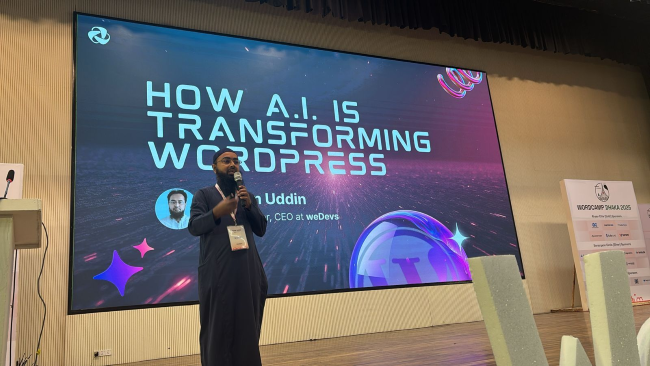
The WordPress community also remains part of his working life. His public profile records organizer and speaker roles at WordCamp Dhaka in 2019. In October 2025, he spoke there about how AI is transforming WordPress. The photograph from that session shows a founder discussing another change in what people might be able to do with software.
His plans have two tracks. Existing WordPress products, including Dokan, WP User Frontend, weDocs and WP ERP, are to gain AI capabilities intended to reduce users’ effort. Alongside them, weDevs is expanding managed commerce through FlyCommerce. He presents the service as a way for entrepreneurs to spend less time thinking about hosting, maintenance and infrastructure.
The ambition is easy to understand through his first encounter with the web. A boy paid for access to something he wanted to explore. The adult builds tools for people who have businesses they want to try. The distance between those two experiences contains failed projects, support replies, shared work and decisions about focus. NASA was an excellent first destination. His subsequent work has concerned the more everyday difficulty of helping people get started.