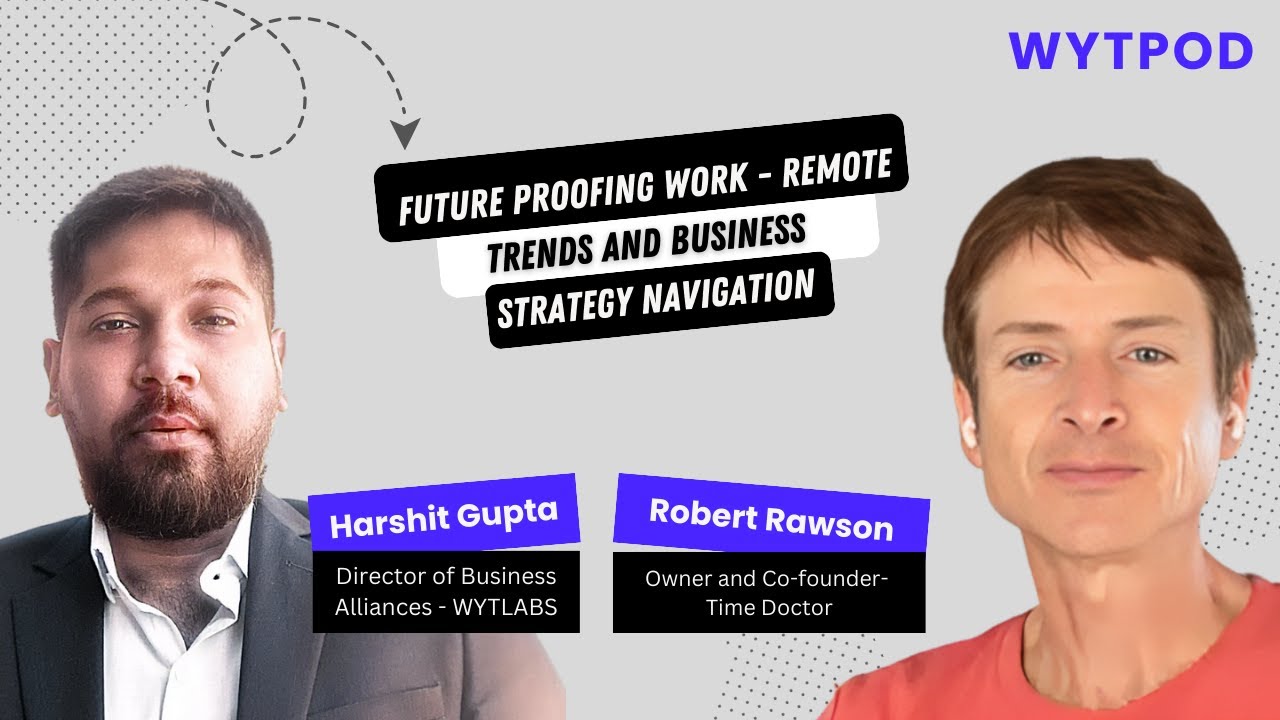
Rob Rawson got rid of the office because the office had become a problem. He had a team in the Philippines, an internet business with uneven revenues, and a wish to work from other places. Rent and equipment were expensive companions for a business whose income could change. The people still needed to do their jobs. Rawson needed a way to understand the work without standing in the room.
This is a less glamorous beginning than the usual tale of a founder spotting the future. It has the advantage of being recognizably human. He wanted to travel. He wanted to cut costs. He wanted the business to keep running. The arrangement required some invention, and the invention eventually became Time Doctor.
Years later, Rawson tried office life again. He bought into an Australian software development company and went in to work. There he found himself exchanging Slack messages with colleagues at nearby desks. Physical proximity had made a rather expensive journey to arrive at the same chat window.
“what am I doing this for?”
Rob Rawson, recalling his return to an office
A drawer full of experiments
Time Doctor emerged from a career full of attempts. Rawson’s early projects included an online mapping site, travel websites, a limousine directory and a Myspace profiling site. He also tried a business intended to teach people to detect lies. The list has the pleasing untidiness of someone who kept finding another door to open.
Some of his internet work made money. In the early affiliate-marketing days, he built websites that sent visitors to other businesses and received payments when those visitors bought something. A site about American satellite television was one example. His customers could be somewhere he was not; his collaborators could help build something he did not yet know how to build himself.
There were wonderfully awkward details. American payment checks accumulated on his bedroom table because depositing them from Australia was inconvenient. A friend saw the pile and wanted to know what he was doing. The internet had made the business international. The banking arrangements still expected someone to deal with the paper.
Those ventures also exposed the fragility of traffic-dependent income. A profitable advertising operation could lose momentum. Rawson became interested in something with more lasting value: a product people returned to, rather than a stream of visitors passing through.
The price of a memorable name
His interest in building durable businesses extended to the names above the door, even when there was no door. Staff.com began with the less concise MyStaff.com. Rawson paid roughly $400,000 to acquire the shorter domain. He had also owned names including Athlete.com, Tasks.com and Faster.com.
There is an easy joke about a founder saving office rent and spending heavily on an internet address. Rawson’s method of choosing names was more instructive than the price. He made a shortlist of fifteen, recorded himself saying them, then repeated them in a different order. Participants recruited through Amazon Mechanical Turk watched the video and reported which names they remembered and could spell.
It was a small experiment applied to a decision that easily becomes a contest of personal taste. A name had a job to do. Before paying for it, he wanted to see whether strangers could carry it away in their heads.
A tiny audience experiment before a substantial purchase.
The wrong feature, beautifully built
Time Doctor’s company history dates its founding with Liam Martin to 2012. Earlier accounts describe development and initial work before that date. Its first customer problem was close at hand: the founders were themselves operating businesses with remote employees and freelancers.
Using the product gave Rawson a regular encounter with its shortcomings. He could see what was missing during an actual working day. That experience offered a useful check on his enthusiasm for building more.
When he discussed early mistakes, he described software developed for months without that immediate feedback. Some ideas were potentially sensible. They simply addressed a need too far into the future while customers were waiting for something else. By the time the work arrived, it had missed the next useful step.
He could be candid about traction, too. Reaching a million-dollar annual revenue run rate felt like a meaningful milestone, he said in 2015. It was one point in an uneven process, rather than a moment that made all subsequent decisions obvious. The company’s later growth without venture funding gives those early product choices their weight: development still had to become something customers would pay for.
Hire the person, then check the map
Rawson’s account of remote work becomes more interesting when it moves beyond his own travel plans. Closing an office changes the conditions of a hiring decision. A candidate no longer has to be within commuting distance.
He described hiring a person in Nigeria because that applicant was the strongest fit for the role. The geography surprised him. It had not been the purpose of the search. Removing location from the first set of filters had changed who could reach the final decision.
His recruitment advice is practical: define what the job involves, then test for that work. He has advocated trial assignments and assessments that resemble the tasks a person will actually perform. A polished account of experience can only tell an employer so much.
He also resists the idea that a checklist can solve every operating problem. Repeated tasks benefit from a repeatable process. Product development and finding a new way to promote an article can require judgment that has not yet been written down. His enthusiasm for systems has room for the person using them.
The harder question is how accountability feels to that person. Time Doctor includes monitoring capabilities, including screenshots. Rawson has presented such records as a way for workers to demonstrate what they did, while acknowledging the importance of making the experience less invasive. The tension runs through his work: software intended to make distance manageable must also earn the confidence of the people being measured.
The meeting that has to earn its place
In 2018, Rawson and Martin created Running Remote. The conference brought people who ran distributed businesses together to exchange experience. A company could buy software to track time and still have questions about decisions, communication and the daily habits of a team.
Their 2022 book, Running Remote, drew on conversations with founders who had already spent years operating this way. It extended their work from the mechanics of recording activity into the management practices that allow people to work at different times.
Rawson is interested in the recurring meeting as an assumption that can be tested. He described trying a week without the regular meetings, allowing exceptions where a conversation was necessary, then considering what deserved to return. The experiment offered a practical way to examine a calendar that might otherwise fill itself indefinitely.
He uses asynchronous video, audio and writing, and has said he watches recorded material at double speed. That does not remove the need to meet. It asks colleagues to decide which exchanges need everyone’s attention at once. In his version of remote work, the invitation still has to make a case.
- 2012Time Doctor’s official founding year
- 2018Running Remote conference begins
- 2022The Running Remote book
- 2026A new CEO at Time Doctor; the Everis chapter
What the profits are for
Ask Rawson about legacy and the discussion can leave software altogether. He has spoken about effective giving and supporting Educate Girls. Peter Singer’s book The Life You Can Save prompted him to consider what his business success could contribute beyond his own household and employees.
The distinction matters in a career so often described through revenue, staff numbers and productivity. Money can fund another venture. It can also fund an opportunity for somebody who has very little connection to the venture that produced it.
There are lighter details alongside the large questions. Asked what he could eat for a week, he chose sushi or Japanese food. Asked about his recent searches, he talked about finding business-class flights using points. The wish to travel survived the company built partly to make travel possible. Apparently the next problem was the fare.
A longer clock
On February 12, 2026, Time Doctor announced Brian Sharp as CEO, succeeding Rawson. The founder who had needed a way to manage work at a distance now had another chapter underway with Martin.
At Everis, the two describe buying B2B software companies and keeping them. Their August 2026 founders’ letter reported a portfolio generating $27 million in annual recurring revenue. They present the company as a long-term home for products whose founders are ready to move on, with operating support across engineering, pricing, customer retention and administration.
It is a different use of the experience accumulated since that office in the Philippines. Rawson once needed his own business to work without his presence in a room. Everis asks how another founder’s business might continue under new ownership.
His experiments have changed scale, from a remembered domain name to an acquired software company. The questions retain a familiar practicality. What do people need next? Which expense earns its place? What can keep working when the person who started it steps away?