The office, respawned in the cloud - where your team walks in each day and nobody had to book a flight.
9:14 a.m., somewhere and everywhere. A SoWork office at the start of a day - avatars settle in, video bubbles flicker on, and the hallway chatter that remote work misplaced quietly returns.
Open a SoWork office and the first thing you notice is that it doesn't look like software. It looks like a place. Somewhere between Animal Crossing and the good corner of an actual office, there are couches and cafe tables and a plant that someone clearly picked out. Little avatars drift in as the workday starts. Video bubbles wink on above their heads. Walk your avatar toward a cluster of colleagues and their voices get louder; wander off and they fade. The room remembers you were here yesterday, because it's persistent - the same desks, the same layout, the same culture rendered in pixels.
None of these people are in the same city. Some aren't on the same continent. And yet the thing remote work quietly deleted - the run-in, the overheard joke, the "hey, got a sec?" - is happening again, on purpose, engineered back into the day.
That part - the hallway, the serendipity, the feeling that you belong to something with a shape - turns out to be the hard part. Calendars are easy. Culture is not. SoWork's whole bet is that presence you can feel through a screen is worth building, and that a workplace can be as customizable as a video game while running the unglamorous machinery of a real company underneath.
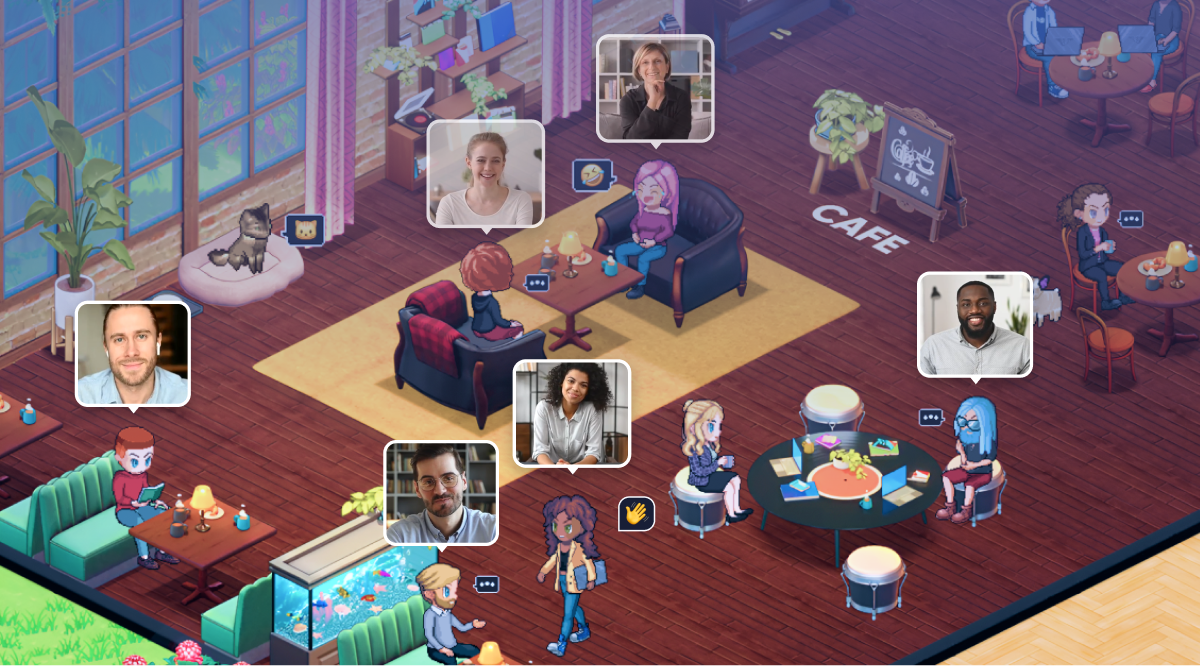
SoWork is a virtual HQ for distributed teams. Underneath the playful surface sits a stack of workplace tools - and, quietly, generative AI doing the note-taking nobody enjoys.
Persistent, customizable rooms with avatars and proximity-based video and audio. Walk over to talk. Wander off to focus.
Automatic transcripts, summaries, and action items captured from meetings held inside the space.
Slack-like chat built into the office, so conversation and place live together instead of in separate tabs.
Presence visualization and insights that give remote managers a real picture of how their team collaborates.
Multiple simultaneous screenshares, plus games and virtual events for the bonding a status meeting can't buy.
Slack, Zapier, Miro, Google Calendar, and Outlook - on desktop, browser, and mobile.
Three founders met at Harvard in 2018, building machine-learning products and, for a while, an edtech company. Then lockdown arrived and scattered everyone to their apartments. The tool they'd hacked together for their own team to stay connected started outgrowing the product they were supposed to be building. Users had made the decision for them. So they followed it.
What emerged, incorporated as Sophya and later branded SoWork, framed itself with an unusually blunt tagline: move workplaces from the earth to the cloud. Not a metaphor, the founders insist - a climate argument. Fewer commutes, fewer half-empty buildings, more of the work happening in software that doesn't need to be heated on a Sunday.
The people building it are worth a look, too. CEO Vishal Punwani is a medical doctor who taught for Khan Academy and worked with the World Health Organization before startups. And the org chart breaks the usual pattern: five of the company's six main teams are led by women. It's a company selling a new shape for work that took the hint and reshaped itself first.
Medical doctor, former Khan Academy teaching fellow, WHO alum. Now steering the humans-first mission.
Runs the operations that keep a distributed company living inside its own product.
Turns proximity audio, persistent worlds, and AI notes into something that actually loads.
Teams reportedly live inside their SoWork office 25-40 hours a week - roughly a full-time job's worth of presence. A rough sketch against how much time other tools tend to hold:
Vishal Punwani, Emma Giles, and Mark Liu meet building ML products. Sophya, Inc. is incorporated.
An internal tool for staying connected outgrows the edtech plan. The team pivots to virtual offices.
Talis Capital leads the round. Tinder shows up as an early customer, running culture rooms and hackathons.
The private beta goes public with a waitlist reportedly topping 1,000 companies and 300,000+ people.
Tinder swiped right - running its hackathons and culture rooms inside a virtual office.- From early customer coverage, TechCrunch, 2021
Open the same office now and the room is fuller. The avatars still drift in at the start of the day, but the layout has grown - a new corner someone built for the design team, a games nook that gets loud on Fridays, a wall of screenshares during a launch. The plant is still there. The AI has been quietly taking notes the whole time, so the person who missed the standup can read what happened instead of guessing.
What SoWork changed about that opening scene isn't dramatic, and that's rather the point. It didn't promise to end meetings or reinvent the human being. It put the hallway back. It gave a scattered team a place with a shape, a door to walk through, and a reason to bump into each other before the calendar fills up.
Whether the whole world follows a workplace into the cloud is still an open question - one with competitors, skeptics, and the stubborn pull of physical rooms. But at 9 a.m., in a customized office that exists nowhere and everywhere, a team that will never share a zip code is starting the day beside each other. That was the thing worth building.