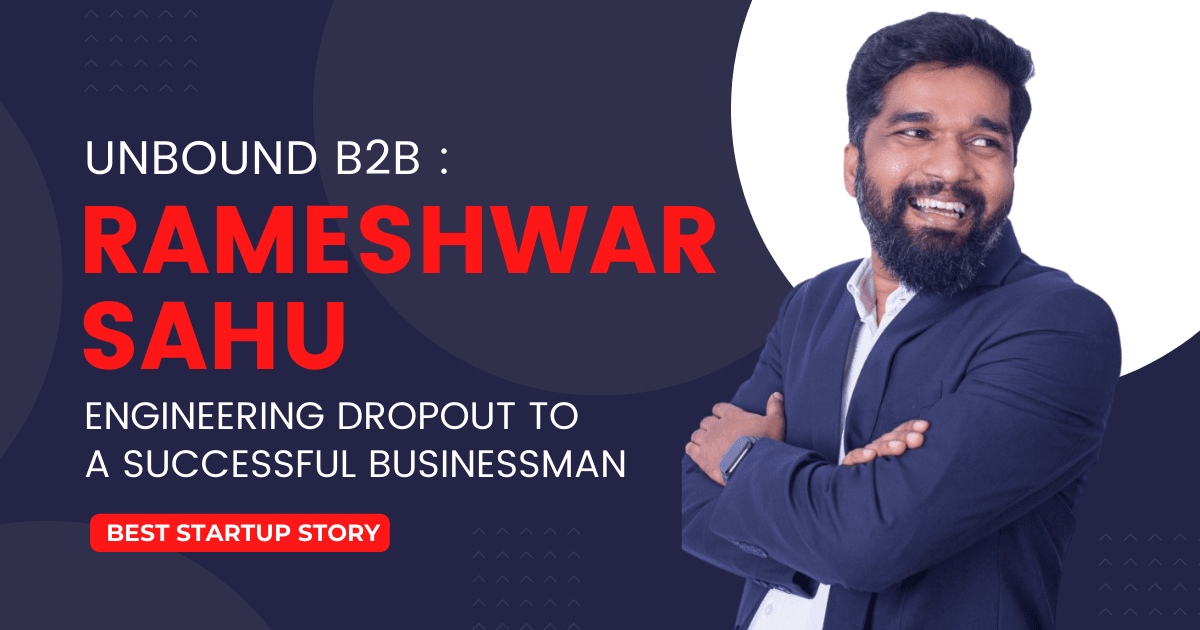
A good lead ought to be a cause for modest celebration. Someone has shown interest. A conversation might follow. In Rameshwar Sahu’s line of work, however, that same lead can also become a departmental dispute: marketing has delivered; sales remains unconvinced. Sahu has occupied both sides of this argument. His career gives him a particular interest in what happens between the promising name on a list and the person expected to call it.
Today, the UnboundB2B co-founder and CEO also leads Unbound IA, whose proposition joins brand building to demand generation. The vocabulary has grown more elaborate since his early working years. The underlying concern is familiar: how do you get people, information, and a commercial promise to arrive at the same place?
The summer job that stayed
Sahu began working in Indian call centers in 2006, while waiting to enter university. He continued after starting engineering studies, drawn to the work and the independence it offered. In 2008, with the economy deteriorating, he chose employment over completing the course. He later moved into sales, accepting a pay cut to get an opportunity without previous sales experience.
His explanation has a useful absence of destiny. Work became interesting before the approved career had properly begun. The headset stayed; the engineering course did not. He describes discovering an aptitude for relationships and managing people, then building a career through different sales responsibilities. It is an origin story with a payslip rather than a pitch deck.
“The summer job turned into a career.”
Rameshwar Sahu
By his account, the venture that became UnboundB2B began operating in Pune in late 2016, initially offering inside sales for technology products. Its services subsequently broadened to include content syndication, demand generation, and account-based marketing. The customer conversation was acquiring a larger supporting cast.
The meeting after the first wins
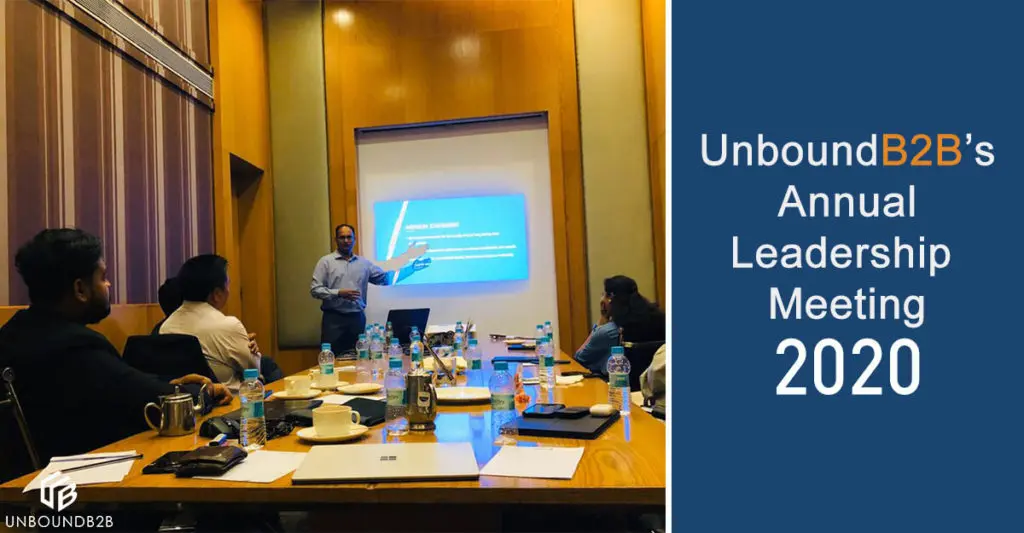
On January 8, 2020, UnboundB2B’s leaders gathered to discuss the year ahead. The agenda was practical: remove bottlenecks, improve productivity, and increase delivery capacity. The company reported winning more than 20 clients during 2019. Sahu and fellow co-founder Nishant Agrawal thanked the team for its contribution.
That meeting offers a more revealing milestone than a ceremonial photograph alone. New customers bring work that must be organized. A growing company needs people who can deliver what the sales conversation promised, with processes sturdy enough to keep doing it.
The operations team anticipated higher demand; quality assurance emphasized engagement and customer returns. These were adjacent concerns with a common consequence. Selling more would require the organization to work together more effectively. An order book has limited patience for an internal bottleneck, however eloquently the bottleneck explains itself.
In January 2022, Unbound Marketing announced Great Place to Work certification. Later that year, UnboundB2B announced its inclusion in SiliconIndia’s marketing-outsourcing selection. Sahu used that occasion to emphasize listening to customers before developing solutions. The sales experience still showed through: understanding the problem came before presenting the offer.
In the 2022 account of its work, the company described serving technology and enterprise clients with intent-based marketing across the sales funnel. Sahu’s own emphasis was on taking time to understand customers’ difficulties and expectations. He put listening ahead of supplying another helping of product information. For someone selling marketing services, that is a demanding position to maintain: the first conversation must leave room for the other person.
A record is somebody’s afternoon
The less photogenic side of this business is data. A company can have a substantial database and still need outside information for particular campaigns. If those records are wrong, the problem lands on the people who must use them.
Sahu described that experience in a ZoomInfo customer video. An earlier provider’s data required manual checking and correction before his team could put it to work. He said a subsequent trial with ZoomInfo saved time and money, and identified international coverage as one reason for the choice.
It is a vendor testimonial, with a vendor’s commercial setting. Its useful detail is the work itself: checking, appending, trying again. A faulty record is easy to count once. The time spent repairing it spreads across a team.
That helps explain the operational cast of Sahu’s marketing arguments. Before a persuasive message reaches a buyer, someone must establish that the information beneath it is usable. The campaign’s elegance is of limited comfort to a sales representative correcting the contact list.
THE WORK BETWEEN A NAME AND A CONVERSATION
- 01Check the recordCan the team use the information?
- 02Establish relevanceDoes the message fit the buyer?
- 03Continue the dialogueWhat should happen next?
An editorial illustration of the operational questions running through his work.
His favorite channel has an inbox
In November 2023, Sahu joined Rita Matuzic for a conversation about marketing through a shifting economy. Budgets were under pressure, buyers were cautious, and marketing teams were being asked to demonstrate returns with fewer resources. The discussion covered account-based marketing, retargeting, content, and the use of buyer-intent information.
The episode description identifies email marketing as his favorite channel. There is something pleasingly unceremonious about that preference. An inbox is an everyday place to meet a buyer, far removed from the excitement surrounding the newest marketing platform.
His emphasis was on opt-in audiences and information that helps teams understand where a buyer stands. The practical question was where limited effort could be useful. A channel earns its place by helping the work proceed.
LinkedIn’s marketing roundup subsequently highlighted the conversation, framing it around the pressure on budgets and the need to show a return. The setting mattered: Sahu was discussing the constraints marketers faced, including the gap between what a chief executive expected and how cautiously a customer might buy.
His interest in content also extends beyond a campaign’s immediate response. In public writing about software marketing, Sahu has encouraged companies to work with industry experts, build audiences, and let employees publish. He connects that activity to more informed, more personal sales outreach. The expertise is meant to give a subsequent conversation some substance.
Tech Research Online belongs to that part of his business history. The company’s account of its development places the publication alongside its creative and brand capabilities. Publishing gives a technology audience reasons to return between buying decisions. It also puts a different demand on a sales-led organization: there must be something useful to read even when there is nothing immediate to sell.
Two clocks on the same wall
By April 2025, another podcast appearance put a related distinction at the center: demand creation and demand capture. Capturing demand serves buyers already considering a purchase. Creating demand involves building familiarity and interest before that moment arrives.
The episode examined how those activities fit the buying cycle, including brand positioning, budget allocation, and measurement. Sahu’s interest in both makes sense for an entrepreneur whose business grew out of sales work. Immediate opportunities matter. So does the audience that will become interested later.
The tension is temporal. A quarterly target arrives on schedule; a buyer’s confidence keeps its own calendar. A marketing plan needs some way to accommodate both. Otherwise, the people cultivating future interest and the people pursuing this month’s opportunities may have little shared language for the value of each other’s work.
ONE BUSINESS, TWO HORIZONS
Demand creation
Become familiar before the buying moment.
Demand capture
Respond when purchase interest is present.
The distinction explored in Sahu’s April 2025 podcast conversation. No fixed buyer timetable is implied.
A customer is also a time zone
In October 2024, UnboundB2B announced an office in Guadalajara, Mexico. The stated purpose was closer support for North American customers, with operations and sales teams central to the location. Sahu linked the move to demand-generation and sales-development work for that market.
The announcement placed geography inside the delivery model. A customer relationship includes availability, feedback, and an understanding of what the customer needs next. Opening an office makes those requirements physical: people need somewhere to work, and someone needs to make the arrangement useful.
That same month, UnboundB2B announced B2B Unplugged in San Francisco, featuring Marketo co-founder Jon Miller. Sahu was among the leaders named for the gathering, alongside colleagues from growth, operations, sales, and marketing.
The planned format combined a discussion of marketing’s future with networking and food. Business-to-business marketing occasionally remembers that its participants would enjoy dinner. More substantively, the event connected Sahu’s organization to practitioners discussing the same questions about buyers, channels, and future demand.
Five teams, one brief
Sahu’s current work at Unbound IA brings those concerns into an explicit organizational proposition. The agency describes strategy, creative, media, sales, and content syndication working from a shared brief. Its account of its development starts with sales and extends into creative capability, publishing, and brand strategy.
The structure gives his career a recognizable throughline. A person who entered business through customer conversations is now trying to organize the disciplines surrounding them. The agency’s language pairs the brand an audience remembers with the pipeline a company needs to develop.
That ambition involves more than adding services to a list. A shared brief has to give different specialists enough agreement to proceed: whom they are addressing, what they are promising, and what would count as useful progress. A handoff is also a test of whether the first team understood what the next team required.
Sahu’s public writing returns to that test. In one post about stalled sales-qualified leads, he highlighted smoother transitions from sales development to account executives, continued marketing support, and a mixture of automation and human follow-up. The attention stays on the interval after a lead is qualified and before a deal closes.
That is where his unfinished business now sits. The former call-center worker has spent years moving closer to the commercial decision, then widening the operation around it. A useful lead still needs a useful next conversation. For Sahu, building the company means taking responsibility for more of what happens in between.