The future of the automobile has a surprisingly large number of progress bars. A map refresh inches forward. A security patch waits for a signal. A feature arrives from the cloud. Somewhere behind each small miracle is a tangle of networks, vendors, software layers, regulations and machines moving at motorway speed. Raj Kanaya has built a career in that tangle. His work is not the glossy screen on the dashboard. It is the connective tissue that lets the screen, the vehicle and everything beyond it agree on what should happen next.
Today, Kanaya is General Manager of the Automotive Business Unit at Aeris, the cellular IoT company. Aeris lists him among its leadership team, and his remit lands where modern motoring becomes a systems problem: connected services, cloud operations, over-the-air updates, diagnostics and the long useful life of a car. The title sounds contemporary. The apprenticeship began much earlier, in the less photogenic world of data centers.
A clean sheet, a crowded network
Kanaya studied computer science at the University of California, San Diego, graduating magna cum laude, then completed an MBA at Stanford Graduate School of Business from 1993 to 1995. His career moved between technical and commercial rooms: consulting at Bain, management at Lucent, then product strategy at NetScaler and Citrix. By the late 2000s, he had spent roughly a decade around data-center infrastructure. Traffic was exploding between corporate facilities, and simply buying more bandwidth looked like a very expensive habit.
In 2008, Kanaya co-founded Infineta Systems with K.V.S. Ramarao. The company set out to accelerate high-volume, latency-sensitive traffic between data centers. Its answer was the Data Mobility Switch, a combination of hardware and software designed to reduce duplicate data and move the remainder quickly. The company raised more than $30 million, including a $15 million Series B in 2011. Version one took two years to build. Kanaya was proud of that pace precisely because it was not a web app that could be posted overnight. It required specialized engineers, long development cycles and equipment that had to work in the physical world.
His description of the founding insight was unusually grounded. The team did not wait for a theatrical flash of inspiration. They met the people responsible for disaster recovery, distributed systems and day-to-day IT. They asked where the strain actually lived. The answer was the wide-area network between data centers. Kanaya joked that IT should not be a casino. Customers should not have to gamble that another costly circuit would solve the real problem.
“Marketing starts at identifying a real problem customers want to urgently solve.”
That sentence explains more of his career than the word marketing usually permits. Kanaya's version includes product requirements, allies, routes to market and delivery. Promotion comes late. The promise has to survive contact with the system. It is the outlook of an engineer who wandered into a marketing meeting and politely moved the whiteboard closer to the customer.
The founder who distrusted his own plan
Infineta's story did not end as its founders intended. The company ceased operations in 2013, and Riverbed acquired some of its intellectual property. Kanaya's public comments from the period make the setback legible without turning it into mythology. A plan, he said, rests on assumptions. Conditions change. Emotional attachment to the original plan can become a liability. Changing direction is painful and messy, but preserving a broken assumption is hardly noble.
He was equally plain about the loneliness of command. His advice to would-be CEOs was to build a network of mentors. Accountability for everything creates a psychological burden; talking to people who have carried it helps. This is not the standard pose of the invulnerable founder. It is more useful: confidence with an escape valve.
Then comes the detail that saves any executive biography from becoming a conference badge. Asked for his favorite app in 2012, Kanaya chose Scramble with Friends. It was quick, fun and, he said, one of the few games in which he could still beat his daughters. The architect of high-speed data movement enjoyed a word game because the latency was low and victory remained barely available.
From moving records to moving vehicles
By 2013, Kanaya was an executive at Aeris. The nouns changed quickly: SIMs, telematics, fleets, automakers. The underlying problem did not. Enterprise data still needed to travel reliably, across distance and through infrastructure that customers did not wish to contemplate before breakfast. At Aeris, however, the endpoint might cross a national border, disappear into a parking garage, or remain on the road longer than the mobile network generation installed at the factory.
By 2014, as chief marketing officer, Kanaya was talking about making machine connectivity easier to buy and manage. Aeris's Neo platform aimed to make ordering an IoT connection feel more like buying cloud computing. In 2016, SoftBank and Aeris formed Aeris Japan K.K. Kanaya became its representative director and CEO. The joint venture brought together SoftBank's position in Japan with Aeris's IoT and telematics platform. In 2017, he represented that work as Aeris supplied the mobility platform behind Mitsubishi Connect.
Another partnership followed in 2020. Volkswagen and Aeris formed Ventic, a joint venture for connected-vehicle platform technologies. Volkswagen held 51 percent and Aeris 49 percent; Kanaya joined the board. Its platform supported the next generation of Volkswagen Car-Net in North America. His own summary of the industry's forces was neat: connected vehicles sat at the center of autonomy, electrification and shared mobility. Each trend asked the vehicle to maintain a much longer conversation with the world outside it.
A car can be half updated
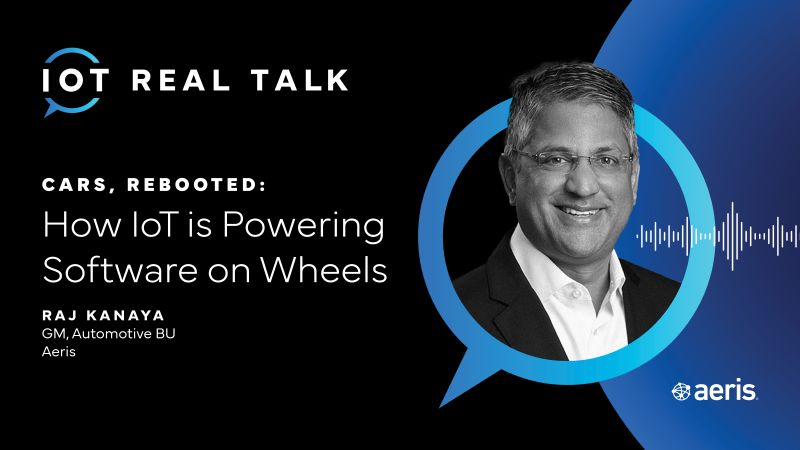
Kanaya's recent public work is preoccupied with operations. In the 2025 IoT Real Talk episode “Cars, Rebooted,” he described the automobile as software that keeps evolving after sale. An over-the-air update sounds simple if one imagines a single laptop on a desk. A fleet is a harsher setting. Suppliers differ. Backend systems multiply. Wireless links wobble. Some cars finish, some lag and some fail. The result is a fleet stuck in what he called a half-done state.
The security problem is similarly layered. Yesterday's automobile was relatively isolated. Today's car exchanges data with networks, clouds, applications and service providers. No single participant owns that whole stack. The automaker controls the vehicle and customer experience; operators provide access; platforms coordinate coverage, eSIMs, provisioning and services. Kanaya's work sits in that middle layer, where responsibility is abundant and control is shared.
The lifespan mismatch makes the problem particularly automotive. A new vehicle may remain in service for fifteen years while cellular standards turn over beneath it. In 2026, Kanaya argued that 5G and remote updates should be designed in from the start, while flexible embedded connectivity and targeted upgrades prepare for whatever the networks do next. Satellite and Wi-Fi can fill specific gaps. Cellular remains the foundation because large updates and real-time services demand its coverage, bandwidth and latency.
A car is sold once. Its software must be operated for years.
Let AI earn the keys
In August 2026, Kanaya borrowed the automotive industry's own Level 0-to-5 language to describe AI in connected-vehicle operations. At Level 0, people watch dashboards, inspect logs and route tickets by hand. At Levels 1 and 2, AI spots patterns and recommends action. Level 3 is the hinge: software can perform defined tasks within agreed boundaries, while humans supervise exceptions. Levels 4 and 5 extend automation toward systems that diagnose, resolve and optimize more of the work.
The appeal is economic as much as technical. Every new software feature adds something to monitor, update and secure. If operational headcount rises at the same rate as software complexity, the model breaks. AI can absorb repeatable work, but Kanaya does not present full autonomy as an overnight conversion. It is a maturity curve. Humans move from doing every investigation to governing the system that handles the familiar ones.
That is the same instinct visible at Infineta: find the point where scale punishes the existing process, then redesign the machinery underneath it. In one era, overloaded links could not support the traffic between data centers. In another, manual teams cannot indefinitely support millions of software-defined vehicles. The objects are new. The constraint is an old acquaintance.
In August, Aeris announced that Kanaya and CEO Aziz Benmalek would take that argument to the J.P. Morgan Auto Conference, discussing AI-driven connectivity, orchestration and security. The setting is fitting. Automobiles are becoming intelligent machines, but the intelligence that interests Kanaya is not only behind the steering wheel. It is also in the quiet operational layer that notices a failed update, finds the likely cause and sends the right response before the owner has reason to complain.
Kanaya once offered founders three necessary qualities: conviction, guts and perseverance. He also admired John Wooden's instruction to make each day a masterpiece. Put together, the maxims might sound grand. His career makes them more workmanlike. Show up. Find the bottleneck. Change the plan when the assumptions expire. Ask mentors for help. Deliver what the message promised. Then do it again, only now the data center is traveling at sixty miles an hour.