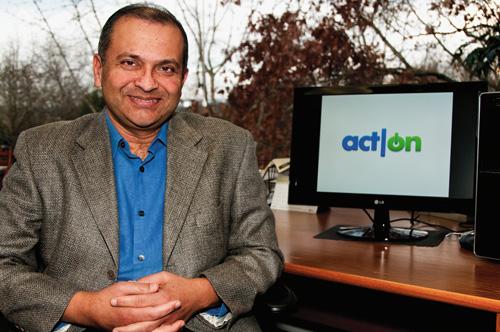
Five million dollars came with an inconvenient condition. Raghu Raghavan could have the investment for Act-On if he moved the company from Oregon to Silicon Valley. In the fall of 2009, he declined. Software is supposed to make geography less troublesome. Here was a funding offer proposing to make it the central feature.
He had already tried the relocation experiment. Responsys, the marketing software company he co-founded in 1998, had moved to California after taking venture capital. Then the internet bubble collapsed. Raghavan remembered the damage to the Oregon team and the interference of investors. When another company and another moving proposal arrived, he had a fairly specific basis for saying no.
Act-On stayed. He hired salespeople to demonstrate demand, and in November 2010 secured $4 million from Voyager Capital and U.S. Venture Partners without the relocation requirement. The refusal belongs near the beginning of his story because it makes the later growth easier to understand: he cared about the terms on which a company was built.
02A chainsaw makes an introduction
Raghavan came from India, studied electrical engineering at IIT Bombay and earned a computer science doctorate at the University of Minnesota. His research concerned routing complexity. Academia was a plausible destination, but he wanted to make things people could use. He went to UNIVAC to work on computer-aided design.
Then came an interview at Mentor Graphics, an Oregon startup operating from a retail storefront. It was a Saturday. People were working. A chainsaw appeared through a wall as builders opened up the neighboring space, heading toward an expensive workstation. The interview acquired an unusually practical demonstration of startup expansion.
He accepted a pay cut and joined in 1983 to build the integrated-circuit layout group. There is a pleasing absurdity in the decision: a trained computer scientist choosing a workplace where the first technical challenge was protecting a computer from the building work. The attraction was the chance to build.
03The customer changes the question
After Mentor Graphics came work on PC-based pension and benefits systems at the Wyatt Company. The consulting work paid well. It also left Raghavan wanting to return to technology development. With former colleagues, he began making reusable software libraries, first in C++ and then in Java. Some were built for the pleasure of solving a problem; licensing them turned that pleasure into a business.
Responsys grew from that technical base. The original thought involved sorting incoming email. Conversations with prospective customers revealed more interest in the messages they needed to send. The direction changed. It is an unglamorous little turn with large consequences: the engineers had tools, but customers supplied the useful question.
The company expanded during the dot-com boom and then faced the disappearance of dot-com customers. Raghavan came to see how deeply connected customer data could keep a marketing system valuable even in difficult conditions. Integration gave a company a reason to keep paying when enthusiasm for new technology had evaporated.
Responsys eventually went public in 2011. Oracle announced an acquisition agreement in December 2013 valued at about $1.5 billion, net of cash, and completed the acquisition in February 2014. By then, Raghavan was already years into another attempt at making marketing software work for a different kind of customer.
04A webinar should leave something behind
The next opening began in conversations with WebEx co-founder Subrah Iyar. They discussed customer churn and what behavioral information could do to make WebEx more useful. A webinar creates more than an attendance list. It leaves clues about interest, timing and the next conversation a salesperson might have.
Raghavan saw an opportunity to arrange those clues around the work a marketer wanted to perform. Salesforce had become an important store of customer information. A separate event tool could do its job perfectly well while leaving the marketing team to reconcile the pieces afterward. His proposed system would connect the event to the surrounding marketing activity.
Act-On was founded in 2008. Cisco, which had acquired WebEx, supplied $2 million in early financing. A channel relationship promised a route to customers, but the timetable became a problem. Raghavan decided to start selling directly with a single salesperson, rather than wait for the larger organization to be ready.
The first deals drew on WebEx users who needed a more complete setup. Act-On joined event promotion, follow-up and information flowing to sales. The early product had a concrete job to do, and the first customers were people already experiencing the inconvenience. That is a more useful starting point than a slide about a vast market.
Let the next conversation inherit the last one.
05Give the small team a working afternoon
By 2011, Raghavan described an ideal customer in terms of the marketing department: fewer than ten people, without an IT specialist to support them. The distinction mattered. A relatively large business could still have a tiny team attempting to run its campaigns. Company size alone would miss the person actually operating the software.
He wanted the experience to follow familiar activities. Bring in a list. Run an event. Follow up with people whose behavior suggests interest. The database would support the task without requiring the marketer to become its architect. His complaint about enterprise applications was brisk: “Enterprise apps are dull and ugly.” Office software had been warned.
Customers helped direct the capabilities. Email, website visits and social activity needed to make sense together. A marketer might want to find people with a particular job title who had recently visited a pricing page, then invite them to an event. The difficulty was making the information cooperate.
The target market included industrial businesses and other companies far removed from the software startup circuit. Their products might attract little cocktail-party attention; their marketing requirements could still be sophisticated. Raghavan recognized paying customers in places where a fashionable industry map might leave empty space.
The early commercial terms reflected that practical approach. In 2011, he described month-to-month contracts and pricing tied to the people contacted. He also described watching product usage and reaching out when customers were leaving useful modules untouched. Getting someone to subscribe was only the beginning of getting the software used.
06Before the bigger cheque, a better model
Raghavan applied a similar curiosity to selling. An unattractive funding offer made him question how clearly he could explain the business. He spent nine months developing a model of sales hiring, training and quotas. Four hires became a way to study how long a new salesperson needed before giving a demonstration independently.
This was a different sort of engineering problem. The inputs were people, time and a product demonstration. The output was a company that could explain what another investment would accomplish. When he returned to fundraising, the process went more smoothly. The $4 million round was followed by $10 million led by Trinity Ventures in 2011.
Growth brought larger numbers. In April 2014, Act-On announced a $42 million financing led by Technology Crossover Ventures, taking its total funding at that point to $74 million. The company had 270 employees. Its premise remained recognizable: sophisticated marketing tools could find buyers among businesses just beginning to adopt them.
The interesting progression is from one salesperson to a system for adding salespeople. A founder can enjoy the drama of closing an early deal. A growing business also has to work on an ordinary Tuesday when the founder is somewhere else. Raghavan had spent time making that ordinary Tuesday measurable.
Individual financing rounds, not annual revenue or cumulative totals.
07The reader behind the software
There is another way into his interests: the books he discussed in 2013. Chinua Achebe’s Things Fall Apart had moved him deeply. He was reading Anthills of the Savannah, drawn to a novel about political power in a fictional West African country. His reading wandered well beyond software and its instruction manuals.
He was also returning to Suetonius’s Lives of the Twelve Caesars. Roman history, he said, was a serious interest; the appeal included personal details about the people wielding power. Alongside these books sat Vince Flynn’s Act of Treason, a thriller he valued as a way to switch off after work.
It is an agreeable combination. A novel about power, an ancient account of emperors, and a thriller that need not demand an evening seminar. Reading can be serious without making every book an assignment. His list gives the technologist a life outside the next funding round, and supplies a welcome interruption to the usual founder bookshelf of management instructions.
08Leaving the corner office for the product
In October 2015, Andy MacMillan became Act-On’s CEO and Raghavan moved to CTO. Raghavan described himself as “very technology focused.” He had built the company, but he did not consider that a requirement to remain its chief executive indefinitely. The business needed leadership for another phase; he wanted to be closer to the technology.
He left the operating role at the end of March 2016. Subsequent work included helping other entrepreneurs. When RFPIO, now Responsive, introduced him as an advisor, his endorsement centered on a familiar combination: a real operational problem and software designed so a company could adopt it easily. The product judgment had survived the change in job title.
Elevate Capital now lists him as Partner Emeritus. His public LinkedIn profile places him in Saratoga, California, associates him with Tamasha Labs, and describes investing, helping entrepreneurs and building software products. Those activities make a recognizable continuation of the earlier career, with more founders on the receiving end of his experience.
The durable thread runs through the practical details: a customer who needs to send email, a marketer assembling a webinar, a salesperson learning a demonstration. Raghavan repeatedly found work worth doing inside those small inconveniences. The five-million-dollar refusal fits that pattern, too. He had a team and a place to build. The address on the cheque was negotiable; the address of the company was his to choose.
“I wanted to build something that really worked.”Raghu Raghavan / on choosing industry over academia