The business idea took shape across the road from a trade show, in a Persian restaurant in London. It was 2013. Rytis Lauris and his collaborators had been walking the aisles of the Ecommerce Expo, looking at a market already crowded with email software. There seemed to be plenty of ways to send a message. Helping a small shop send a useful one, without employing a department to arrange it, was another matter.
The choice they saw was awkward: straightforward bulk email at one end, elaborate enterprise systems at the other. Somewhere between them stood a merchant with products to sell and a finite afternoon. Lauris wanted to build for that person. Within four months, the team had launched the first version of Soundest, the business that would become Omnisend. It began as a free service, a question put to the market before anyone pretended to know the answer.
There is a pleasing lack of grandeur to this beginning. A crowded exhibition, a meal, a particular kind of customer. The subsequent story contains plenty of ambition, but Lauris tends to make ambition sound like something that has to earn its keep.
Before the inbox, the ringtone
Lauris studied political science at Vilnius University. As a teenager, he had imagined a political career; business eventually took precedence. Public speaking survived the change of direction. So did the usefulness of approaching people who might be uncomfortable to approach, competitors included. A degree need not become a job title to remain useful.
His introduction to commerce came at fourteen, helping in his mother’s optical shop. He has explicitly corrected the more convenient version in which he founded a business at that age. Later, a friend brought him into a venture selling polyphonic mobile-phone melodies. Before the automated shopping reminder came the pocket-sized tune: a modest reminder that entrepreneurs often begin wherever an opening happens to be.
Other attempts included eco-friendly postcards, with a tree planted for each sale, and IQ Polls, an audience-interaction tool for speakers. Lauris is careful about the plural. He had partners and co-founders in these ventures. The solitary founder makes a tidy photograph; his own account is considerably more crowded.
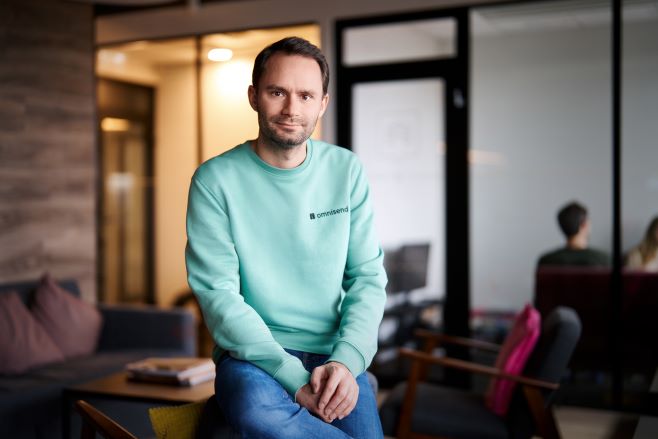
The client on the other side of the table
A digital marketing agency gave Lauris another route forward. One client was a public-relations agency managed by Justas Kriukas. Both men ran businesses with local reach. Both wanted to build something that could travel. The relationship supplied more than a useful introduction: Kriukas became Omnisend’s co-founder.
Online retail offered them a practical advantage. A merchant could observe a visitor arriving, browsing and buying, then communicate with that customer using the history of those interactions. The opportunity was to make that information usable. A shopkeeper should be able to follow up without manually supervising every message. In this telling, the founding connection matters as much as the founding idea. The person buying agency services became the person helping build the product.
By August 2014, Soundest’s own roadshow description counted more than 2,200 businesses using it, six months after its February launch. The model was freemium: basic functions were free, while premium features carried a charge. It was still seeking financial investors and agency partners. The later identity as a customer-funded company was being assembled in public, with the uncertainty still attached.
The money that did not arrive
Early fundraising failed. Lauris has described bootstrapping as the approach that this forced upon Omnisend, rather than an immaculate principle adopted before anyone had tried the alternative. That distinction gives the story some welcome friction. A financing setback can become a philosophy, but it first has to be survived.
“We work bit by bit each day,” he says. His preferred illustration comes from Jim Collins: the twenty-mile march, a steady daily distance through favorable and unfavorable conditions. It is an unglamorous image for a software business. That is its attraction. A company can organize itself around repeatable work, even while the weather refuses to cooperate.
He also remembers needing two years to understand where the product created value and what customers would pay for. The team launched with gaps. Some users left. Their departures supplied information as well as disappointment. Asking the people who leave what went wrong is a fairly stern form of listening; they have already voted with their feet.
“We work bit by bit each day.”
Rytis Lauris
A bigger name, a narrower customer
On October 31, 2017, Soundest became Omnisend. The announcement put its reach at more than 30,000 brands in 130 countries. The name change reflected a product extending beyond email into connected points of contact: forms, popups, receipts and other ways for a merchant to keep a relationship going.
The intended customer remained recognizable. Lauris wanted smaller ecommerce businesses to have useful capabilities at an accessible price, with a manageable learning curve. Expanding the ways a product works is one decision; expanding whom it serves is another. Omnisend’s argument depended on preserving that distinction. The merchant who began the story still needed to finish the day’s work.
He has been willing to reverse product decisions. Omnisend added messaging channels including Facebook Messenger, WhatsApp and Viber, then removed them after they failed to demonstrate enough value for its ecommerce customers. Email, SMS and web push remained. There is something refreshing about a software roadmap with an eraser on the desk.
Its first integrations also reveal the contingencies behind the finished business. Early traction came through Tictail, a Swedish ecommerce platform, before Shopify. Later, a network of smaller agencies and freelancers became another route to customers. Lauris described making that partner program largely self-service, so even a partner bringing two leads a year could participate without creating a miniature bureaucracy.
- 2014Soundest launches
- 2017A new name: Omnisend
- 2018SMS joins the platform
- 2020The US office opens
- 2025150,000 online stores
The calendar has the casting vote
In his account of a typical working day, Lauris puts tasks directly into his calendar. A list can accommodate endless optimism. A calendar, rather rudely, contains hours. He also reserves ninety-minute focus blocks without meetings or interruptions. With Europe already working while American colleagues and customers are starting their mornings, later hours often fill with conversations across time zones.
Delegation has required a different kind of discipline. In 2024, he identified handing work to people better suited to it, and giving them authority, as his biggest personal challenge. That admission is more revealing than an instruction to hire good people. Hiring is a transaction. Allowing someone else to do the job requires the founder to change a habit.
He returned to delegation, customer communication and the balance between quantitative and qualitative information in a February 2025 conversation about scaling Omnisend. The business was introduced there as having reached $50 million in annual recurring revenue without outside funding. Growth had enlarged the organization; the discussion still circled back to how its leader should listen and let go.
The scale has continued to change. Omnisend’s history records a team of 250 in 2024 and 150,000 online stores using the platform in 2025. Its current biography of Lauris describes a company that has reached $70 million in annual recurring revenue. These are company measures, but they also sharpen his personal problem: the work of leading grows increasingly distant from doing everything yourself.
Online stores using Omnisend in 2025
A dated company milestone, not a count of paying customers.The pleasure of changing your mind
WordPress offered a particularly useful correction. Omnisend initially supported the ecosystem, discontinued support after disappointing results, and later returned. By his 2024 account, it had become the company’s fastest-growing ecosystem. Lauris named BobWP, Jonathan Wold and Robert Windisch among the people who helped the team find its place in that community.
Outside work, the details are pleasingly ordinary: reading, cycling, squash, occasional tennis and family time. Holiday planning involves negotiation. His wife favors warmer destinations; he has developed a taste for mountains and markedly different landscapes. The founder who wants a global company must still agree where to go on holiday. Geography retains a veto.
He is also prepared to be funny at his own expense. Asked about coding, he recalled friends teasing him for running a technology company without being able to write a line himself. “And I say yes because I’m smart,” he replied. He enjoys dancing, admits singing is beyond his talents, and likes fiction as well as business books. There is room here for a person who does not need every interest to become a management technique.

A cheaper message, a larger ambition
In May 2026, Lauris announced a cut in Omnisend’s SMS prices. US rates would start at $0.007 a message, depending on volume. He attributed the room to reduce prices to the scale and infrastructure the business had developed. The announcement brought his longstanding affordability argument into the considerably less abstract territory of a customer’s bill.
His public work has also moved into connected AI. A June 2026 Commerce Roundtable session explored linking marketing data to AI for practical tasks such as performance reviews, segmentation and deliverability checks. The questions have changed with the tools. The preoccupation is familiar: what useful work can a merchant actually get done?
Beyond Omnisend, Lauris chairs the board of Švietimas #1, a Lithuanian nonprofit established by Unicorns Lithuania. Its work includes education data, school leadership, examples of effective practice and pilot models. The organization has developed a ten-step education roadmap with ISM University of Management and Economics. It is a substantial return to public questions for someone whose political-science degree led him into business.
The distance from an optical shop to ecommerce software is easy to measure in job descriptions. The distance from running a company to helping change education is harder. Both ask what happens when an ambitious plan meets people with limited time and existing ways of doing things. Lauris’s business history suggests an answer he is comfortable living with: begin, hear the objections, adjust, return tomorrow. Twenty miles is a long way if you insist on walking it every day.