Before there was a factory in Pune, there was a sari. Radhika Patil and her husband, Bharath, used an old cotton one belonging to her mother, along with springs, linkages and a metal rod, to make a cradle for their daughter. In her account of the experiment, the child accepted the arrangement. The first customer had exacting standards and no interest in a pitch deck.
The couple kept adding things: a motor, music playback, a way to monitor their increasingly mobile daughter. The object changed as the child changed. Looking back, Patil described a household invention gradually becoming a commercial idea. A family had asked for something useful, and two engineers had begun answering with whatever they could build.
That modest beginning makes an instructive introduction to Cradlewise’s co-founder and CEO. Her company now makes connected cribs and operates its own manufacturing facility in India. Yet the most revealing part of her story remains the interval between noticing a problem and deciding it was hers to solve. She had semiconductor experience. She also had a customer in the next room.
The classmates who kept building
Patil grew up in India and followed an interest in mathematics and electronics into engineering. Her education took her through Pune’s College of Engineering and the Indian Institute of Science in Bengaluru. The combination matters: she came to consumer hardware through circuits and systems, with the habits of someone accustomed to asking how a thing actually works.
At IISc, she and Bharath were classmates in the Center for Electronics Design and Technology. They worked together on technical projects and talked about eventually starting a company. Friendship, marriage, parenthood and a business partnership followed. Those roles accumulated around the same two people; the technical collaboration came early.
Her professional experience included power systems at Qualcomm; Bharath worked on imaging at Texas Instruments. Their eventual product drew on that kind of engineering knowledge, but its brief came from ordinary family life. A nursery has an efficient way of making an abstract technical question very specific. Can this detect movement? Can it respond? Can it do so quietly?
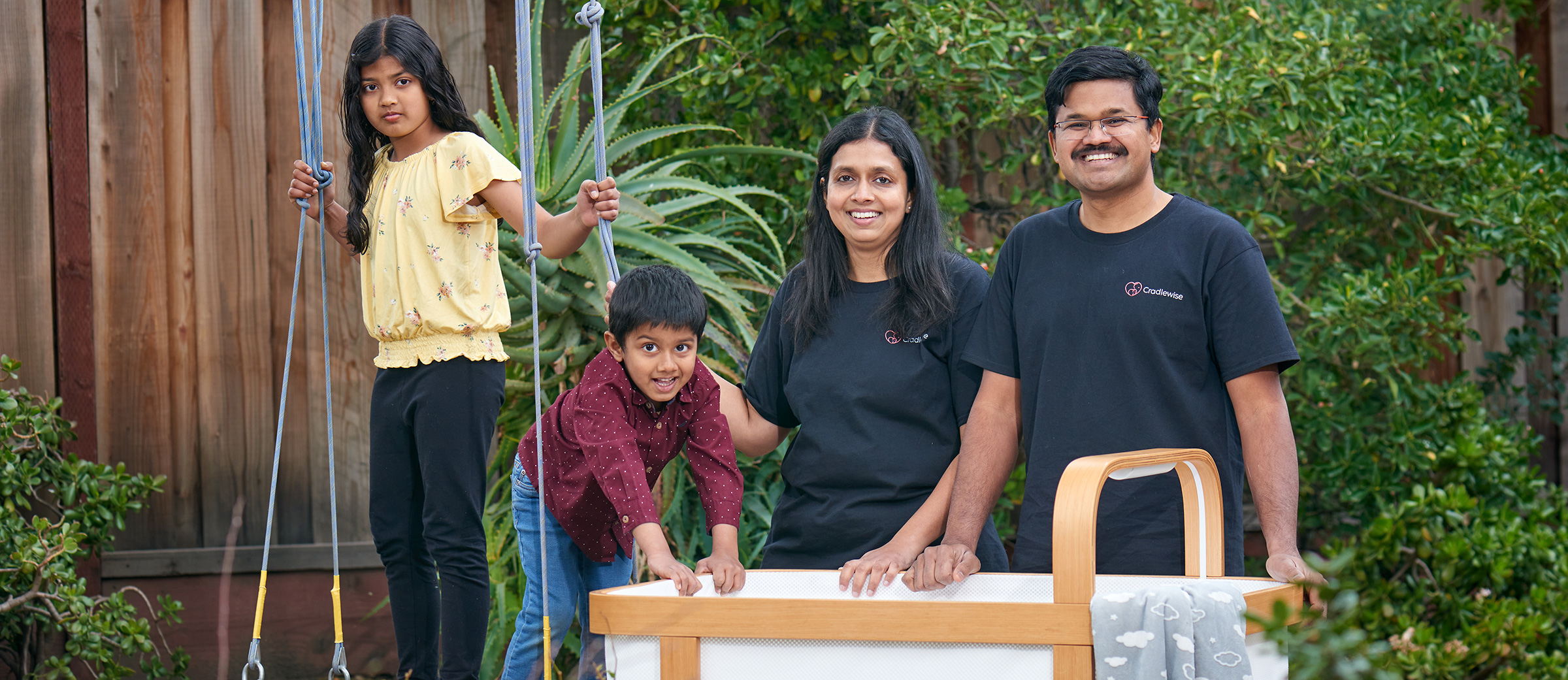
A matter of timing
The observation behind Cradlewise concerned a small window of opportunity. The Patils noticed that responding when their daughter first stirred could help her settle again. Waiting until she was fully awake made the task longer. Anyone who has missed a train can understand the structure of the problem. A few moments can change the next half-hour.
Patil’s question was whether a cradle could recognize that earlier moment and respond. It was a practical use for sensing: an observation would lead to a physical action. In the commercial product, monitoring, software and gentle bouncing became parts of the same system, rather than separate objects demanding separate decisions from a parent.
The distinction earned Cradlewise a place in TIME’s Best Inventions of 2020. Sensors detect the first stirrings, and the crib uses the child’s schedule to decide whether to bounce or allow waking. That arrangement captures the design challenge: recognizing a signal is only useful if the response fits the moment.
- 01SenseNotice early movement.
- 02InterpretConsider the pattern.
- 03RespondApply gentle motion.
For Patil, this also created a question about the purpose of data. Another chart could tell a parent what had happened. Her interest was in building something that could help with the task itself. The company’s hardware gives that preference a literal form: information goes into the system, and a mechanism moves.
The nursery goes on the road
A working prototype still leaves a considerable distance to a business. Cradlewise joined the HAX hardware accelerator in 2019. Patil’s early recognition also included the Qualcomm Design India Challenge in 2018. These were steps toward turning an invention into something that could be produced, financed and sold beyond the family that first needed it.
The American market became a deliberate choice. Patil saw greater readiness there to buy smart home technology, alongside a different pattern of family support. She and Bharath moved from Bengaluru to the San Francisco Bay Area with their two children in 2020. Selling into that market meant living closer to the people whose confidence they needed to earn.
Their early demonstration programme had the name Nursery on Wheels. They drove a crib in a van to prospective customers for demonstrations. Patil later described doing this for the first 100 customers and speaking personally with the first 1,000. A company selling a substantial piece of nursery furniture had made its founder part of the service.
The van is a useful detail because it gives customer focus an address and a set of tyres. Showing the product took time. Questions could not be waved away with a specification sheet. Parents wanted to understand what they would be bringing into their homes, and Patil had to learn how to explain the engineering in terms they cared about.
She has described investors stopping pitches because they were uninterested, and an early batch of 100 cribs requiring rework that she and Bharath handled themselves. Her account of those beginnings is full of repairs, conversations and follow-ups. There is a certain corrective pleasure in that list. The future, when it arrives, apparently still needs someone to check the shipment.
“Focus is the key to getting to the next stage.”
Radhika Patil
Learning to run the company she wanted to build
Patil’s relationship with Bharath is central to the enterprise. Their shared technical background gave them a place to begin, while their responsibilities have developed in different directions. She leads strategy, product vision, go-to-market work and partnerships. He leads hardware, embedded systems, sensing, AI and product engineering.
That division makes the business a continuing exercise in cooperation. A change in product design can become a manufacturing question; an observation from a customer can become an engineering task. Patil’s job spans those handovers. The homemade cradle could evolve around one child. A company has to decide which changes will serve many households and how to deliver them.
Outside that partnership, her network widened. The 2021 seed round brought $7 million, led by Footwork with participation from CRV, SOSV and Better Capital. Stitch Fix founder Katrina Lake was among the angel investors. The connection was fitting: another founder with experience building a consumer business could see the appeal of a product developed by a parent.
Growth also required people to encounter the crib outside its founders’ direct orbit. Cradlewise began shipping across the United States in 2022. Its first retail partnership, with Babylist, followed in 2023, including an opportunity to see the product in a Beverly Hills store. For an object whose defining feature is movement, being able to watch it has an obvious usefulness.
- 2019
- HAX accelerator
- 2020
- Bay Area pilot
- 2023
- Babylist partnership
- 2024
- Pune manufacturing
- 2026
- $12m Series A
Going back to Pune, with a factory
The manufacturing journey crossed several borders. Production moved from China to Vietnam in 2022, then to Pune in 2024. Patil has spoken about returning to her home city to establish a factory with particular affection. The move brought a business built for overseas customers back to a place she knew personally.
Owning the manufacturing operation gives the company direct involvement in assembly, testing and production decisions. It also changes what leadership involves. A founder who started with a makeshift cradle now has to think about repeatability: whether the next unit can be made, checked and packed with the same care as the last. The romantic origin acquires an operations department.
Her public recruiting language suggests that the engineer remains close to the surface. On LinkedIn, Patil has called for people who enjoy schematics, layouts, board bring-ups and debugging. She identifies the circuits and boards inside the crib as work her team designs and manufactures in Pune. That is a more revealing recruiting pitch than a row of fashionable adjectives.
In April 2025, Cradlewise launched in India. The move raised the question of access as well as geography. Patil has discussed developing more economical products for that market, where the existing crib is a substantial purchase. Having built an international business, she was confronting another design brief: how to reach families with different budgets.
A bigger audience, the same practical question
Sam Altman’s public recommendation in April 2025 gave the company an unexpected audience. Patil said he had ordered two cribs before posting about them, and that other well-known customers subsequently approached the business. Celebrity attention arrived years after the prototypes, accelerator work and early deliveries. It could amplify an existing product because there was already one to buy.
By September 2026, the next business chapter had become concrete. Cradlewise announced a $12 million Series A involving 3one4 Capital and Prudent Investment Management. The plans included broader distribution and development beyond the crib, through software routines and related hardware. Patil’s ambition now extends to supporting families as their children grow.
That expansion will ask fresh questions of her product instincts. An older child has different routines; a different price point changes the engineering choices. The original experience gives her a method rather than a finished answer: pay attention to what a household actually does, build something, then listen when the people using it explain what needs changing.
There is an appealing continuity between the cotton sari and the Pune production line. Both belong to a story in which Patil treats domestic experience as material for engineering. The circumstances have grown more complicated, and the number of customers has multiplied. Her first lesson remains wonderfully concrete: watch the small person who gets the final say.
More from Patil’s world
- Cradlewise - the company ↗
- Radhika Patil on LinkedIn ↗
- Radhika Patil on X ↗
- Read her account of the first homemade cradle ↗
- Watch: Radhika Patil’s PointBreak conversation ↗
- Listen: Patil in conversation with Dave Graveline ↗
- The co-founders on building together ↗
- The journey back to manufacturing in Pune ↗
- The September 2026 investment announcement ↗