Free WiFi begins with a tiny social contract. A venue gives you bandwidth; you give it a few seconds, an email address or merely the patience to tap “accept.” Most businesses treat that exchange as dull plumbing. Purple built a company around making it legible.
The Manchester-born software business sits between a venue's access points and the people trying to get online. It can put a branded page in front of the connection, verify an email, record marketing consent, pass the result to a CRM and recognize a return visit. Its newer identity tools can skip the page altogether, installing a secure profile that lets a device reconnect automatically. Down another corridor, its maps can lead a patient to radiology or help staff locate equipment.
This is less a story about WiFi than about overlooked moments. Purple noticed that a login could be a customer record, a loyalty invitation, a survey, a security credential or the first dot on a journey through a building. The product has consequently become useful to three tribes that do not always share a budget: IT, marketing and operations.
The decision that made the company£800,000 for a narrower idea
Founder Gavin Wheeldon did not arrive as a networking lifer. He had built and sold Applied Language Solutions, then started So Purple Group with an aversion to bad guest connections. The group initially contained an ordinary broadband business, ADSL24, alongside its WiFi ambitions. In May 2013 it sold that broadband operation - 4,000 customers plus hosting and mail assets - to Coms PLC for £800,000, mostly in shares.
The transaction answered the most important early question: what business was this actually in? Selling internet access was dependable but broad. Software around the connection could travel. It could be installed across a chain without Purple laying cable, and it could improve as more venues asked for analytics, campaigns and integrations. The first thing to fail was not a company; it was the assumption that access itself was the interesting layer.
Two years later, Purple took its first outside funding, a $5 million round led by former Tesco chief Sir Terry Leahy with Bill Currie, Iain MacDonald, Bob Willett and Juno Capital. At the time, the service was already live in about 7,500 venues across 60 countries. The money went toward product and international teams. A reported £3 million debt facility followed in 2016. BGF then invested £10.5 million in 2023 as a long-term minority backer.
What the software actually doesA login with four jobs
Purple's guest product comes in three tiers. Connect is free and covers a branded captive portal plus basic network analytics. Capture adds verified first-party data, behavioral insight and CRM integration. Engage adds personalized journeys, deeper analytics, Passpoint authentication and managed options. Salesforce, HubSpot, Microsoft Dynamics, Mailchimp and loyalty systems can receive the records. Paid WiFi can sell extra time, data or speed. Shield filters content; surveys collect feedback; professional services handle more of the deployment.
The hardware-agnostic choice matters more than the colorful portal. Purple works as a cloud overlay with equipment from Cisco Meraki, HPE Aruba, Ruckus, Juniper Mist, UniFi, Fortinet and others. A supported estate does not need to be ripped out. That lowers the political and financial cost of adoption: the network manager keeps familiar infrastructure while another team gains a customer-data tool.
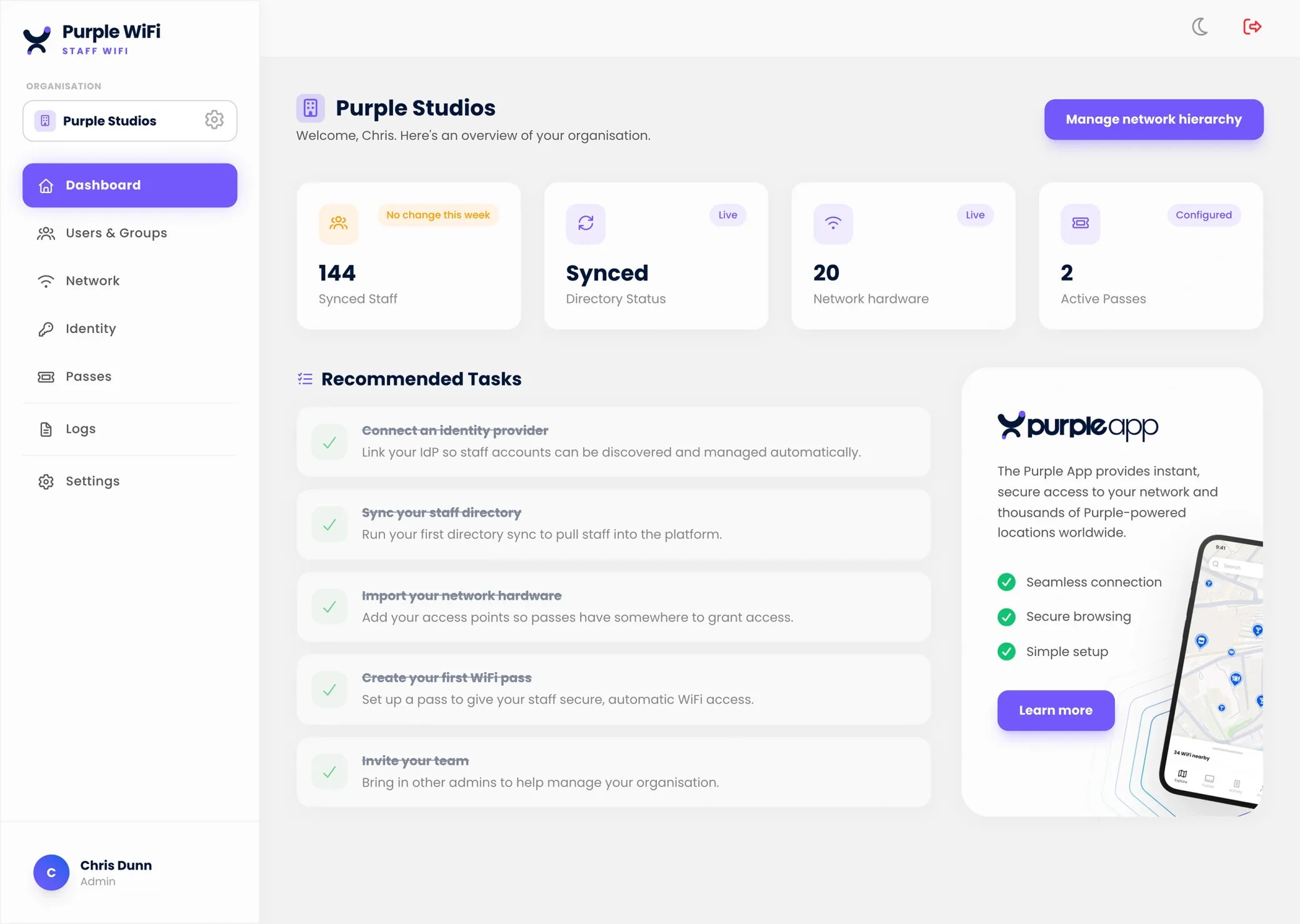
SecurePass is the company's answer to two weaknesses in the classic captive portal. Open guest networks can be insecure, and modern phones rotate their MAC addresses, making repeat visitors look new. SecurePass uses Passpoint, 802.1X and device profiles to authenticate a person once and reconnect the device with enterprise encryption. For staff, credentials can be tied to Entra ID, Google or Okta and revoked when somebody leaves. For apartment buildings or student halls, identity-based pre-shared keys create private networks for each resident and their devices.
“WiFi should connect automatically and securely.”Gavin Wheeldon, founder and CEO
The other half of the propositionFrom knowing where people are to helping them arrive
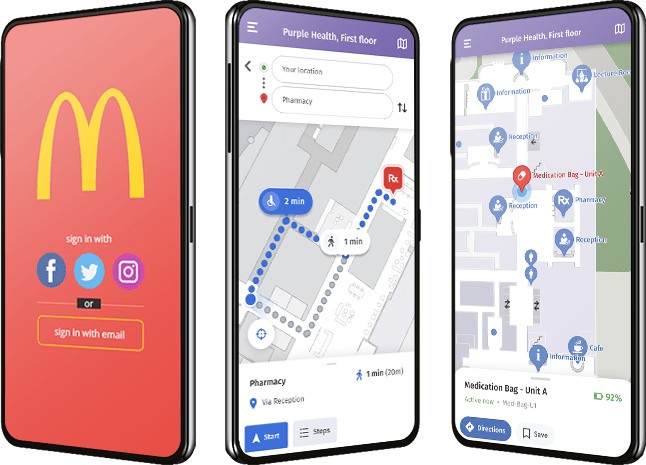
Purple changed its mind about the edge of its market in 2019. The merger with Ohio-based LogicJunction added indoor wayfinding - a related problem, but not a captive portal. Kiosks and web maps can draw a static route. Mobile “blue dot” navigation can combine WiFi signals, Bluetooth beacons and geomagnetic fingerprints, update as a person moves and reroute after a wrong turn. In a hospital, where “just ask a nurse” scales badly, the economic value is unusually visible.
At Croydon Health Services, Purple says digital navigation produced 58,465 sets of directions after an August 2021 deployment. Its case study attributes roughly £731,000 in avoided missed-appointment costs and 80,000 hours of staff time saved to fewer lost visitors and interruptions. These are vendor-reported calculations, but they illustrate a disciplined sales habit: translate a map into the metric a hospital already fears.

The results customers buyThe splash page becomes a shop window
Harrods offers Purple's cleanest retail argument. In one measured year, 581,317 individuals used the store WiFi. Some 38% opted into marketing. The login asked whether visitors wanted to join Harrods Rewards, then passed interested people to a pre-filled form. Purple says 4,453 became members and the combined activity returned 57 times the retailer's original WiFi investment. The cleverness was not a new ad format. It was removing repeated typing between expressed interest and enrollment.
Elsewhere the output changes with the venue. AGS Airports sold faster or longer connections beside a free tier and reported an 842% return. Avanti West Coast used automated surveys and communications across trains and stations, reporting a 463% return. The Brooklyn Nets captured 11,887 fan records in a first week. McDonald's Belgium combined Purple, Cisco Meraki and Socialspot and reported 90% fewer IT site visits. Each customer started with the same commodity - WiFi - but attached it to a different balance-sheet line.
What it costsFree at the door, negotiated upstairs
Purple publishes a free Connect plan and offers a 30-day trial of Capture and Engage. Most enterprise prices are not public. Quotes vary with the number of sites and access points, integrations, identity provider and service level. The wayfinding product is clearer about its structure: an annual licence per application, plus a one-time setup fee based on total floor area. Surveys are advertised at $0.96 per response. Paid WiFi pricing is tailored.
Branded captive portal and basic network analytics for a single venue getting started.
First-party data, verified email, richer analytics and a connection into CRM.
Personalized journeys, advanced analytics, SecurePass and managed-service options.
Annual product licensing with an initial fee tied to mapped square footage.
That structure lets Purple enter cheaply, then grow with the value it proves. It also suits a channel business. Resellers and managed service providers can wrap the software in hardware, installation and reporting. Purple says partners can earn recurring software margin while retaining their professional-services revenue. BT, TELUS, Evolve, Redcentric and infrastructure vendors help put the platform in front of buyers Purple may not reach alone.
A market with rivals on every sideBreadth is the bet - and the burden
Purple competes in several overlapping categories. Cloud4Wi, IronWiFi and Cloudi-Fi sell enterprise guest access. Aislelabs, Cisco Spaces and Beonic analyze physical behavior. Adentro, Social WiFi, Beambox and Stampede lean into marketing. SecureW2, Portnox and Cloudpath approach from identity and network security. A small restaurant may prefer a cheap fixed-price marketing tool; a Microsoft-centered IT department may start with a narrow RADIUS product; a Cisco-only estate may favor Cisco's own location stack.
Purple's differentiation is the attempt to carry one identity layer across guest, staff and tenant networks while keeping marketing analytics and indoor maps close. The 2025 merger with Splash Access deepened its Cisco Meraki, education and multi-dwelling expertise. All Splash Access staff were retained, according to the merger announcement. The combined business said it served nearly 500 million users historically across 80,000 venues.
Breadth can make a contract more defensible, but it also makes implementation less casual. The product works when a venue has enough footfall, compatible network gear, a clear consent policy and someone willing to act on the data. It weakens when logins merely accumulate in a dashboard, when the CRM is neglected, when staff cannot maintain maps, or when a tiny venue only wants an inexpensive password page. Hardware neutrality avoids replacement cost; it does not remove integration, governance or training.
The playbook worth borrowing
- Find the ignored moment inside a necessary utility. Purple chose the login, not the router.
- Fit around installed infrastructure so adoption does not require a second capital project.
- Give several departments distinct value from the same event: security, data and operations.
- Measure the outcome in the customer's language - loyalty joins, appointments kept, IT visits avoided.
- Add adjacent products only when they reuse the same context, buyer or location data.
The company nowManchester base, global ambition
Purple became a certified B Corporation in July 2024 with a score of 83.6. Its stated mission is to help physical venues thrive in a connected world, while its newer language is blunter: make WiFi secure, seamless and broadly available. That pairing is not friction-free - a company built on permissioned customer data has to make privacy and genuine choice part of the product, not decoration. Purple emphasizes GDPR and CCPA controls, ISO 27001 certification and explicit opt-ins.
In June 2026, the company opened a new hybrid-work office at Annie Kenney Mill in Chadderton, Greater Manchester. It said the business had passed £1 million in profit and aimed to generate 60% of revenue outside the UK within three years. The building runs Purple's own staff WiFi. It is a tidy demonstration of where the company landed after that 2013 sale: not providing the broadband, not making the access point, but deciding who connects, how securely and what useful thing happens next.