Before South Africa’s lockdown in 2020, a 3D printer left Propella Business Incubator for an engineer’s home. Motors and a microcontroller went with it. The equipment had a new assignment: help build a device that could assist breathing when hospitals feared a shortage of ventilators.
Nelson Mandela University engineering students Zain Imran and Neo Mabunda worked with Zaahid Imran and Kelvin Langwani. Within five days, they had a working prototype. Its central component was familiar hospital equipment: a bag-valve resuscitator. A servo motor supplied the repetitive movement, as the 2020 project report explained.
THE QUICK READ
- University research meets business coaching and manufacturing support.
- ICT founders can access a virtual programme; industrial ventures can seek technical help.
- The useful lesson: test the customer, the funding route and the manufacturing plan together.
The project makes a useful introduction to Propella, based in Gqeberha, the city formerly called Port Elizabeth. A shared printer can shorten an experiment. Bringing an invention into production requires another set of relationships.
Five days was the beginning
Anaesthetist Dr Hennie Smit evaluated the prototype. His description was precise: It is meant to assist respiration and not full ventilation
. The distinction matters. The team was developing a specific breathing-assistance device; a prototype demonstration was one step in that process.
In a 2020 SEDA interview, the entrepreneurs reported R100,000 from the Technology Innovation Agency and R150,000 from SEFA for early development. That R250,000 bought progress. It should not be mistaken for the entire cost of developing and manufacturing the product.
The May 2020 production account identified an immediate obstacle: finance for tooling and the initial components. Injection-moulded parts needed tooling. Some components needed importing. The team aimed for a price of R5,000 or less per unit, a target rather than a confirmed selling price.
Here was the awkward interval that incubation exists to address. The machine could move. The manufacturing plan still needed money, suppliers and work. A founder who budgets only for the first working version has budgeted for the opening scene.
The machine could move. The manufacturing plan still needed money, suppliers and work.
A university idea gets a commercial address
Propella emerged in 2015 from Innovolve, Nelson Mandela University’s commercialisation company, and Engeli Enterprise Development. Its official launch was in June. The partnership put research and enterprise support into the same undertaking, serving university ventures alongside other technology entrepreneurs.
The university’s 2015 annual report recorded a Telkom FutureMakers commitment of R25 million in cash and kind over five years. Infrastructure was part of the proposition. When the FutureMakers hub opened in May 2016, a dedicated fibre connection helped software developers and engineering businesses collaborate.
The strategy also changed. University reporting says Propella repositioned itself as a smart incubator and accelerator in 2017, revising its model around entrepreneurs and the challenges facing Nelson Mandela Bay. Renewable energy, efficiency, ICT and advanced manufacturing became parts of an urban technology brief.
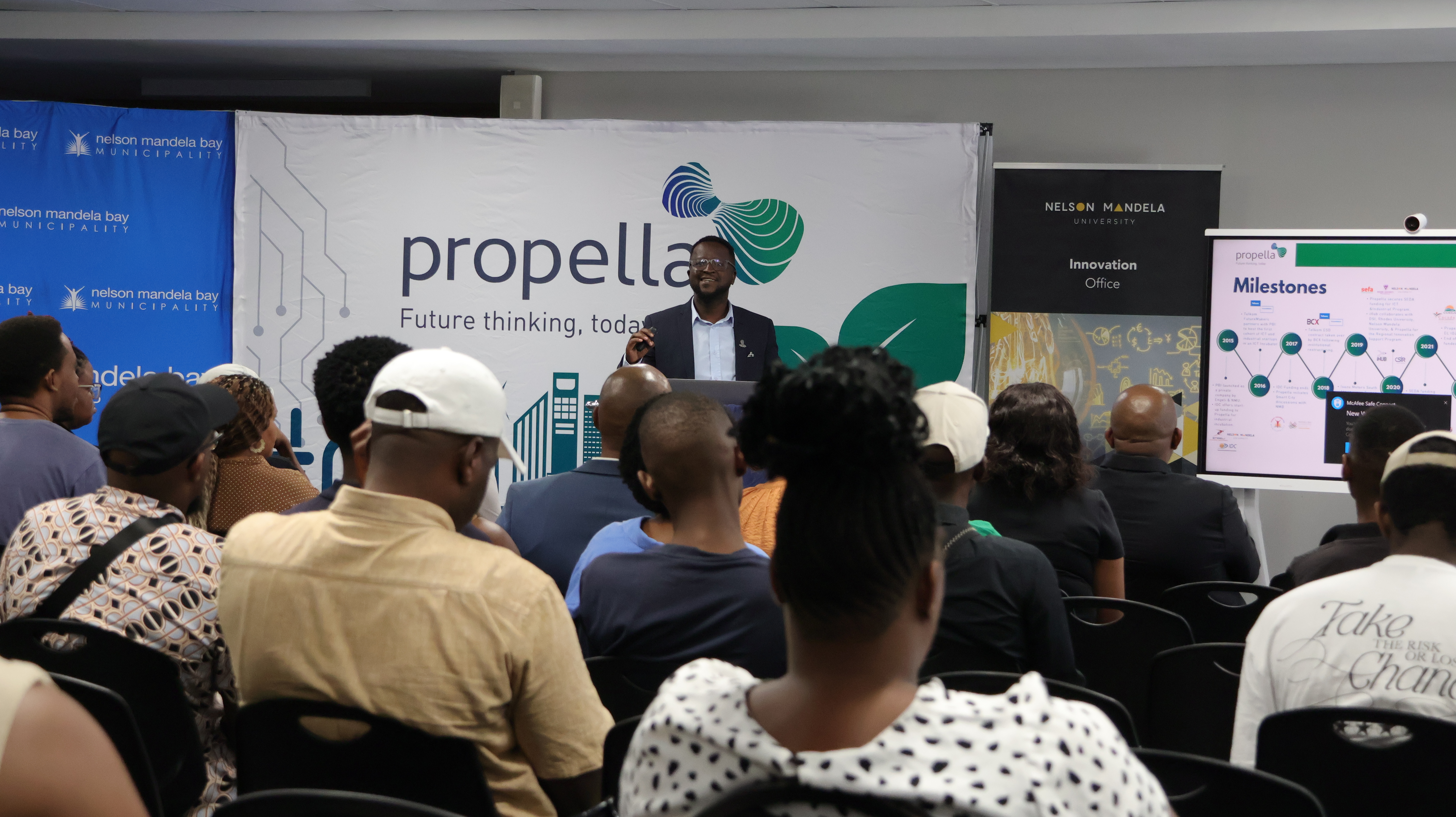
Some ideas need a workshop
Propella describes shared access to 3D printing, machining, robotic welding and facilities for small production batches. For a technical founder, that can bring an experiment within reach before buying equipment independently. Its contribution combines business mentoring, technical development and help finding markets.
Consider the range. Robert Bosch’s doctoral work on replacing zinc oxide in rubber became a commercialisation project; by 2017, Propella was reporting export opportunities. In 2018, Innovative Dental Solutions won startup gold for a smart gum guard designed to record and transmit impact information.
Four other Propella-linked innovators received recognition at the same manufacturing awards, including work on accessible parking, daylight technology, rubber and wind-turbine blades. Those examples explain its place in the market: useful to founders whose product has to survive contact with materials, machinery and customers.
The price of a free bootcamp
The published virtual ICT bootcamp has no participation fee and is open across South Africa. Propella asks participants to commit at least eight hours a week to business-development workshops, plus their own research. The broader incubation offer describes subsidised facilities. Applicants should establish the terms of the particular programme they want.
There is another customer in the model: businesses funding enterprise and supplier development. Propella offers corporate partners contribution arrangements using grants, loans and hybrid structures. That makes it an intermediary between entrepreneurs needing support and organisations seeking to develop businesses and suppliers.
For founders, choosing between an incubator, an engineering consultant and rented workspace depends on the missing capability. Propella’s appeal is the combination. A team that already has equipment but needs customer validation has a different problem from one waiting for a machinist.
THE WORK BETWEEN INVENTION AND INCOME
- 01Make it workPrototype + test
- 02Find the buyerValidate the need
- 03Make it repeatableProduction + finance
Build around the next obstacle
The newer programmes keep that practical focus. A 2025 clean-technology call covered energy, water, waste and related fields. In February 2026, ECSECC announced an agreement with Propella tied to entrepreneurial collaboration, particularly for women and young people. In June, Propella reported onboarding 60 ProFuture ICT innovators around smart city solutions.
A 2026 Eastern Cape TIA call advertised grants of R50,000 to R650,000 per project, with a 16 October deadline. Such funding targets technology development. Propella’s published funding guidance excludes ordinary working capital. An entrepreneur needing money for day-to-day operations must distinguish that need from a prototype grant.
The fit also depends on the founder. A local industrial programme cannot offer the same experience as a remote software workshop. A team seeking specialist medical development needs expertise beyond general business mentoring. Propella’s Township Hub accelerator, meanwhile, is aimed at existing businesses and publishes requirements for registration, operating history, staff and revenue. Those boundaries help applicants choose support for the business they actually have.
The lesson a reader can copy is concrete: identify the next obstacle before spending on the next version. Ask whether it is technical, commercial or financial. Then find the person equipped to resolve it. Shared machinery helps when machinery is missing. It cannot supply customer demand. Propella’s story becomes useful at exactly that boundary.
KEEP EXPLORING
Meet the work. Watch the machines.
ON YOUTUBE
▶Salutaris: the low-cost ventilatorHedgeSA / project showcase↗▶Provolution 3D production printerProduct demonstration↗▶What is Propella Business Incubator?Company introduction↗