Five minutes to explain your business. Three minutes to answer for it. In a 2018 competition in Medina, Business Hub put eight projects through that compact exercise in persuasion. The field included interior design, content writing, a home-maintenance app and a waffle business. Entrepreneurship, on this stage, had room for both software and dessert.
Lora, an education-through-entertainment project, took the top prize: SAR 10,000 and three months of incubation. Two runners-up also received cash and incubation. The useful detail was the combination. A short performance could lead to a longer period of support, giving the winners something to do after the applause.
That early contest offers a good way into Business Hub today. The company brings together startup programs, shared offices, training and business advice. Its proposition is practical: help people move between the different jobs involved in starting a company. A founder can need a room, a sharper proposal and an introduction in the same week.
Eight finalists. One short window to make the business make sense.
A business with several front doors
Business Hub lists its founding year as 2017 and its headquarters as Medina. The 2018 competition report identified engineer Basim Albeladi as its founder. Later coverage identifies Yousef Albeladi as chief executive. The company describes itself as a startup studio, incubator and accelerator authorized by Monsha’at, Saudi Arabia’s Small and Medium Enterprises General Authority.
Those descriptions point to different kinds of work. Incubation supports an emerging business; acceleration organizes a more concentrated development program; a studio takes a more active role in building ventures. Business Hub also offers services that a conventional small company can use without adopting any of those labels.
Its contact form makes that breadth visible. Visitors can submit an idea or project name, describe what they are building and explain their request. The invitation reaches people with a proposal as well as people with an operating enterprise. The business relationship can start before there is an impressive company presentation to attach.
The desk has a price tag
Workspace is the most tangible entry point. Business Hub advertises private offices, shared offices, meeting rooms and private calling rooms, alongside everyday facilities such as parking and a coffee corner. The setup addresses ordinary working needs: somewhere to take a call, meet a client and keep a small team together.
A Monsha’at Mazaya listing for the Al-Qiblatayn location makes the economics more concrete. It shows a shared-office base price of SAR 958.33 for one month, including VAT. An internal private office is listed at SAR 3,910. These are published package figures, subject to the offer’s terms and current availability.
The same listing describes support of up to SAR 10,500 for eligible enterprises over a maximum of one year. Eligibility includes business-size and activity conditions. Meeting-room bookings carry an extra charge. A prospective tenant should therefore compare the full payable package, including room use, with the work the team actually needs to do.
This is where a grand conversation about entrepreneurship becomes a purchase decision. An occasional meeting and a permanent team base are different needs. The subsidy can change the calculation for an eligible business, but the useful unit remains the month of work: what space, what access and what additional services does it buy?
Shared-office base price, including VAT.
Monsha’at listing; eligibility and current terms apply.
The customer may be a university
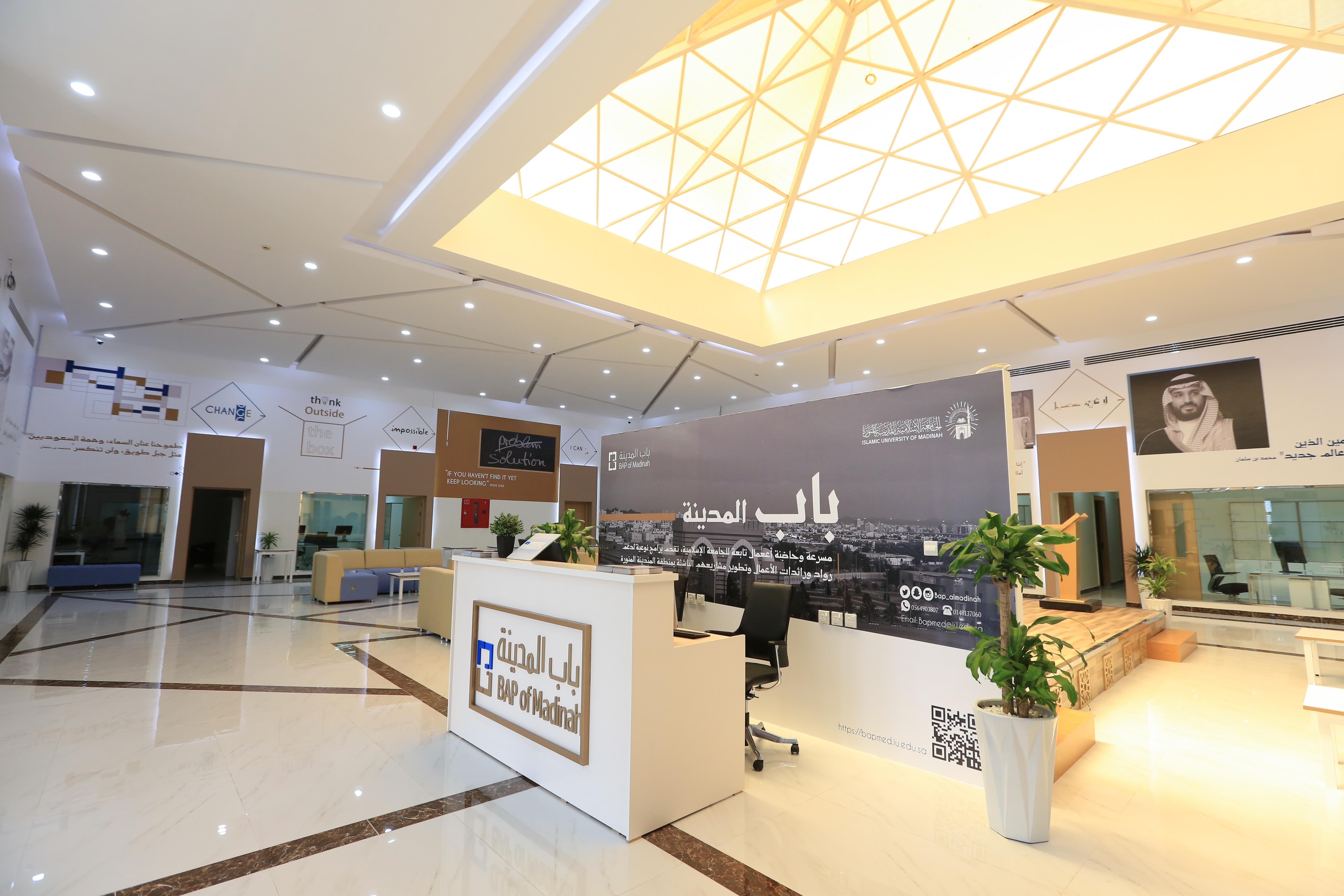
Business Hub also works on the institutional side of entrepreneurship. Its published project list includes operating Bab Al-Madina’s incubator and accelerator with the Islamic University in Medina. It describes e-commerce accelerator work with Monsha’at and Salla, plus training, workshops and consultations through Vibes AlUla with the Royal Commission for AlUla.
The same portfolio includes employee training for National Water Company and filming and editing educational videos for the Social Development Bank’s Productive Families Bridging Program. Together, these examples suggest a service business with several kinds of buyer: a founder buying workspace, a partner commissioning a program, or an institution purchasing training and production.
That distinction matters when judging the company. An institution needs a program delivered; a participant needs useful help. Serving both requires attention to the brief and to what happens in the room. The visible expertise spans organizing learning, developing ventures and producing the material that carries the instruction beyond a single session.
Bring the students. Bring the difficult questions.
In December 2023, Saudi Electronic University reported a visit by its business and finance students to Business Hub. Yousef Albeladi introduced the center, encouraged participation in its labor-market courses and joined a discussion of working-life challenges. The visit ended with a tour of the facilities.
The episode gives the company’s audience a human scale. These were students exploring the world of work, not just founders arriving with companies ready for investment. It also illustrates a straightforward educational use for a business hub: make business activity accessible enough that people can ask questions before committing themselves to a venture.
An announced session for November 13, 2024 narrowed the questions considerably. Muath AlOdaini, a cofounder of the Bayynah app, was scheduled to discuss attracting a first investment at Business Hub’s Wadi Al-Aqeeq location. The agenda included building investor trust, negotiating terms and the effect of an initial investment on growth.
For a would-be founder, that is a useful progression from general interest to a specific decision. A conversation about raising money is most helpful when it addresses the transaction itself: whom to approach, what to explain and what the terms mean for the business afterward. A room full of ambition still needs an agenda.
“We build, develop, and invest in entrepreneurs”Business Hub · its stated proposition
Medina’s address, Oman’s next chapter
The company’s Saudi roots now sit alongside a visible Oman operation. Enjaaz Group describes Business Hub Oman as a strategic joint venture with Business Hub Saudi. Its announcement sets out incubation, acceleration, company formation, advisory work and investment facilitation across borders as intended services.
Enjaaz’s public account also connects the expansion with activity around the Samail Economic Forum and investor presentations. A reposted account describes 15 projects presented during the investor gathering. Business Hub’s current homepage emphasizes Muscat and Oman Vision 2040 while retaining language about its development from Medina.
The partnership offers a more specific explanation than treating the two locations as interchangeable. A Saudi company is extending its operating model through an Omani partner. As a business interpretation, the appeal is clear: local relationships and administrative knowledge matter when helping someone establish and develop a company in a new market.
There is a parallel institutional thread in Saudi Arabia. November 2025 reporting from Biban identified an agreement with the Royal Commission for Jubail and Yanbu to support entrepreneurship and innovation. The pattern is one of working through organizations that already have a place, an audience or a development brief.
Seventy-two hours, with sport as the brief
Sabbaq brings a more focused subject to the program roster. Its public page describes a sports innovation hackathon at Al-Ansar Club in Medina, built around 72 hours and six challenge tracks. The topics range from training technology and fan experience to sports data, fitness, artificial intelligence and sustainability.
The advertised format combines mentoring, prototype development and prizes, with a stated cash-prize pool above SAR 100,000. Those are event offerings, rather than evidence of subsequent commercial success. The relevant question for a participant is whether the challenge provides a useful problem to work on and access to people who understand it.
For Business Hub, the event illustrates how a general startup-support capability can be applied to a particular sector. A club supplies a setting with real operational concerns; participants bring ideas and technical skills. The short deadline gives the collaboration a shape. A prototype at the end is something concrete to discuss.
What a founder can take from it
The most transferable part of Business Hub’s approach is the connection between activities. A competition can lead into incubation. A visit can introduce a student to a practical course. A workspace can provide the setting for a meeting. These connections are useful when each one answers the next problem a participant actually faces.
Anyone designing a local entrepreneurship program can copy that logic without copying the entire company. Start with a clearly defined participant and a task. Give the session an output: a revised pitch, a prototype, a customer conversation or a workable budget. Then specify what support follows and who is responsible for providing it.
The conditions matter. A team seeking a quiet office may place little value on events. A mature company with a specialized technical problem may need a specialist adviser. A founder who needs customers immediately should examine whether a program reaches those customers. Good matching is more useful than adding another activity to the calendar.
For prospective partners, the same principle applies at institutional scale. Define the work to be delivered, the people to be served and the evidence that would make the project worthwhile. Attendance can describe a busy room; the next decision or completed task tells you more about what participants took away.
Business Hub’s place in the market is at these practical intersections: workspace and advice, institutions and entrepreneurs, preparation and presentation. Its early five-minute pitch contest remains a compact illustration of the idea. The interesting part begins when the timer stops and the founder has to decide what to do on Monday.
Step inside
Explore the company website, workspace options, Sabbaq program and Monsha’at workspace offer.
Follow Business Hub on LinkedIn, X and Instagram. Read the 2018 competition report or explore Enjaaz Group’s Oman updates.