An office is a pleasing thing to acquire before a business has customers. There is a door, perhaps a respectable address, somewhere to put the name. In February 2013, Ibraheem Alzuhimeel offered prospective founders a less expensive route to looking serious: meet the customer in a coffee shop. If the occasion called for something more formal, buy lunch.
The suggestion appeared in an Arabic essay about starting a business without money. Its author had recently helped establish OCEANX, the Saudi business consultancy. He was addressing a familiar ambition: build something of your own, then find the capital to begin. His advice started with the expenses a founder could postpone.
There is a small comedy in the business lunch becoming the substitute for a business premises. There is also a useful clue to Alzuhimeel’s working interests. He pays attention to the machinery around an idea: costs, capabilities, customers and the people who can help. Across consulting, startup support and company boards, those concerns keep returning.
Today, the Riyadh-based co-founder’s responsibilities include chairing OCEANX and Hamah Capital. The distance between a borrowed café table and a boardroom makes for a tidy career arc. The more interesting connection is the question both rooms must eventually answer: how will this enterprise actually work?
An engineer learns to read a business
Alzuhimeel graduated in mechanical engineering from King Saud University in 2005. In 2008, he completed a master’s qualification at Griffith University in Australia, with financial management listed as its specialization. Engineering and finance give his biography two distinct starting points: the workings of a physical system and the workings of an enterprise.
From 2009 to 2012, he worked at the Badir technology-incubator program. His formal career record describes a partnerships role there; an older professional profile calls it corporate services management. Both place him inside the support structures for young technology businesses before he became a consultancy founder himself.
OCEANX followed in 2012, co-founded with Abdullah Alassaf. Alzuhimeel’s career record also includes a vice-presidential role at Asad Labor Services between 2012 and 2014. In 2017, he became an accredited economic-enterprise valuer through the Saudi Authority for Accredited Valuers, TAQEEM.
Those details help explain the kind of founder he became. His professional history runs through the arrangements that allow companies to function: partnerships, services and financial assessment. An idea can be described in a sentence. Working out its obligations tends to require rather more paper. The people on either side of those documents have to agree on the work, the responsibilities and the resources. That is a substantial subject for a consultancy to make its own.
King Saud University
Griffith University
TAQEEM accreditation
The drawer full of unstarted companies
His early writing put that institutional experience into everyday language. The 2013 essay recommended delaying premises, taking on several jobs personally and finding modest ways to reduce initial spending. He described a founder moving between the duties of secretary, manager and marketer. The job title might be singular; the working day certainly was not.
For a reader considering a first venture, the appeal is easy to understand. The first decisions can feel like a test of whether the enterprise deserves to exist. His suggestions give those decisions a smaller scale: one meeting, one expense, one task the founder can attempt personally before committing more money.
His closing image was a desk drawer holding the dreams of businesses that had never begun. In translation, he preferred “a working product with limited resources” to those stored ambitions. It is an unusually domestic picture for entrepreneurship: the obstacle sitting quietly beside the stationery.
The appeal of that essay is its scale. Nobody needs to imagine an entire economy changing before deciding whether to rent a room. The decisions are close enough to touch. Read beside his later institutional work, it provides an early statement of interest in making the first practical steps possible.
A promising idea meets the monthly bills
By November 2018, Alzuhimeel was teaching another part of the same subject. At a Riyadh Chamber workshop on feasibility studies, delivered with OCEANX, he asked would-be business owners to understand their activity and the environment in which they intended to operate before preparing the study.
His checklist included the number of competitors, expected profits, demand for the product or service and the target customer. He linked expected sales and earnings to monthly spending, so an owner could see whether the business was heading toward a gain or a loss.
The workshop also covered technical challenges, available financial resources, initial spending and expansion plans. He discussed using an understanding of monthly returns when deciding whether to increase production, add production lines or reduce output. These were questions about adjustment as well as launch.
The shift from the café advice is instructive. Reducing costs can help someone begin; understanding the relationship between demand and spending helps them decide what to do next. In his public teaching, the entrepreneur gets encouragement and homework. A spreadsheet is a fairly demanding form of optimism.
Who runs the room for founders?
A few months earlier, on 19 July 2018, Alzuhimeel had represented OCEANX at an agreement with Al-Ahsa Chamber to operate its business incubator. The chamber’s secretary-general, Abdullah Al-Nashwan, represented the other side. This put Alzuhimeel’s firm inside an institution’s plans for supporting local enterprises.
The intended support included studies, advice and help with technical, financial and marketing needs. Alzuhimeel spoke about backing entrepreneurial projects and helping young businesses continue in the market. The assignment expanded the setting of his work from a founder’s individual choices to the organization of a support program.
There are several people in that picture even before the first entrepreneur arrives. A chamber sponsors the initiative. An operator takes responsibility for running it. Specialists provide different kinds of assistance. Each relationship needs enough definition for the entrepreneur to know where to turn.
This is the quieter side of the startup story. Someone has to organize the help. The Al-Ahsa agreement gives Alzuhimeel a concrete place in that work: representing the company entrusted with operating the incubator. It also gives the word “support” an address and an assignment.
A handshake with a division of labour
In June 2019, another photograph caught him at the joining point between business advice and technical expertise. Alzuhimeel stood with Oracle’s Saudi country leader, Fahad Al Turief, to mark a memorandum of understanding aimed at helping Saudi entrepreneurs establish and grow their startups.
The arrangement paired OCEANX’s consulting role with Oracle’s technical guidance. The announced activities included consultation, workshops and training, alongside an opportunity for startups to benefit from Oracle’s global startup program. Each organization brought a different part of the proposed assistance.
Alzuhimeel described OCEANX’s responsibility directly: “This collaboration will see OceanX deliver a business consultant role”. It is a useful line because it assigns a job. The photograph records the handshake; the sentence explains what his company intended to do after it.
His stated ambition at the announcement was to help Saudi startups across their development, with digital expertise supporting the business work. For a consultant concerned with whether an enterprise can function, a technology partner adds another set of questions and people to the table. The task becomes coordinating the advice around the company trying to grow.
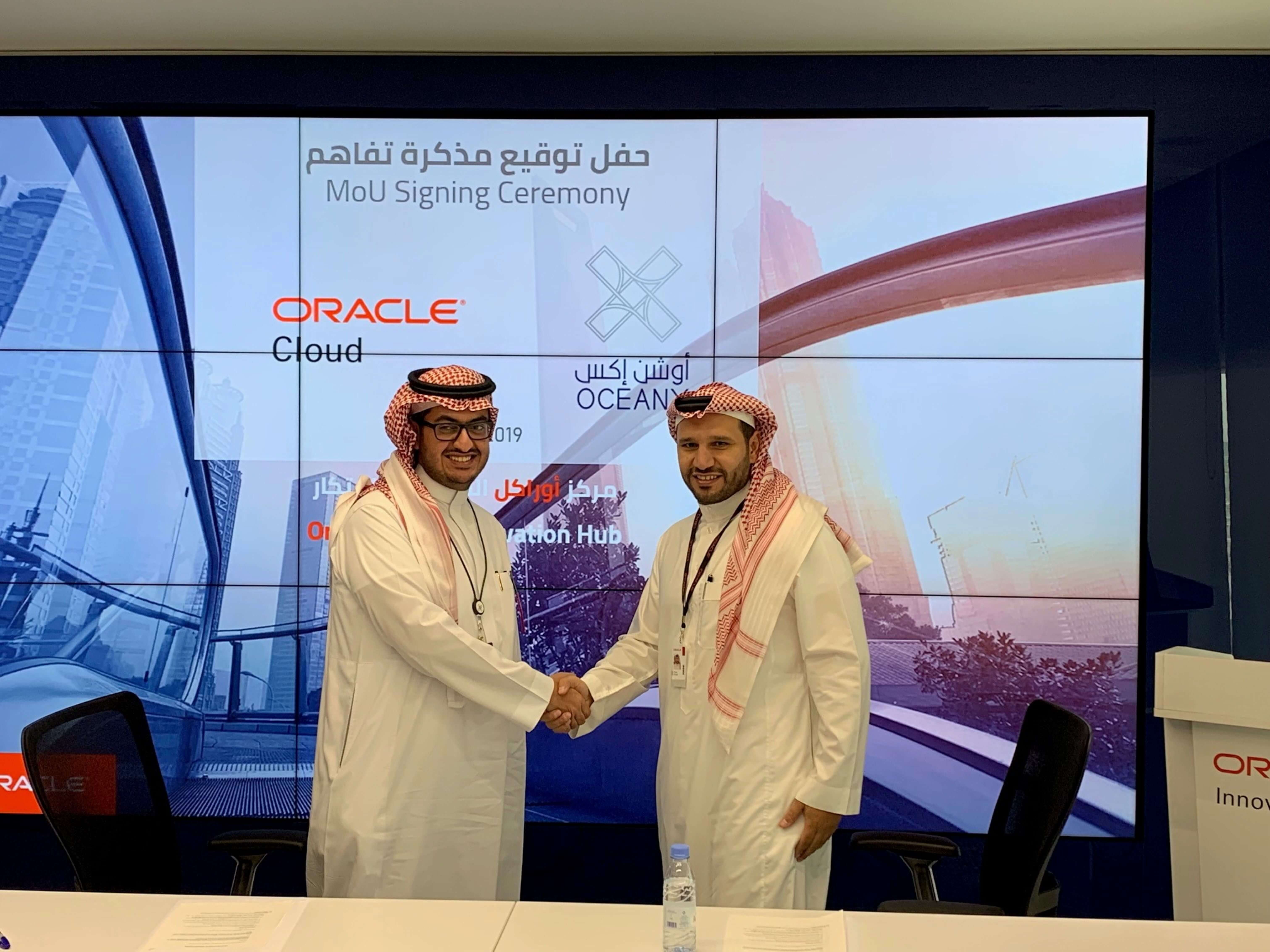
“This collaboration will see OceanX deliver a business consultant role”
Ibraheem Alzuhimeel · June 2019
Sometimes he takes the interviewer’s chair
Alzuhimeel’s public work also includes hosting conversations. The Stage’s Asf community describes a space in which he brings entrepreneurs together to discuss their experiences. Its program spans restaurant investment, saving and investing, fashion and the market for used goods.
One discussion features Fahad Aljumaiah, founder of fashion label 1886. Another brings in Fahad Alhassan, co-founder and CEO of Soum, to discuss the used-device marketplace. An audio edition of the Soum conversation was published on 25 June 2024, running for 55 minutes.
That format leaves room for the particulars of a business. A restaurant, a fashion label and a marketplace face different questions about customers and operations. Putting their founders in conversation makes those differences available to an audience that might otherwise encounter only the finished product.
He has also sat on the other side of an interview. In 2023, he shared a Next Step conversation with Mohammed Alnuhait about the role of research in life. On LinkedIn, he described it warmly as one of the interviews he had particularly enjoyed. The consultant who hosts questions appears comfortable receiving them, too.
From starting companies to overseeing them
His more recent responsibilities bring the financial side of his career into sharper view. An August 2025 board biography lists him as chairman of OCEANX and Hamah Capital, alongside board positions at The Chefz, Order and DNA. It records a chief-executive period at Thra Crowdlending during 2023-2025.
Hamah Capital’s own leadership page names him as chairman and lists Alassaf as vice-chairman. The two OCEANX co-founders therefore appear together again in a financial-services setting. Hamah’s activities include investment management and fund operation, arranging and advice, under its Saudi Capital Market Authority license.
In August 2023, the two had welcomed communications minister Abdullah Alswaha, deputy minister Haitham Al-Ohali and Digital Government Authority governor Ahmed Alsuwaiyan to OCEANX’s Riyadh premises. The visit included introductions to the company’s services, teams and its owners’ technology investments.
The rooms have changed since that early essay. The subject has grown to include oversight, institutions and capital. Yet the practical concerns remain recognizable: understand the business, establish who contributes what, and examine the resources available. Alzuhimeel’s career keeps bringing him back to the work that begins when a promising idea asks for a place in the world.
Keep the conversation going
Read his 2013 essay, explore OCEANX and Hamah Capital, or follow him on LinkedIn and X.