Ahmed Bukhamseen’s first client had offered him a job. It is a small detail with a pleasing amount of trouble inside it. An employer sees someone worth hiring; the prospective employee sees a customer. Somewhere between those two assessments sits the beginning of Quant, the Saudi data business Bukhamseen co-founded. The offer could have put him back on a familiar career path. Instead, it became part of his account of learning to sell the company he was building.
Years later, his work would involve satellite pictures, property maps and the question of what a piece of land actually contains. But that first conversion is a useful place to start. Bukhamseen had to persuade someone to buy an answer from him before he could build a business that helped other people find answers. A mathematical education can prepare you to measure uncertainty. It leaves plenty of uncertainty about who will pay the invoice.
A respectable job, followed by a resignation
His preparation was specific. At King Fahd University of Petroleum and Minerals, he studied actuarial science and financial mathematics between 2009 and 2013. He also directed the Actuarial Science Club, promoting the profession in Saudi Arabia. Mathematics, statistics, finance and insurance were the ingredients of his degree. They gave him a way to examine risk that would later travel beyond the insurance business.
After university, he worked in Bahrain as an actuarial analyst at Lux Actuaries & Consultants. By late August 2015, he was exploring a business of his own. He resigned at the end of October and returned to Saudi Arabia. Quant dates its founding to 2015; its early operating story continues into 2016, when Bukhamseen entered Wa’ed’s entrepreneurship programme in Dhahran and the business began taking shape in the market.
He recruited people he knew, including friends with jobs of their own, and sought help from the Badir technology incubator. There was a practical education alongside the mathematical one: developing the business, finding support and persuading people to join. His early account includes advice to keep the prestigious job a little longer. He chose the company. The risk specialist had acquired a rather personal case study.
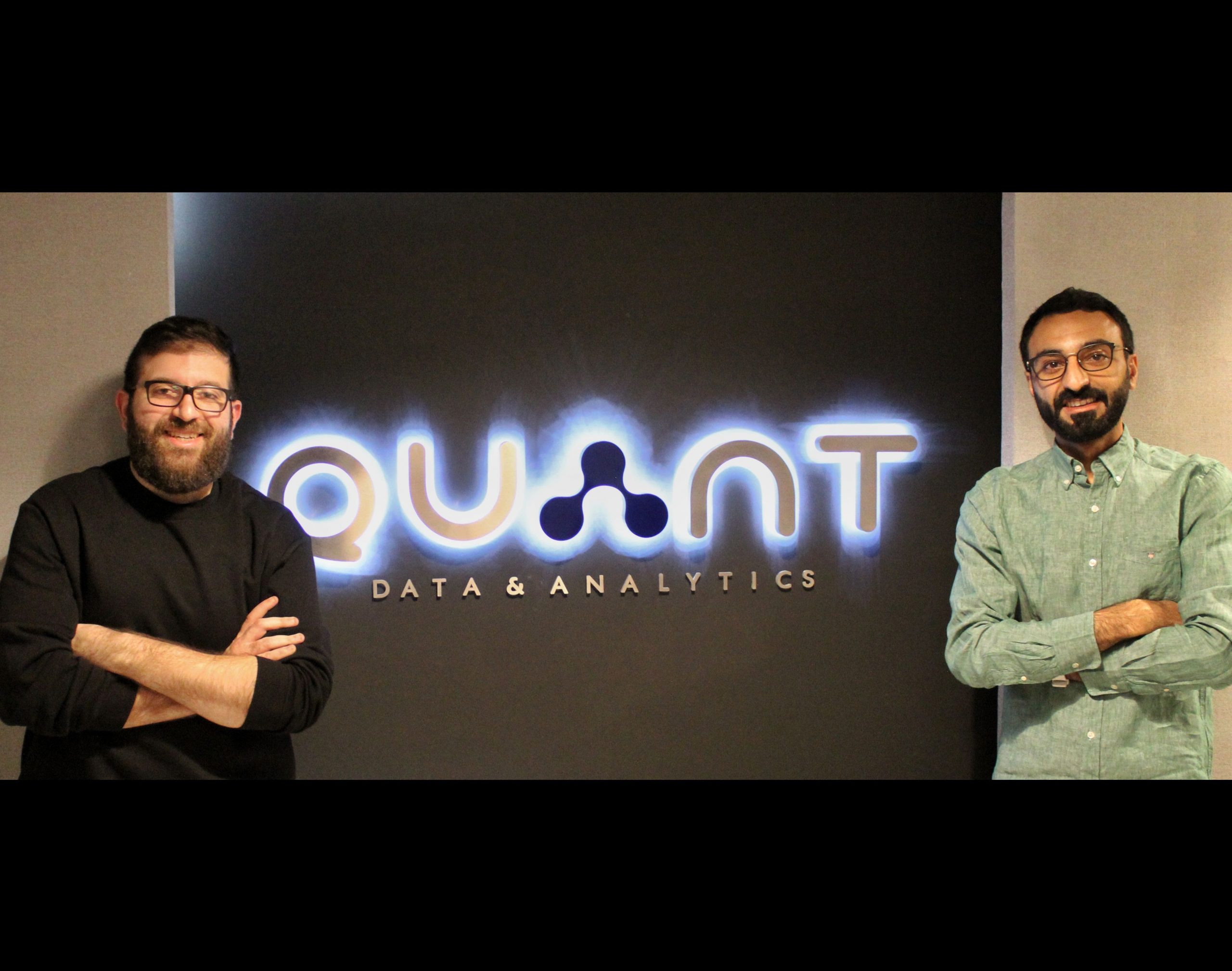
The customer needed a reason to care
Quant began with analytical services. Its early clients spanned insurance, property development, education, roadside assistance and restaurant technology. That variety made sense for a company selling a method: collect information, examine it and help a business make a better decision. It also presented a sales problem. A company can understand its own industry perfectly well while still needing an explanation of what a data specialist might add.
Bukhamseen’s early description of the obstacles included market understanding and concerns about data privacy. These were questions of confidence as much as calculation. A prospective customer had to understand the work, trust the provider and see a use for the result. Producing an analysis was one task. Making its value legible to someone running a business was another, and the second task helped determine whether the first became a contract.
By March 2021, when he appeared on Mashhoor Aldubayan’s Sawalif Business podcast, the conversation covered subscription products as well as the founding story. Suhail addressed property information; Fruits addressed retail and restaurants. The discussion included Quant’s cooperation with Foodics. A consultancy’s knowledge was becoming something customers could use repeatedly, through software, rather than commissioning each question as a separate piece of work.
and work in Bahrain
and Quant’s founding
agreement
ambitions
A neighbourhood deserves a better answer
Property gives the problem a familiar shape. Someone wants to understand the price of land or a home in a particular neighbourhood. A developer needs to examine an area before committing money. A retailer needs to choose a location. Each is asking about a place, but each needs a different combination of facts. A price, a planning record and a picture of the ground answer different parts of the question.
When Bukhamseen returned to Sawalif Business in November 2024, the discussion centred on Suhail and the difficulty of obtaining dependable property information. The application brought together price indicators, urban information and other market data. He described availability, accuracy and credibility as challenges. Gathering material from several ministries, adding satellite observations and applying artificial intelligence were ways of getting closer to a reliable account of an individual parcel.
The attraction of that work lies in the distance between a simple question and a complicated answer. A user may want to know what a site is worth. Before answering, a system has to establish what information belongs to that site and whether the information is useful. A map can make the result look effortless. Bukhamseen’s account of building the underlying data makes clear how much effort can sit beneath a finger moving across a screen.
- RecordsGovernment and property information
- ObservationSatellite images of the ground
- AnalysisModels that interpret what is there
- DecisionInformation for a buyer, developer or retailer
The view from above, with the small print
In August 2023, Quant signed a three-year agreement with satellite company Satellogic. The plan was to combine imagery with Quant’s geospatial and AI work for real estate and retail, including Suhail and location intelligence associated with Fruits360. Looking down from orbit is an extravagant-sounding way to answer a local question. Yet whether a parcel contains a building is a decidedly local question, especially for someone considering that parcel.
A technical account published that November put useful numbers beside the idea. Quant’s team compared building detection using 30-centimetre imagery with results from Satellogic’s 70-centimetre imagery in Riyadh’s Alrabie neighbourhood. Across 4,975 parcels, the classifications agreed on 4,817. The reported agreement was about 97 per cent. The question was whether the lower-resolution imagery could serve this particular task at a cost suited to working over large areas.
Matching building-or-land classifications across the two imagery datasets.
The qualifications deserve room beside the large number. The images came from different dates, and the model had originally been trained on 30-centimetre imagery. Both could affect the comparison. That matters because a neat percentage can tempt a reader to stop asking questions. Here, the remaining questions are part of what makes the result useful: what changed on the ground, what the model had learned and what resolution the job actually required.
This was the work of Quant’s technical team and its imagery partner. It also makes Bukhamseen’s business easier to understand. The company was choosing how to obtain evidence at a workable cost, then deciding how that evidence could support a product. A sharper picture has an obvious appeal. A picture sufficiently sharp for the decision, available at a sustainable price, has a business attached.
The explanation is part of the work
Bukhamseen has taken these questions into public conversations as well as products. In November 2023, he was scheduled to speak at Misk’s session on the role of data analysis in decision-making. Its agenda included tools, practical benefits, challenges and the distinction between data analysis and business analysis. The subject connected his technical background with the explanation customers and people entering the field need.
There is an institutional side, too. In 2023, Quant renewed a partnership with Saudi Arabia’s Housing Program to use property data and assess the effects of housing initiatives. Bukhamseen described the need for reliable information and periodic reporting. The audience for an analysis could therefore extend from a person inspecting a property to teams examining the effects of a programme. The scale changes; the obligation to make the information understandable remains.
“Our mission is to digitise real estate data”
Ahmed Bukhamseen, March 2025
From understanding a property to acting on it
In March 2025, Bukhamseen described Quant as a real estate and location business serving investors, developers, portfolio managers and retailers. He discussed cloud performance and the responsiveness users expect from a map-based application. Infrastructure becomes rather less abstract when someone is waiting for a screen to catch up. A property tool has to carry its analysis all the way to the person trying to use it.
His plans also moved closer to transactions. He described a property wallet for registering assets, receiving valuations and making properties available for transactions, with an ambition to extend capabilities beyond large portfolios to smaller owners. He also discussed retailer site selection and expansion into Dubai. These were his stated plans at the time, each connected to the same practical aim: helping a user do something with the information.
That brings the story back to the prospective employer who became a client. Bukhamseen began by persuading someone to use his judgement outside an employment contract. Quant’s later products attempt to make analytical judgement accessible to many more people, one location at a time. The journey has carried him from actuarial calculations to satellite imagery. The useful question at the end is still close to the ground: what do you need to know before you commit?